Structure on June 24 Sets Next Year's Fruit
Master Cho Han-kyu, interpreted by Kim Chang, Founder of Korean Natural Farming (Janong)
Master Cho spoke Korean, with an interpreter. We translated every Korean line again and checked it, so you read what he said, not only what the room heard.
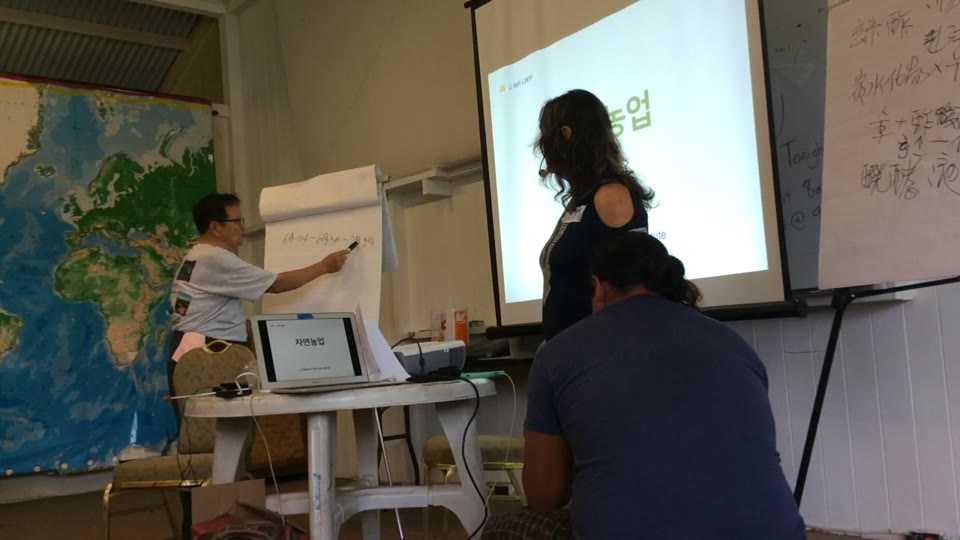
Members watch every session
The whole seminar, as it happened, with the checked English beside the video. Membership is $60 a year.
This part runs from 0:00 to 39:34 of the session video. Keep watching and the next part plays on.
Now playing the next part: Nature = 3 Chi + 3 Heats + 4 Bodies + 3 Kingdoms
Cho cuts open a dry tangerine from breakfast and explains why it failed: fruit that bears once a year is conceived the summer before, between June 30 and July 5, so water-soluble calcium phosphate (Structure) goes on June 24 with Medicine (OHN). He writes the dates on the flip chart, then turns to the breakfast papaya, nitrogen and taste, and a long parable of mother's milk against cow's milk.
What he taught
Why is this year's fruit dry and tasteless, and when do you have to act to fix next year's?
First hour of Friday. Cho holds up and cuts a tangerine served at breakfast; the room tasted it. He writes 6月24 → 6月30 → 7月5일 on the flip chart (about 905 s). The interpreter's microphone fails from about 690 to 830 s. Later he asks about the breakfast papaya, then tells the mother's-milk parable.
- Changeover feeding for fruit that bears once a year (starts June 24) — Cho's Korean: water-soluble calcium phosphate, Structure (WCP), from June 24 of the year before the harvest, a week before June 30, with Medicine (OHN) added so it is absorbed fast. Use the water-soluble form, not solid calcium phosphate. No dilutions spoken here; the interpreter said the full prescription would be handed out. Handout (영양주기에 따른 자연농업 처방, changeover column 교대기): Cleanser (brown rice vinegar) 1:500; Food (FPJ: acacia flower, 동자액, fruit) 1:500; Medicine (OHN) 1:1,000; Fuel (fish amino acid) 1:1,500–2,000; Structure (WCP, 인산칼슘) 1:1,000; Reproduction (WCA, 수용성칼슘) 1:1,000; Protectors (LAB) 1:1,500–2,000; Mineral D 1:1,000. The handout lists WCP and OHN in this column, matching what Cho said.
-
This spring's flowers formed as buds last year, end of June to early July
Cho: the flowers that bloom in spring didn't form in spring. What you fed then decides this year's fruit.
▶ 0:58 As spoken
-
Fruit that bears once a year must be conceived the year before, end of June to early July
Cho made the interpreter repeat it when the room didn't react.
▶ 1:28 As spoken
-
The breakfast tangerine formed no proper flower bud last June–July, or the flower 'miscarried'
Skin, but little inside. Cho compares it to a mother with bad morning sickness: mother suffers, baby suffers.
▶ 3:49 Shown in the room
-
Juice sacs are made at conception: short of nutrients then, few small sacs and little juice
In a good tangerine the sacs sparkle; in this one they are dull, colorless and wrinkled, and it chews like cotton.
▶ 4:56 Shown in the room
-
Plump fruit is conceived June 30 to July 5; that is when you hit the 'home run'
Missing it is an 'error' or a 'foul ball'. Cho: 'all year long you've been farming a crop that misses.'
▶ 7:23 As spoken
-
Give the changeover treatment on June 24, a week before June 30
Water-soluble calcium phosphate (Structure) then multiplies the rooms that hold the juice.
▶ 11:08 As spoken
-
Add Medicine (OHN) with the WCP to speed absorption
Cho: 'you have to speed up circulation so absorption is fast; to speed it up, OHN.'
▶ 10:09 As spoken
-
June 24 is early pregnancy; feeding after that is an 'error'
Flip chart: 6月24 → 6月30 → 7月5일. Start WCP June 24; conception falls between June 30 and July 5.
▶ 14:18 Written on the board
-
Use water-soluble calcium phosphate, not solid, so it is absorbed fast
▶ 17:26 As spoken
-
The June 24 date is for fruit that sets once a year; papaya and other repeat bearers follow their own cycle
Their formula was promised for the afternoon handout.
▶ 17:54 As spoken
-
Fed at the right time, the fruit holds more juice and more sugar
▶ 19:00 As spoken
-
People, livestock and crops differ in kind but go through the same process of reproducing
So the same nutritive cycle applies.
▶ 22:07 As spoken
-
Left to its seasons, a tree bears fruit; greedy feeding blocks it
Told through the fig tree Jesus cursed (Mark). Cho: people piled on fertilizer and blocked the grace.
▶ 24:46 As spoken
-
Lots of nitrogen: no taste. A little nitrogen plus calcium phosphate: very good taste
The breakfast papaya had not been fertilized and was a little short of nitrogen.
▶ 28:24 As spoken
-
Young crops need a little nitrogen in their basic growth so their bodies get big
Like a newborn growing fast on the protein in mother's milk. Cho said 'a little'; the room heard 'extra'.
▶ 29:08 As spoken
-
Scholars judged milk by nutritional value alone and left out love
Cho's frame for farming by analysis only; milk-factory baby contests judged babies only by weight.
▶ 31:41 As spoken
- The tangerine and papaya are single fruits from breakfast; nothing was measured.
- No dilutions were spoken on this page; the rates above come from the printed prescription handed out later in the session.
- The peach sheet handed out later in the session dates its changeover treatment (교대기 처리) June 20, not June 24; Cho's June 24 here is for once-a-year fruit like this tangerine.
- The interpreter's microphone failed from about 690 to 830 s, and several of Cho's Korean lines are partly unclear (marked in the transcript), including the sour-craving analogy.
- Cho also uses stretch marks in pregnancy and babies raised on cow's milk to make his points; these are claims about people, not tested, and we don't repeat them as advice.
- For fruit that bears once a year, next year's crop is set at the end of June and early July of this year. Mark the dates.
- Start Structure (WCP) about a week before conception, around June 24 in Cho's telling, with Medicine (OHN) to assist uptake.
- Use the water-soluble form of calcium phosphate so the plant can take it up quickly.
- Keep nitrogen light near fruiting; a little nitrogen plus calcium phosphate assists flavor.
- Young crops can use a little nitrogen early in their growth.
- Papaya and other repeat bearers follow their own cycle, not the June 24 date.
What the room didn't hear
Where the English in the room left out or changed what Master Cho said in Korean.
-
▶ 3:24
The room heard So this year, when they flowering, that nutrient is according to last year's, between end of June to beginning of July, nutrient.
Cho said The flowers that bloom in spring didn't form in spring. The flower itself formed last year, at the end of June and early July.
The room got the timing but not that the bud itself is made the summer before.
-
▶ 7:23
The room heard Between end of June and beginning of July, you need to have a good nutrient, but they didn't give enough nutrient.
Cho said To make it plump and firm, it's June 30 or July 5, and you have to hit the home run then.
Cho gave the exact conception dates; the room heard a vague 'end of June'.
-
▶ 11:08
The room heard So when you give water-soluble calcium phosphate, previous year, June 24th, and... There's a little pocket.
Cho said Give calcium phosphate a week before June 30, on June 24, and the rooms that hold the juice multiply.
Dropped why June 24 (a week before June 30) and what it does (more juice sacs).
-
▶ 9:31
The room heard So he is going to give you the recipe, but when they are morning sickness, if you don't give enough of calcium phosphate...
Cho said When a mother has morning sickness she craves sour food; tangerines in their morning sickness crave the sour too, so give calcium phosphate then.
The sour-craving reason was dropped. Cho's Korean is partly unclear here.
-
▶ 24:46
The room heard In nature, if you leave the tree alone because of nature, it doesn't naturally bear fruit or what not.
Cho said If you leave a tree in nature to its seasons, the season makes it bear fruit. People got greedy and kept feeding it, and blocked the grace.
The interpreter reversed Cho's point.
-
▶ 29:08
The room heard So even the crops, when they are baby, give extra nitrogen, then their body will grow big.
Cho said When crops are young, in their basic growth, give them a little nitrogen so their bodies get big.
'A little' became 'extra', minutes after Cho warned that lots of nitrogen ruins taste.
Next to Master Cho's books
-
Agrees
Fruit quality is set at flower-bud formation the previous June; a poorly fed tree has 'morning sickness' His posters say plants have morning sickness just before flower-bud formation; his fruit-tree charts put flower-bud differentiation in June.
CGNF posters (Korean) (English translation), p. 3
-
Agrees
Water-soluble calcium phosphate, not solid, so it acts fast Janong says calcium phosphate was thought slow-acting but works fast when made water-soluble and used by the lifecycle.
Cho, Janong Natural Farming (2003), p. 133–134
-
Agrees
Too much nitrogen spoils taste; WCP raises sweetness CGNF Advanced ties WCP to sweetness and color and warns against excess nitrogen around flower-bud differentiation.
CGNF Advanced (2005.08) (English translation), p. 7
-
Agrees
Mother's milk vs cow's milk as a lesson for feeding crops Cho tells the same parable in the 2017 fruit seminar, where he ties it to not giving chemical fertilizer before sprouting.
2017/Advanced w: Cho/advanced fruit/IMG_3194 @ 0:11:49
“Seeing there's no reaction, you explained it wrong. Do it again.”
▶ 2:31
“The flowers that bloom in spring didn't form that spring. Those flowers formed last year, at the end of June and early July.”
▶ 3:24
“This is an error, what else? ... So all year long, you've been farming a crop that misses.”
▶ 8:06
“Even without receiving God's grace, because we supplement with nutrients that have the same content as that grace, we can make something very tasty.”
▶ 26:53
“The scholars paid attention only to nutritional value. They left out love.”
▶ 31:41
In this part
- 0:00The tangerine cut open
- 3:23This spring's flower formed last June
- 7:22Home run or foul ball: June 30 to July 5
- 9:31Structure with Medicine at changeover
- 11:30Microphone fails
- 14:03June 24 is early pregnancy: the dates on the flip chart
- 15:52Dull juice sacs, water-soluble calcium phosphate
- 17:47Once-a-year fruit vs papaya
- 19:16Stretch marks and elasticity (an analogy)
- 22:35The fig tree Jesus cursed
- 27:23This morning's papaya: little nitrogen, more calcium phosphate
- 28:59Mother's milk, cow's milk, and nitrogen for young crops
- 35:47Baby contests judged by weight; the cow's 'calves'
Transcript
English translation, checked against the Korean as spoken.
0:00 Kim Chang (interpreter): Did you eat these fruits this morning?
0:12 Audience: Yes.
0:14 Kim Chang (interpreter): Was it tasty or not?
0:18 Audience: Very tasty.
0:19 Kim Chang (interpreter): Very tasty?
0:20 Audience: One was.
0:22 Kim Chang (interpreter): Oh, one. One was tasty, but one was not tasty. One was tasty, but one was disappointing. Something is wrong with your taste buds. Look at this skin, there's lots of space. This is not a tangerine, it's like cotton.
한 개는 맛있는데, 한 개는 아쉬워요.
0:58 Master Cho: The tangerine flowers that bloomed this year — last year, the flower buds that formed from the end of June to early July are what bloom.
금년에 밀감 꽃이 피는 것은 지난해에 6월 말에서 7월 초에 꽃눈이 생긴 게 피는 거예요.
1:09 Kim Chang (interpreter): So this year's crops, the plants that give you fruit — actually the nutrient that you gave last year between June and July, that affects how the quality of the fruit comes out.
1:27 Master Cho: Fruit that sets once a year — almost all of it has to be conceived from the end of June of the previous year to early July for the fruit to come out right.
1년에 한 번 열리는 과실은 거의가 다, 6월 말서부터, 전년도 6월 말서부터 7월 초에 임신된 거라야 제대로 되는 거예요, 과실이.
1:42 Kim Chang (interpreter): So the fruit that you are harvesting this year, actually their nutrient depends on the last year's June and through the July, what you give to the plant, and then that time, it depends on what you are giving to them. Their pregnancy is pregnancy of the stage on this year, which is fruiting. It will result. Yeah, result. Their result, yeah. Thank you.
2:31 Master Cho: Seeing there's no reaction, you explained it wrong. Do it again.
반응이 없는 거 보면 얘기 잘못한 거야. 다시 해.
2:44 Kim Chang (interpreter): Okay, I'm going to tell you again. The result of this year's fruit harvest just depends on what you are giving on last year's nutrients, June to July.
2:58 Master Cho: June to July — from the end of June to early July,
June to July. 6월 말서부터 7월 초에
That's the first few minutes. Members read all 342 lines, with the Korean as spoken, and watch along.
Become a member