Charcoal + Microbes, No Deep Hole: Lava to Soil in 6 Months
Master Cho Han-kyu, interpreted by Kim Chang, Founder of Korean Natural Farming (Janong)
Master Cho spoke Korean, with an interpreter. We translated every Korean line again and checked it, so you read what he said, not only what the room heard.
Members watch every session
The whole seminar, as it happened, with the checked English beside the video. Membership is $60 a year.
This part runs from 3:27:08 to 3:53:46 of the session video.
Cho draws the deep planting hole JICA used in Tanzania, 60 to 70 cm with fertilizer at the bottom, the way Hawaiʻi is told to plant fruit trees, and shows four ways it kills the tree. His way: no water, five lumps of charcoal on top and IMO4 over them. Then raising seedlings in poor soil before rich, and the Kona lava field he turned to 3 cm of soil in six months with charcoal, IMO4, corn and the Type 2 feed. The session ends with a cheer and dinner.
What he taught
Why do deep planting holes with fertilizer at the bottom fail, and what does Cho do instead?
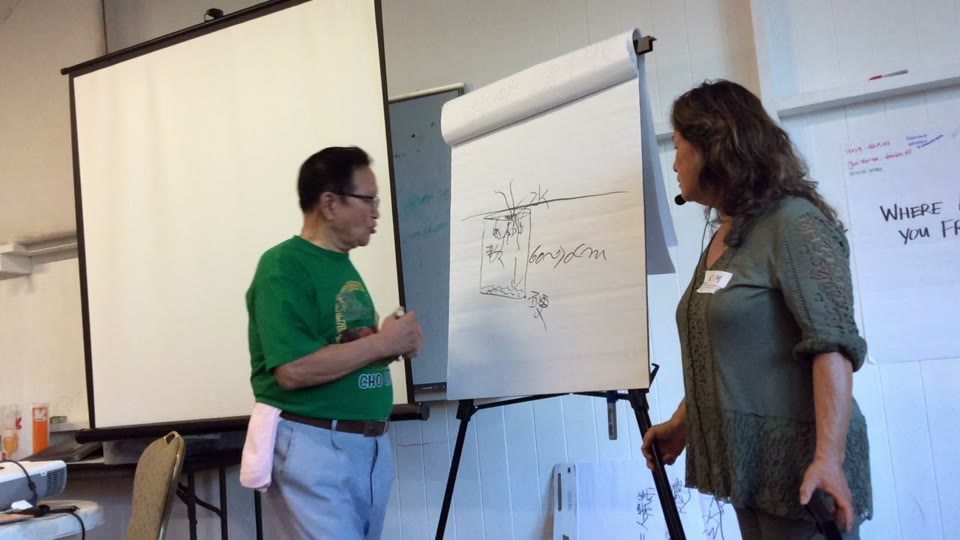
The last half hour before dinner. Cho draws on the flip chart: a tree in a hole marked '60~70cm', water pooling at the bottom, O2 / CO2, then charcoal lumps on the surface and '70%'. Kim Chang interprets beside him. Then the Kona lava story, told without slides.
- Planting a tree on hard, dry ground (Tanzania) — Don't dig a deep hole or put fertilizer at the bottom; don't water. Set five lumps of hardwood charcoal, 'about this big' (shown by hand), on the soil at the tree, then scatter Microbes (IMO4) over the charcoal. The charcoal draws in moisture and the microbes live in it. (Cho's Korean; the interpreter named IMO4.)
- Raising seedlings — Raise tomato, papaya, paprika and similar seedlings in poorer soil than the field, then transplant into rich soil. (Cho's Korean.)
- Lava to soil with corn (Kona, University of the Nations) — Scatter small pieces of charcoal on the lava, then Microbes (IMO4). Sow corn and water freely. When it stalls (about 30 cm), give the nutritive cycle's Type 2 (vegetative stage) feed: 1 m 20 in a week. Knock it down, sow corn on top: about 80 cm in a week; Type 2 again: 1 m 50; knock it down again. The fallen corn becomes fertilizer. Charcoal goes in once, at first planting. No amounts per area were given, and the Type 2 recipe is left for Friday.
-
JICA in Tanzania planted trees in holes 60 to 70 cm deep, fertilizer at the bottom, watered on top
Cho: this is how Hawaiʻi is told to plant fruit trees now. Depth from the interpreter and the board ('60~70cm').
▶ 3:27:50 Written on the board
-
In hard ground, a dug hole fills with pooled water
The dug soil is soft and the soil below is hard, so the water stops at the bottom.
▶ 3:28:55 As spoken
-
Watering on top pulls the roots up; they dry out and die
Roots follow the water.
▶ 3:30:21 As spoken
-
Roots that do go down to the pooled water die when it drains in a dry spell
Cho's second failure.
▶ 3:31:10 As spoken
-
The dug soil settles, the tree sinks, and its 'nose' gets buried
Cho says fruit trees such as papaya and mango breathe through a 'nose' at the base; bury it and the tree dies.
▶ 3:32:01 As spoken
-
Fertilizer at the bottom sits in the pooled water, rots, and gives off carbon dioxide, which suffocates the roots
Board: O2 / CO2. The room heard 'carbohydrates'.
▶ 3:34:12 Written on the board
-
Cho didn't water; he set five lumps of hardwood charcoal on the soil
Shown 'about this big' by hand; no measurement.
▶ 3:36:37 As spoken
-
Charcoal draws in moisture even in a desert, from passing clouds
▶ 3:37:03 As spoken
-
Microbes (IMO4) scattered on the charcoal live at 70% moisture, so the wet charcoal becomes their home and a reservoir
'70%' on the board. The trees grew well through drought. (On Saturday morning, session 6, he puts IMO4 at 80% moisture and 70% as what all living things need.)
▶ 3:37:48 Written on the board
-
Raise seedlings in poor soil, then transplant into rich soil, and they don't get disease
Tomato, papaya, paprika. A seedling raised in rich soil is a rich family's daughter married into a poor house.
▶ 3:43:37 As spoken
-
To turn Hawaiʻi's lava into soil, scatter small pieces of charcoal and IMO4 on the rock
▶ 3:44:53 As spoken
-
In Kona the corn stalled at about 30 cm; the Type 2 feed took it to 1 m 20 in one week
Corn sown after the IMO and watered freely. Cho will explain Type 2 tomorrow. Interpreter: about 4 feet.
▶ 3:47:16 As spoken
-
Knock the corn down, sow again on top: 80 cm in a week; Type 2 again: 1 m 50; knock it down again
The fallen corn became fertilizer and everything grew.
▶ 3:48:12 As spoken
-
After six months, 3 cm of soil had formed on the lava, with earthworms
Microbes came and the rock crumbled.
▶ 3:49:03 As spoken
-
Nature takes 200 years to make 1 cm of topsoil; 3 cm in six months is 600 years' worth
▶ 3:50:04 As spoken
-
Charcoal goes in only once, at first planting
Asked how much per area; the quantity wasn't answered and questions were held for later.
▶ 3:51:36 As spoken
- The Tanzania, Mongolia and Kona results are Cho's accounts; no measurements, photos or controls were shown.
- No amounts were given: charcoal lump size is shown by hand, and the charcoal and IMO4 per area were asked but not answered.
- The Type 2 feed for the corn isn't given here; Cho says he'll explain it on Friday.
- Parts of Cho's Korean are garbled, including the hole depth (taken from the interpreter and the board) and the IMO4 line (from the interpreter).
- Don't plant trees in deep holes with fertilizer at the bottom, and don't water on top to pull roots up.
- Set charcoal on the surface around a new tree and scatter Microbes (IMO4) over it; it holds moisture and houses the microbes.
- Raise seedlings in leaner soil than the field they'll go into.
- On rock or lava, charcoal, IMO4 and repeated corn knocked down as mulch help the microbes and earthworms build soil.
What the room didn't hear
Where the English in the room left out or changed what Master Cho said in Korean.
-
▶ 3:27:08
The room heard So in Tanzania — Japan? I think it's a Japanese foreign aid organization. They brought in lots of trees.
Cho said At that time in Tanzania, Japan's JICA brought in a lot of money and planted trees to green the desert.
Who planted (JICA) and why (greening the desert) were lost.
-
▶ 3:31:06
The room heard When there is water, the water will go down, but there is no root, it's all dried out.
Cho said Another problem: since there's water down here, at first the roots go down well. But the water drains away, and in a dry spell those roots dry up and die.
Cho's second, separate failure (drainage, then drought) was merged into the first.
-
▶ 3:34:12
The room heard Is there going to be oxygen come out, or carbohydrates going to come out?
Cho said When it rots, does oxygen come out, or carbon dioxide?
Carbon dioxide from rotting fertilizer is the reason the roots suffocate.
-
▶ 3:40:41
The room heard So in Europe, some of the organizations made a research center in Mongolia.
Cho said The European Union supported Mongolia and set up a desert-greening research institute.
Who funded it and what it was for set up Cho's contrast: they research, he plants.
-
▶ 3:43:37
The room heard If you grow them in the poor soil condition and then move to rich soil, they do really well.
Cho said Raise seedlings of tomato, papaya, paprika and so on in a poor house and marry them off into a rich house, and they don't get disease.
The claim was 'no disease', not just 'do well'; papaya and paprika were dropped.
-
▶ 3:46:35
The room heard He is going to explain the nutritive cycle tomorrow, but there is a Type 2...
Cho said There's what's called the Type 2 feed of the nutritive cycle, for the vegetative growth stage.
Which stage Type 2 serves (vegetative growth) was left out.
Next to Master Cho's books
-
Agrees
Deep planting holes with fertilizer at the bottom kill trees He taught the same in Hawaiʻi earlier in 2017: the soft dug hole over hard ground turns roots back up. His DVD seminar says to plant on a mound and not dig a hole.
2017/Cho - Papaikou/IMG_9596 @ 0:03:59 (translated)
-
Goes further
Raise seedlings lean, then transplant His book says seedlings raised on little water root faster after transplanting. Here he extends it to soil richness and says they get no disease.
CGNF Advanced (2006.03) (English translation), p. 20
-
Agrees
Lava to soil with corn in six months; 200 years per cm in nature The 2018 Hawaiʻi seminar notes give the same numbers (corn to about 1.2 m, cut, repeat, six months, 200 years per cm). The details differ: in 2018 IMO4 goes on when the corn reaches 1.2 m; here charcoal and IMO4 go on first and a Type 2 feed drives the growth.
notes: cho-advanced-hawaii-2018 — Building soil on bare lava with corn
“Scholars say 'water it, put in fertilizer.' Following what they teach isn't science.”
▶ 3:39:24
“A seedling raised in rich soil is a daughter raised in a rich house.”
▶ 3:42:20
“However hard a person works, they can't do the work that microbes or earthworms do.”
▶ 3:52:07
“This is the spirit of natural farming.”
▶ 3:53:21
In this part
- 3:27:08JICA's 60-70 cm planting holes
- 3:28:39Pooled water: roots go up and dry out
- 3:31:06Drainage, settling soil, the buried 'nose'
- 3:33:19Fertilizer at the bottom rots: carbon dioxide
- 3:36:36Five lumps of charcoal and IMO4, no water
- 3:40:09Mongolia; raise seedlings poor, plant them rich
- 3:44:16Kona: lava to soil in six months
- 3:51:20Charcoal once; the spirit of natural farming; dinner
Transcript
English translation, checked against the Korean as spoken.
3:27:08 Master Cho: At that time in Tanzania, Japan's JICA brought in a lot of money and planted trees to green the desert.
그런데 그때 그 탄자니아에 일본의 JICA(자이카)가 돈을 많이 가져와서 사막을 녹화시킨다고 나무를 심었어요.
3:27:20 Kim Chang (interpreter): So in Tanzania — Japan? I think it's a Japanese foreign aid organization. They brought in lots of trees, plants to grow trees.
3:27:36 Master Cho: But how did they plant the trees? They dug down (60 to 70 cm).
그런데 나무를 심을 때 어떻게 심었냐 하면 (60~70cm) 파고
3:28:05 Kim Chang (interpreter): So when they were planting the tree, they dig 60 to 70 cm and then plant the tree like that.
3:28:15 Master Cho: And they put fertilizer in here (at the bottom). This is how they'd tell you to plant fruit trees in Hawaii now.
그리고 여기다 거름을 넣은 거예요. 이거는 지금 하와이에서 과수나무 심을 때 이렇게 심으라고 할 거예요.
3:28:22 Kim Chang (interpreter): Probably in Hawaii, they plant the tree that way.
3:28:32 Master Cho: And then they tell you to water here. So when you water, does the water sink, or go up?
그리고 여기다 물을 주라는데 그럼 물을 주면 물이 가라앉아요, 위로 올라가요?
3:28:38 Kim Chang (interpreter): So when you give water to the tree, is the water going down or up?
3:28:50 Master Cho: It goes down. The water comes down here. The water comes down, but here it's hard, so the water pools.
그러니까 내려간단 말이에요. 이리로 내려온단 말이에요, 물이. 그러면 물이 내려오는데 여기는 단단하니까 물이 고이지.
3:29:00 Kim Chang (interpreter): So water goes down but right here is very hard so water is going to reside at the bottom right here.
3:29:08 Master Cho: But since you dug a hole here, the soil here is soft.
그런데 여기 구덩이를 팠으니까 여기 땅은 유연하지.
3:29:12 Kim Chang (interpreter): So they dig the hole here, so the top is very soft.
3:29:18 Master Cho: And the soil down here is hard soil.
여기 땅은 단단한 땅이란 말이야.
3:29:21 Kim Chang (interpreter): And the bottom soil is very hard.
3:29:24 Master Cho: So the water goes down and pools here. Now, the tree you planted — its roots — the roots ought to go down, but (…) (…) they go down, and they come up.
그럼 이 물이 내려가서 여기 고이잖아. 그럼 나무를 심었는데 그 뿌리가, 뿌리가 내려야 되는데 (…) (…) 내려가고 올라가고 있어.
3:29:44 Kim Chang (interpreter): So, because of the water at the bottom, and then the roots are going to go up or down?
3:29:54 Master Cho: Do they go down? The water's on top, and they go down? Hm.
내려가요? 물이 위에 있는데 내려가? 응.
3:29:55 Kim Chang (interpreter): The water is on top right now. So they water it.
3:30:04 Master Cho: You watered here, right?
여기다 물을 줬잖아.
That's the first few minutes. Members read all 269 lines, with the Korean as spoken, and watch along.
Become a member