Fat Tree, Empty Fruit: The IMO5 Ring at the Drip Line
Master Cho Han-kyu, interpreted by Kim Chang, Founder of Korean Natural Farming (Janong)
Master Cho spoke Korean, with an interpreter. We translated every Korean line again and checked it, so you read what he said, not only what the room heard.
Members watch every session
The whole seminar, as it happened, with the checked English beside the video. Membership is $60 a year.
This part runs from 0:00 to 37:10 of the session video. Keep watching and the next part plays on.
Now playing the next part: See Half, Farm Half: The Eightfold Path on the Board
Cho opens with plans: next time he wants to walk farms and diagnose crops, and he wants Hawaiʻi visitors to eat on natural farms. Then he cuts open the mangosteen a participant gave him. It's nearly empty, because the tree was overfed when young and lacked calcium phosphate the July before. His fix is IMO4 mixed 1:1 with vinegar-moistened bone char, spread in a ring at the drip line ahead of flowering; the room's questions settle what the 1:1 means.
What he taught
Why did the mangosteen come out empty, and what does Cho put down, where and when, so the next crop fills?
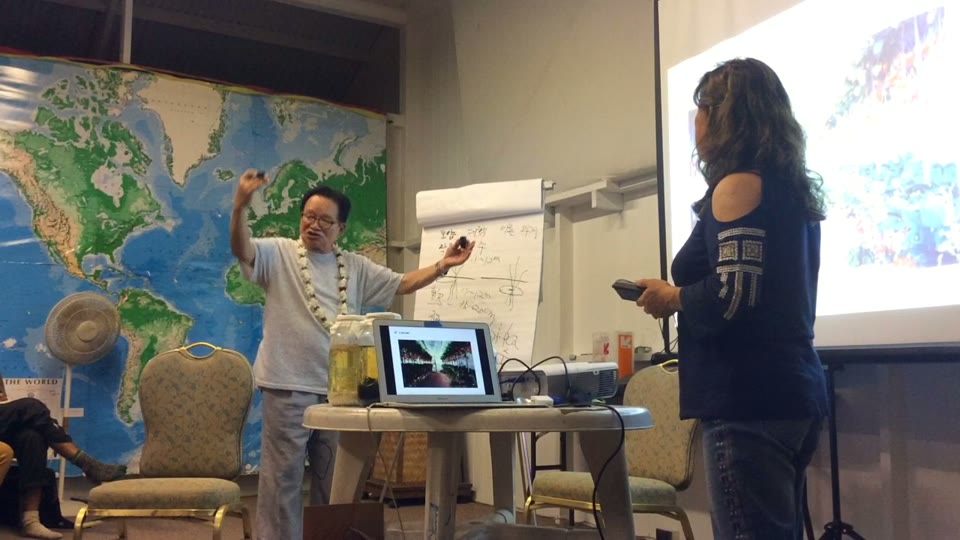
Friday evening, first hour. A participant gave Cho a mangosteen; he cut it open and found it nearly empty. After 18 minutes of plans (farm visits next trip, farm tourism, lobbying), he explains the fruit and prescribes. He points at the bones on the table, then draws a fruit tree with a ring at its drip line on the flip chart (about 24:00). From 31:40 the audience asks what 'one to one' means; the interpreter relays it to Cho in Korean and he answers.
- IMO5 ring for fruit trees (Cho's name for it here) — Cho's Korean: char cow or pig bones; put the char in a container about this size and pour brown rice vinegar over it, 'then it all dissolves into it'; then 'mix it 1 to 1 with IMO4' (22:31–22:57). Asked what the 1:1 meant, Cho answered 'It's the char you made' (32:41), and the vinegar goes on only until the char is 'just slightly moist' (35:04), judged by feel. So: 1 part IMO4 + 1 part bone char moistened with brown rice vinegar. The interpreter gave the ratio as 1 lb IMO4 to 1 lb bone char (34:05); Cho gave no unit. Spread it in a donut-shaped ring at the drip line (interpreter; Cho's board shows the ring). Put it down in May (Cho); the interpreter frames it as one month before a June flowering. Same for papaya, banana, coffee and all fruit trees.
- Bone char in brown rice vinegar (the start of Structure, WCP) — As Cho tells it here: char the bones, put the char in a container, pour brown rice vinegar (현미식초) over it and it dissolves. No ratio or time given on this page; his recipe book gives charred bone : vinegar 1:10.
-
The mangosteen came out nearly empty: 'miscarried'
Cho: almost all these mangosteens are miscarried. It was fed too many 'meat side dishes' when young (the interpreter said too much nitrogen), so it put on weight but has nothing inside.
▶ 18:26 Shown in the room
-
A tree grown big and fat doesn't flower
People think a big tree bears a lot; this one got so fat it didn't flower.
▶ 19:08 As spoken
-
It was short of calcium phosphate last July
Cho: last year in July it lacked calcium phosphate. For the fruit to fill, the 'pregnancy' in July has to go well. The grower took the land over only in May and started harvesting the month before.
▶ 20:10 As spoken
-
IMO5 = IMO4 mixed 1:1 with bone char moistened with brown rice vinegar
Cho first describes pouring brown rice vinegar over the char so it dissolves, then mixing 1:1 with IMO4. Asked if the 1 was diluted liquid, he said 'It's the char you made.' Interpreter: 1 lb IMO4 to 1 lb char.
▶ 22:51 As spoken
-
Spread it as a donut-shaped ring at the drip line
Interpreter: make a circle like a donut where the drip line is and sprinkle the mixture. Cho draws a tree with a ring at the branch tips on the flip chart.
▶ 23:51 Written on the board
-
Feed papaya, banana, coffee and every fruit tree this way
Cho: fertilize coffee trees this way and you get a lot of very tasty coffee.
▶ 24:29 As spoken
-
Put it down in May, so the nutrients are taken up as the flowers form
Cho: May. The interpreter: a tree that flowers in June gets it in May, one month before, so it's already in the soil.
▶ 25:37 As spoken
-
Give calcium phosphate before the 'pregnancy', as for a mother
Cho: before pregnancy you give calcium phosphate so it will be strong; the same for mango, papaya, mangosteen.
▶ 26:18 As spoken
-
Treated trees give nearly a bumper harvest against untreated ones
Cho's own comparison, no numbers. Not interpreted.
▶ 26:48 As spoken
-
At conception the roots give off a scent and the soil microbes swarm to it
Like a cat in heat whose scent calls a tomcat from 30 ri (12 km). The microbes that arrive 'team up' with the calcium phosphate already put down, and the plant takes it up faster.
▶ 30:22 As spoken
-
Vinegar on the char: just slightly moist, judged by feel
No measured amount. A Korean mother doesn't weigh the seasoning, and knows from the baby's face when to change the diaper.
▶ 35:04 As spoken
-
Next visit: diagnose on farms, 3 or 4 a day
Neighbours gather at the host farm to learn there. Cho wants visitors to eat on natural farms: pig roast in Kohala, chicken at Steven's and Joe's, mandarins at Drake's, coffee in Honokaʻa, cane juice.
▶ 0:35 As spoken
- Two checkers read the IMO5 recipe differently. Cho's first description (22:31–22:57: char, pour brown rice vinegar over it, it dissolves, mix 1:1 with IMO4) can be heard as the liquid extract mixed 1:1 with IMO4, and that is how the interpreter gave it to the room. His answer when asked (32:41, 'It's the char you made') points to the moistened char itself. We follow the answer; the first reading can't be ruled out.
- 'One pound to one pound' is the interpreter's. Cho gave no unit, and no vinegar amount beyond 'just slightly moist'.
- Timing: Cho says May. 'One month before flowering, for a June-flowering tree' is the interpreter's framing. For the mangosteen itself Cho points to last July; its flowering month was heard as August, but that line is unclear.
- The bumper-harvest comparison is Cho's statement; no numbers or trial were shown.
- The first 18 minutes are plans and politics (farm visits, tourism, women lobbying the governor), not technique.
- Don't push young fruit trees with nitrogen. A fat tree may not flower, and the fruit can come out empty.
- Char bones, moisten the char with a little brown rice vinegar, mix it 1:1 with IMO4 and spread it in a ring at the drip line to assist fruit set. Cho calls it IMO5.
- Put it down ahead of flowering (Cho: May), so it's already in the soil when the tree needs it.
- Use the same ring on papaya, banana, coffee and other fruit trees.
- Small amounts like the vinegar are judged by feel; Cho gives no measure.
What the room didn't hear
Where the English in the room left out or changed what Master Cho said in Korean.
-
▶ 22:31
The room heard So put the bone char in the big container and pour the vinegar in there.
Cho said Make the char, put it in a container about this size and pour brown rice vinegar over it.
The kind of vinegar was dropped.
-
▶ 26:48
Cho said Compare trees treated this way with untreated ones: the treated ones give nearly a bumper harvest.
Cho's own result; the room never heard it.
-
▶ 29:17
The room heard The smell goes about 30... let's say 30 miles away.
Cho said A tomcat 30 ri away, 12 km away, loves that smell.
30 ri is about 12 km (7.5 miles), not 30 miles.
-
▶ 32:41
The room heard It's diluted.
Cho said It's the char you made. The char you made.
Settles the 1:1: IMO4 to bone char, not to liquid calcium phosphate. The interpreter then corrected herself.
Next to Master Cho's books
-
Agrees
Overfed nitrogen keeps a tree fat and stops flowering His Theory book says late nitrogen keeps crops at type II instead of reaching type III, with poor floral differentiation. Same diagnosis as the mangosteen.
Cho, Cho Han-Kyu's Natural Farming (Theory), p. 119–120
-
Agrees
IMO5 = burned bones mixed into IMO4, put down ahead of fruiting In Hawaiʻi in 2018 he describes IMO5 the same way: burned cow, pig or fish bones mixed into IMO4, applied in advance so peppers or papayas set heavily. Elsewhere IMO5 means IMO4 mixed with local materials, so this is a narrower use of the name.
2018/Cho - advanced hawaii/cho advanced 2018 3-3 @ 0:50:35 (translated)
-
Goes further
Bone char moistened with vinegar, not the usual 1:10 extract The usual Structure (WCP) recipe is 1 part charred bone to 10 parts vinegar, and you use the liquid. Here the solid char, barely moistened, goes into IMO5. A different use, not a contradiction.
notes: meetings — Recipes & methods demonstrated
-
Goes further
Roots give off a scent at conception that draws microbes His Advanced bulletin says microbes gather on the root surface because the roots supply organic matter. Tying the scent to the conception stage is new here.
CGNF Advanced (2006.02) (English translation), p. 34
“It put on weight, but there's nothing inside.”
▶ 18:51
“People think a tree grown big bears a lot, but because it got so fat, it didn't flower.”
▶ 19:08
“When mom makes food in the kitchen, does she weigh it all on a scale?”
▶ 35:16
“You'll see natural farming that reaches your heart, not just your head.”
▶ 4:31
In this part
- 0:00The mangosteen gift, and visiting farms next time
- 4:51Set the dates early: 47 countries, visitors from China
- 7:35Hawaiʻi as a base, and farm tourism
- 13:00Off-topic: let the women lobby the governor
- 18:06An overfed mangosteen: fat tree, empty fruit
- 21:47IMO5: IMO4 plus bone char, in a ring at the drip line
- 25:37Put it down in May, before the flowers
- 28:17The cat in heat, and roots that call microbes
- 31:43The room asks: the 1:1 is the bone char
- 34:55How much vinegar? Just moist, by feel
Transcript
English translation, checked against the Korean as spoken.
0:00 Kim Chang (interpreter): I cannot remember who gave me the mangosteen. Who gave me this mangosteen?
0:00 Master Cho: Who was it that gave me the mangosteen? It came to me while I was eating it: what went wrong here needs a remedy, a prescription.
저에게 망고스틴을 주신 분이 누구죠? 내가 먹다가 생각이 나서, 이거가 이렇게 된 게 잘못된 거를 처방(치료책)을 내야 된다.
0:21 Kim Chang (interpreter): So, if you want to try her mangosteen, and then there's something is going on with this mangosteen, so he is going to give you a prescription for your mangosteen tree.
0:35 Master Cho: So actually, next time I come, rather than all of us sitting together like this for a seminar, I'd go around the fields, go to the field, look at the crops, diagnose them, and lay out what to do.
그래서 사실은 제가 다음에 올 때는 이렇게 모여 앉아서 세미나 하는 것보다는 현장을 다니면서 그 밭에 가서 작물을 보고서 진단을 해가지고 방법을 제시하는 겁니다.
0:54 Kim Chang (interpreter): My wish is next time when I come to teach, I don't want to teach this setting. I would like to go visit your farms and then look at your crops and give you prescription.
1:10 Audience: Yay!
1:21 Master Cho: I get tired, so I can't do many places. About three or four places a day.
지치기 때문에 많은 데는 못 하거든요. 하루에 3군데 내지 4군데 정도 다니게.
1:28 Kim Chang (interpreter): I'm getting old, so I'm getting tired quickly, quicker than before, more tiring. So I can maybe visit three farms or four farms a day.
1:48 Master Cho: That's because I'm young right now, in the springtime of life.
왜 그러냐면 내가 지금 청춘이기 때문에
1:54 Kim Chang (interpreter): Because I'm still cheongchun (young), has a lot of stamina.
2:03 Master Cho: So the people near that farm gather at that farm.
그래서 그 농장 근처에 있는 사람들은 그 농장으로 모이게
2:06 Audience: Nice.
2:07 Kim Chang (interpreter): So when I visit certain farm, so who live near the farm come to that farm and study together.
2:22 Master Cho: So today we're holding the seminar here, but isn't there someone who slaughtered the pig today? His farm isn't far from here. If you went to a place like that just once, you'd learn a lot right away, but doing it only in here, your head just gets heavy, and nothing gets into your heart.
그래서 오늘 여기서 세미나를 하고 있지만 오늘 돼지 잡은 사람 있지 않으세요? 그 사람의 농장이 여기서 얼마 안 되지. 그런 데를 한번 가서 보면 금방 많은 걸 배울 수가 있는데 여기서만 하다 보니까 머리만 무겁지. 가슴에 들어온 게 없다고.
2:42 Kim Chang (interpreter): So today who roasted the pig, his farm is near here, David Fortes Farm. But we are studying like this style. You receive lots of knowledge through your brain, but it doesn't touch your heart.
That's the first few minutes. Members read all 389 lines, with the Korean as spoken, and watch along.
Become a member