Eggshell, Bone + Vinegar = Hens Laying, Sows in Heat
Master Cho Han-kyu, interpreted by Kim Chang, Founder of Korean Natural Farming (Janong)
Master Cho spoke Korean, with an interpreter. We translated every Korean line again and checked it, so you read what he said, not only what the room heard.
Members watch every session
The whole seminar, as it happened, with the checked English beside the video. Membership is $60 a year.
This part runs from 0:00 to 29:12 of the session video.
Drake interviews two Kohala farmers, then the camera catches the outdoor egg yolk oil demo. Back in the hall, Cho talks about egg yolk oil, then turns to Reproduction (WCA) from eggshells and Structure (WCP) from burned cow bone: why each dissolves in vinegar, and how he uses them for flower buds, hens that stop laying and sows that won't come into heat.
What he taught
How do eggshells and bone become calcium a plant or animal can use fast, and what does Cho do with them and with egg yolk oil on the farm?
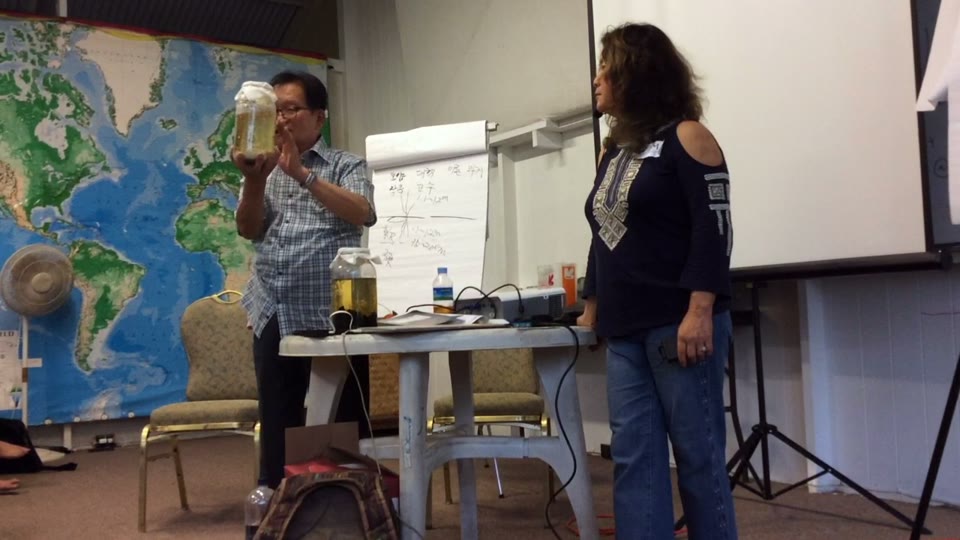
Friday afternoon, after the hands-on making outside: the tape opens on Drake's porch interview, then a short clip of the interpreter, Kim Chang, cooking egg yolk oil at a camp stove. From 5:01 Cho teaches at the front with two big jars on the table: eggshells in vinegar (Reproduction, WCA) and charred cow bone in vinegar (Structure, WCP). He holds up the eggshell jar at about 17:00 to show the shells rising, and the bone jar at about 25:30. A flip chart with Korean notes stands behind him but isn't readable, and there are no slides or handout here.
- Egg yolk oil (outdoor demo) — From the interpreter at the stove: start with one dozen eggs, go to two dozen once you're good at it; she does 36 eggs at a time at home. Cook until the eggs look done enough to eat, put them in a bowl, run an immersion blender over them, then put everything back in the pan 'to make it really fine' and keep cooking. About an hour; longer in wind. The tape never says whether only the yolks were used.
- Reproduction (WCA), eggshell in vinegar — Cho: eggshells in vinegar. Eggshell is alkaline, vinegar is acid; they react, and the calcium in the shell dissolves into water-soluble calcium. Shown in the jar. No ratio or timing given on this tape.
- Structure (WCP), cow bone in vinegar — Cho: cow bone holds protein, starch/carbohydrate and fat, which can't react with vinegar, so burn the bone first. What's left is calcium (phosphate), which is alkaline; in vinegar it dissolves. Shown in the jar. No ratio or timing given on this tape; his recipe book gives charred bone : BRV = 1:10, about 7 days.
- Hens that stopped laying after a molt — Cho: 'that's when you give this'; the interpreter says WCA and WCP together. No amount; Cho says he'll explain feed-making later.
- Sows that won't conceive or come into heat — Cho: mix WCA and WCP and shake them into the drinking water; add Medicine (OHN) with it so the effect comes fast. No dilution given on tape. His recipe book gives WCP at 1/500 in drinking water for pregnant or ovulating livestock.
-
Start egg yolk oil with one dozen eggs; a batch takes about an hour
Interpreter at the outdoor demo: one dozen to start, two dozen when you're good at it, 36 at a time at home. Cook until done enough to eat, blend with an immersion blender, back into the pan. Longer in wind.
▶ 4:00 Shown in the room
-
Egg yolk oil on a livestock wound heals it quickly
Animals that fight and get hurt: put egg yolk oil on the wound.
▶ 5:16 As spoken
-
Give it to crops and lots of flower buds set
'I'm not a doctor... but from my experience growing crops.' Cho says 'this'; the interpreter says 'these two' (WCA and WCP). No rate or timing given.
▶ 14:22 As spoken
-
A hen 'has a period every day'; a molt is like one that comes all at once, and she stops laying
When all her feathers fall out she stops laying. That's when you give it: hens that had stopped start again, and the laying period gets longer. No amount; feed-making comes later.
▶ 14:55 As spoken
-
Eggshells rise and fall in vinegar because alkali meets acid
Cho holds up the WCA jar. Eggshell is alkaline, vinegar is acid; they react and the shell's calcium dissolves into water-soluble calcium.
▶ 16:52 Shown in the room
-
Press egg yolk oil with a loving heart; after a fight with your spouse the oil won't come out
'These things aren't dead. They're all alive.' Not in words like ours, but living cells talk to each other.
▶ 24:18 As spoken
-
Burn the bone first: protein, carbohydrate and fat block the vinegar
Cow bone is living bone. Burning removes protein, carbohydrate and fat; what's left is calcium, which is alkaline. Vinegar (acid) then dissolves it into water-soluble calcium (phosphate).
▶ 25:36 Shown in the room
-
Sows that won't conceive or come into heat: WCA + WCP shaken into their drinking water
Cho says they come into heat (발정). No dilution given.
▶ 27:56 As spoken
-
Add Medicine (OHN) with WCA and WCP and the effect comes very fast
They're nutrition that has to get into the blood, so circulation has to be good for them to be absorbed.
▶ 28:18 As spoken
- No dilution, ratio or amount is given anywhere in this session. The rates in the treatments come from Cho's recipe book, not the tape.
- The tape is three clips with long unrecorded gaps (about 28 minutes after the interview, then about 1 hour 40 minutes after the demo). Cho's part starts mid-sentence.
- For flower buds and hens, Cho says 'this'; only the interpreter says 'these two' (WCA and WCP together).
- The outdoor demo doesn't say whether only yolks were used; Cho's earlier teaching uses yolks only.
- Cho also lists human uses of egg yolk oil, WCA and WCP, including how fast people absorb water-soluble calcium, and doctors who came to ask how he made it; these were not tested and we don't repeat them as advice.
- Burn bones to charcoal before they go in vinegar, so protein, carbohydrate and fat don't block the reaction.
- Watch the eggshells rise and fall in the vinegar: that's the acid and the alkali reacting.
- Cho gives Reproduction (WCA) and Structure (WCP) to assist crops in setting flower buds.
- When hens molt and stop laying, Cho gives WCA and WCP to assist them back into lay.
- For sows that won't come into heat, Cho shakes WCA and WCP into the drinking water with Medicine (OHN) to assist circulation.
- Make your own egg yolk oil, starting with one dozen eggs; Cho uses it on livestock wounds.
- Make the solutions in a calm, loving frame of mind. Cho says they're alive.
What the room didn't hear
Where the English in the room left out or changed what Master Cho said in Korean.
-
▶ 5:56
The room heard We are created by the nature with the sunshine and the air and all those things that we learn.
Cho said Everything on earth is made from the same sunlight, air, soil and water.
Soil and water dropped from Cho's list.
-
▶ 14:33
The room heard If you give these two to your crop, they will have lots of flower buds.
Cho said From my experience growing crops, when you give this, lots of flower buds set.
Cho said 'this' (이걸); the room heard two solutions. Which one he meant isn't said.
-
▶ 25:02
The room heard Because they are living inputs, because they communicate.
Cho said Not in words like ours, but living cells talk to each other, and I think that's why it happens.
His reason for making them with a calm mind: living cells, not words.
-
▶ 27:56
The room heard When your pig doesn't get pregnant, you mix these two inputs and put it in their drinking water. Then they will start having baby.
Cho said When pigs won't conceive or won't come into heat, shake these two into their water and they come into heat.
'Come into heat' (발정), the sign a farmer watches for, was dropped.
-
▶ 28:24
The room heard When you put Oriental Herb Nutrient and these two inputs together, it works way better.
Cho said Add OHN with it and the effect comes very fast.
Cho's point is speed, through circulation.
Next to Master Cho's books
-
Agrees
Burn the bone to remove protein and fat before the vinegar His recipe book says the same: burn boiled bones to charcoal at a low temperature to burn off organic and fatty matter, then 1:10 in BRV. It also gives WCP at 1/500 in drinking water for livestock that are pregnant or ovulating, which fits the sow advice here.
Cho, Natural Farming Agricultural Materials (Recipe), p. 65–66
-
Agrees
Eggshell (alkaline) and vinegar (acid) react, and the shells rise and fall The book gives the same reaction: calcium carbonate and acetic acid give off CO2 slowly, and the fluffy, floating shell is that gas.
Cho, Natural Farming Agricultural Materials (Recipe), p. 60
-
Agrees
WCA works faster with OHN, and sets flower buds Janong says WCA's power 'can even be strengthened by mixing OHN' and that it 'strengthens the flower bud'. Here Cho gives circulation as the reason, for livestock drinking water.
Cho, Janong Natural Farming (2003), p. 132
-
Unclear
Egg yolk oil is made from yolks only His DVD seminar fries yolks only, in a dry pan, until the oil separates. The outdoor demo here talks of cooking 'eggs' and blending them, and never says the yolks were separated.
notes: cho-dvd-seminar — Egg-yolk oil
“We only differ in kind. Everything on earth is made from the same sunlight, air, soil and water.”
▶ 5:56
“If you've had a fight with your spouse, the oil won't come out.”
▶ 24:18
“These things aren't dead. They're all alive.”
▶ 24:51
“Not in words like ours, but living cells talk to each other.”
▶ 25:02
In this part
- 0:00Interview: two Kohala farmers on what stuck
- 2:15Outdoor demo: tasting and making egg yolk oil
- 5:01Egg yolk oil: livestock wounds and other uses
- 11:10Eggshell calcium: why water-soluble is fast
- 14:22Flower buds, and hens that stop laying
- 16:45Why eggshells dissolve in vinegar
- 17:45Doctors come to ask how he made it
- 23:06Press the oil with a loving heart
- 25:28Cow bone: burn it first
- 27:56Sows in heat, and add Medicine (OHN)
Transcript
Transcribed and checked by hand against the recording.
0:00 Drake Weinert: Yeah, why not, man? So, we're going to do a one minute interview with Jeremy and Morgan.
0:09 Interviewee: We live here in Kohala. I'm a mango farmer. Found out about Korean Natural Farming a little over a year ago, something that very much inspires me. To improve the land that we live on and the farm that we're working at, mango trees.
0:27 Drake Weinert: So with your advanced training, what was the most profound thing that happened to you today?
0:36 Interviewee: Today I'd say just like the reaffirmation of how important it is to put live things into your soil and have a living farm, you know, other than a conventional organic farm that is just kind of a way of the past, you know. And if you keep farming in the past, then nothing's going to change. So I think that's my favorite lesson so far. For me, I think just learning again about the different inputs that mean so much, the water-soluble calcium phosphate to trigger flowering. Yeah, just reaffirming that.
1:23 Yeah. For me, one of the coolest things is knowing how connected this is. Whether it's for my plants, or for my... [unclear] But also... Yeah, I'm really interested in that, you know?
1:41 Drake Weinert: You gonna grind some...? What? Are you going to grind some inputs when you get home?
1:46 Interviewee: Oh, heck yeah. Yeah. I'm going to, like, spray LAB all over my body and just soak in it, you know? So for the last eight years or so, I've been washing my laundry with it. And to this day, like, I don't really smell that. I don't sweat a lot, but I don't smell.
2:04 Drake Weinert: Is that right?
2:05 Interviewee: Okay. That's fine.
2:07 Drake Weinert: I believe you.
2:12 Interviewee: But, yeah, no, I don't smell, you know. I will too.
2:21 Kim Chang (interpreter): It's a little bit hot. No, it's not burning. It's bitter. It's like burned stuff. I never taste it if I put it on cuts. But if you have like a skin irritation or anything or cough, right now it's hot.
2:45 Audience: What about funguses? Do you know how people get fungus on their skin? Do you put that medicine in them?
2:50 Kim Chang (interpreter): Oh, I don't know. I have to ask Master Cho about that. It helps to get rid of infection. I know. I mean, just from personal experience. Oh, yeah. Oh.
That's the first few minutes. Members read all 346 lines, with the Korean as spoken, and watch along.
Become a member