What a Crop Can Do: 8,000 Tomatoes, 14-Brix Papaya
Master Cho Han-kyu, interpreted by Kim Chang, Founder of Korean Natural Farming (Janong)
Master Cho spoke Korean, with an interpreter. We translated every Korean line again and checked it, so you read what he said, not only what the room heard.
Members watch every session
The whole seminar, as it happened, with the checked English beside the video. Membership is $60 a year.
This part runs from 59:30 to 1:37:15 of the session video. Keep watching and the next part plays on.
Now playing the next part: Chicks on Brown Rice, Hens on Green Corn, Sun on the Floor
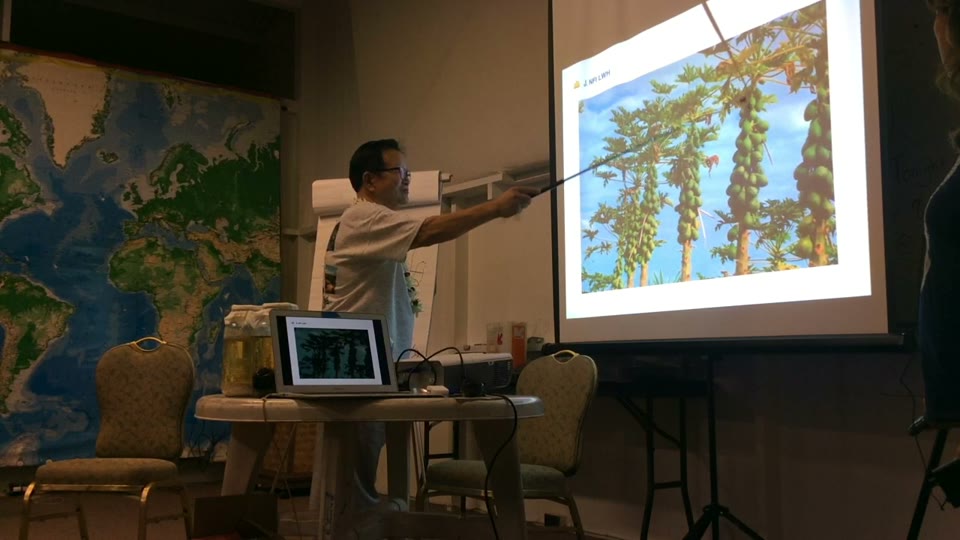
Cho points at the bubbling jars (alive, so never seal them in plastic), then takes an aside on crocks and a water machine from Korea. Then his slides of what crops can do: a 15-year grape vine, his 8,000-tomato plant, a Hilo papaya fruiting down the trunk on IMO4 alone, papaya brix, a Thai longan grove saved with a beer-and-vodka stopgap, chili, banana and taro on IMO4. He ends with a Korean field trial where Natural Farming got the worst field and the biggest harvest.
What he taught
What can a crop do when it's raised properly, and what does IMO4 alone do on the ground?
Friday evening, about an hour in. Two clear jars bubble on the table; Cho points at them. From 1:08 the interpreter runs Cho's slides: a grape vine (half shown), a tomato plant, a Hilo papaya with fruit down the trunk (1:14:30), longan in Thailand, chili and banana in India, taro in Honolulu, and a Korean trial field. An audience member asks about longan in Hawaiʻi.
- Thai longan stopgap (no OHN on hand) — Cho: beer mixed with vodka ('high-proof soju kind of thing'), plus mango, banana and coconut juice and mango juice, all mixed and given to the trees. The interpreter adds that it was fermented one week. No dilution given. Cho: a makeshift trick; Medicine (OHN) is far stronger, so make OHN here.
- Sugar boost for fruit — Interpreter: Minerals (seawater) mixed with Reproduction (WCA) and Structure (WCP) raises sweetness 2–3. Cho says only 'mix about [unclear amount] of this here', touching the jars, and adds that aroma goes up too. Banana, papaya, mango. No dilution or timing heard.
- IMO4 on the ground — Papaya in Hilo, taro in Honolulu: only IMO4 spread on the ground. Chili in India: same seed, only IMO. Banana and papaya disease under nets: spray IMO4. No rates given.
-
What ferments in the jar is alive; never cover it with plastic
If it can't breathe, it dies. A clear bottle lets sunlight in, which is not as good.
▶ 1:00:28 Shown in the room
-
One 15-year grape vine bore 3,600 bunches; the record vine bore 15,000
The slide shows only half of the vine. Trunk 50 cm across. Cho gives 15,000 without a unit; the interpreter says grapes.
▶ 1:08:30 From the slides
-
Cho's record: 8,000 tomatoes from one plant, spring to fall
World record 15,000. His plant's stem was 70 cm in diameter at the base.
▶ 1:11:30 As spoken
-
You don't know how much a crop can do; do it properly to draw it out
Ties back to the 'right way of living' on the board.
▶ 1:13:05 As spoken
-
A Hilo papaya fruited down the whole trunk with only IMO4 spread on the ground
Normally papaya bears a little at the top. Growers in Taiwan copied it and got the same.
▶ 1:14:23 From the slides
-
Papaya should reach 14 brix; it must pass 7 to taste good
Papaya coming out in Hawaiʻi now doesn't reach 7; some at market is 4. Low-sugar papaya is worth nothing.
▶ 1:15:48 As spoken
-
Seawater with the calcium solutions raises sugar 2–3 points, and aroma
Interpreter names seawater, WCA and WCP. Cho: banana, papaya, mango. Amount unclear.
▶ 1:16:42 As spoken
-
A Thai longan grove that never fruited bore the same year on Cho's stopgap mix
The owner was about to cut the trees down. Beer, vodka and fruit juices; OHN is much stronger.
▶ 1:19:14 From the slides
-
Firecracker powder around longan is a shock, not natural; use the nutrition cycle
Audience: Hawaiʻi growers use commercial firecracker powder around the trees. Cho: it heaves the soil and lets air in, like whacking a dozing person awake.
▶ 1:22:57 As spoken
-
Same chili seed, only IMO added: far bigger plants
India. Slide: a man holding a big and a small plant.
▶ 1:24:52 From the slides
-
IMO sprayed around a dying tree brought new roots down
When a crop fails, blame yourself: you applied it without knowing.
▶ 1:25:14 From the slides
-
Hawaiʻi bananas bear 4–5 hands; the Indian banana on the slide has 13–14
Netting bananas and papayas doesn't stop disease; Cho says spraying IMO4 does. His claim, no data shown.
▶ 1:25:56 From the slides
-
David Wong's taro in Honolulu, IMO4 only, stands over a 1.8 m man
Cho: Hawaiʻi imports 95% of its food; used properly, its land could feed it and export.
▶ 1:27:50 From the slides
-
Korean trial: Natural Farming got the worst field and the biggest harvest
Microbe importers paid an agricultural technology center to compare imported microbes with Cho's IMO. NF got a field with 3 years of continuous-cropping injury. The Rural Development Administration later published it as its own work.
▶ 1:30:44 As spoken
- The crop results are Cho's slides and stories. No measurements, controls or rates were shown.
- The brix boost: the amount Cho gives is unclear, and only the interpreter names the three solutions.
- The chemical in the longan 'firecracker powder' was never named, and the Korean relay told Cho it was set off, which shaped his answer.
- Cho's claim that taro was Hawaiʻi's first farm export to the mainland is not checked.
- Cho and an audience member describe a water-particle machine said to help cancer patients, save fuel and keep food fresh; it wasn't tested and we don't repeat it as advice.
- Let living ferments breathe: cover with something porous, never plastic, and keep them out of the sun.
- Spread IMO4 on the ground to assist fruit trees and taro; Cho's slides show papaya fruiting down the trunk on it.
- Aim for papaya at 14 brix. Cho uses seawater with the calcium solutions to assist sugar and aroma.
- If you lack OHN, Cho's stopgap was beer, vodka and fruit juice; make OHN when you can.
- Feed the nutritive cycle instead of shocking trees into fruit.
What the room didn't hear
Where the English in the room left out or changed what Master Cho said in Korean.
-
▶ 1:12:20
The room heard That tomato plant at the bottom of the stalk is 70 centimeters.
Cho said The tomato plant I grew that way: its diameter was 70 cm.
Cho said diameter; the room heard no measure.
-
▶ 1:15:31
The room heard If you don't, it doesn't taste good at all.
Cho said If the papaya's sugar is low, the papaya is worth nothing.
Cho's point is market value.
-
▶ 1:17:05
The room heard Their sweetness all goes up.
Cho said Give this to them and the sugar goes up and the aroma goes up.
Aroma was dropped.
-
▶ 1:22:08
The room heard (Audience, in English) They use a firecracker powder around the tree... put that chemical around the tree.
Cho said (Relay to Cho) They pile it in a ring next to the tree and set it off.
The relay added an explosion; Cho's answer about shock and air rests on it.
-
▶ 1:28:43
Cho said Hawaiʻi now brings in 95% of its food from the mainland.
Not interpreted.
-
▶ 1:32:13
The room heard A businessman wanted to make money with a foreign microorganism... they give him a very bad plot.
Cho said The microbe importers couldn't sell because of the indigenous microbes, so they gave the center money and had it run the trial.
Who paid for the trial was dropped.
-
▶ 1:35:36
The room heard Even you did all the work, the university or scientist said, I did the work.
Cho said The University of Hawaiʻi or places like it will write papers on your work and get their doctorates from it.
A warning to Hawaiʻi farmers, softened.
Next to Master Cho's books
-
Agrees
Don't cover a living ferment with plastic Cho said the same in Hawaiʻi in 2016: cover with paper, never plastic, the microbes must breathe.
2016/Cho - Hawaii/seminar @ 0:08:03 (translated)
-
Agrees
Seawater with calcium raises fruit sugar 2–3 points In the 2017 advanced fruit course he says the final-stage treatment raises sugar by two or more in bananas, papayas and mangoes in Hawaiʻi and Taiwan.
2017/Advanced Cho/advanced fruit/IMG_3465 @ 0:40:40 (translated)
-
Goes further
Beer and vodka as a stand-in for OHN His book makes OHN by soaking herbs in brewed alcohol such as beer. The Thai mix uses the alcohols with fruit juice and no herbs, and Cho calls it a weaker trick.
Cho, IMO and Vital Power of Crops and Livestock, p. 29
-
Agrees
IMO4 on the ground alone revives fruit trees In 2018 Cho says to always put IMO4 on the drip line when a tree is sick.
2018/Cho - advanced hawaii/tour-hs @ 0:50:41 (translated)
“It's alive, because there are microbes in it.”
▶ 1:00:38
“This is the grape's ability.”
▶ 1:10:26
“Don't do that. You can make this happen by regulating nutrition.”
▶ 1:24:23
“Don't blame anyone else. Turn the blame on yourself: you applied it without knowing.”
▶ 1:25:33
“So don't doubt it. Let's just try it.”
▶ 1:27:16
In this part
- 59:30Why Cho hits you; a living jar must breathe
- 1:01:24Off-topic: crocks and a water machine from Korea
- 1:08:06What a crop can do: a 15-year grape vine
- 1:11:298,000 tomatoes on one plant
- 1:14:09IMO4 papaya in Hilo, and papaya brix
- 1:18:41Thai longan: beer, vodka and juice
- 1:21:46Firecracker powder on Hawaiʻi longan
- 1:24:42IMO4 results: chili, a dying tree, banana
- 1:27:25Taro taller than a man; Hawaiʻi can feed itself
- 1:29:43The worst field wins: Korea's microbe trial
- 1:33:25The government takes the credit
Transcript
English translation, checked against the Korean as spoken.
59:34 Kim Chang (interpreter): then you will remember.
59:36 Master Cho: Ah... why do I have to hit you?
아... 이걸 왜 때려야 되냐?
59:41 Kim Chang (interpreter): Do you know why I hit you guys? Because I love you guys.
59:45 Master Cho: It leaves you a memory.
추억이 남지.
59:51 Kim Chang (interpreter): So when I hit, then you remember. You will have a permanent memory.
59:56 Master Cho: Don't feel hurt that I hit you.
때렸다고 섭섭하게 생각하지 마.
1:00:04 Kim Chang (interpreter): So don't feel bad when I hit you.
1:00:09 Master Cho: All right, let's move on to the next one. Look here, this one is still doing this, right now.
자, 그러면 다음으로 넘어갈게요. 여기 지금도 이거 이러고 있잖아.
1:00:18 Kim Chang (interpreter): So look at it, the fermentation is still working, going up and down, up and down.
1:00:24 Master Cho: Up and down, up and down. But here's the thing: Is what's inside here dead, or alive? It's alive, because there are microbes in it. So you must not cover this with plastic wrap or anything like that.
업앤다운, 업앤다운. 그런데 여기서 말이야, 여기 안에 있는 게 죽은 거예요? 산 거예요? 살아있어. 미생물이 있으니까. 그래서 이건 뚜껑을 비닐이나 이런 걸로 덮으면 안 돼.
1:00:47 Kim Chang (interpreter): So this is alive, the microorganism is in there too. So you cannot use plastic.
1:00:58 Master Cho: Then if it can't breathe, it dies.
그러면 호흡을 못하면 이게 죽어.
1:01:01 Kim Chang (interpreter): So if you use plastic, they cannot breathe, so they will die.
1:01:08 Master Cho: And this bottle, you see: if sunlight gets into it, that's not as good.
그리고 이 병이 말이지, 햇빛이 들어가면 덜 좋아.
1:01:15 Kim Chang (interpreter): So this is a clear bottle. When sun hits this bottle, that's not good.
1:01:24 Master Cho: So this time in Korea we made a jar, a crock made only for Natural Farming use. Dr. Hoon Park is bringing materials over from Korea by container this time, so if you order jars here, they can come in the same container. He asked me to tell you as he left earlier (for Kona).
그래서 이번에 한국에서 항아리를, 자연농업에만 쓸 수 있는 항아리를 따로 만들어 봤거든. 그 박훈 원장님이 이번에 한국에서 자재를 컨테이너로 실어 오니까, 여기서 항아리 신청하면 거기다 같이 실어 올 수 있겠다고, 아까 (코나에) 가시면서 얘기 좀 하라고 하시더라고요.
1:01:52 Kim Chang (interpreter): So Dr. Park said... Master Cho said they made this ceramic jar for natural farming. So Dr. Park said he's going to order some stuff. If you guys want... He cannot ship the ceramic jar from Korea, so if anybody wants those jars, please let us know.
1:02:21 Master Cho: Since the machine is coming over this time, if the jars ride in the same container as the machine, they can come cheap.
그러면 요번에 기계를 가져오니까, 그 기계 가져오는 컨테이너에 같이 실어가지고 오면은 값도 싸게 가져올 수 있다.
That's the first few minutes. Members read all 338 lines, with the Korean as spoken, and watch along.
Become a member