The Season on One Table: Soil, Soak, Flowers, Sugar
Master Cho Han-kyu, interpreted by Kim Chang, Founder of Korean Natural Farming (Janong)
Master Cho spoke Korean, with an interpreter. We translated every Korean line again and checked it, so you read what he said, not only what the room heard.
Members watch every session
The whole seminar, as it happened, with the checked English beside the video. Membership is $60 a year.
This part runs from 29:35 to 53:10 of the session video. Keep watching and the next part plays on.
Now playing the next part: Certificates, the First Level 2, and the Group Photo
Told he has two minutes, Cho asks what matters most in farming (the soil), then runs through the whole season on the projected table: cover crops, the seedling soak with the leaves kept dry, Type 2, the changeover and next year's fruit, Mineral D as water drawn from rock, Type 3 and ripening. He closes with his hopes for Hawaiʻi: classes on the islands, a CGNF Hawaiʻi quality mark, and starting small.
What he taught
What goes on the crop at each stage of the season, from soil to harvest, and why?
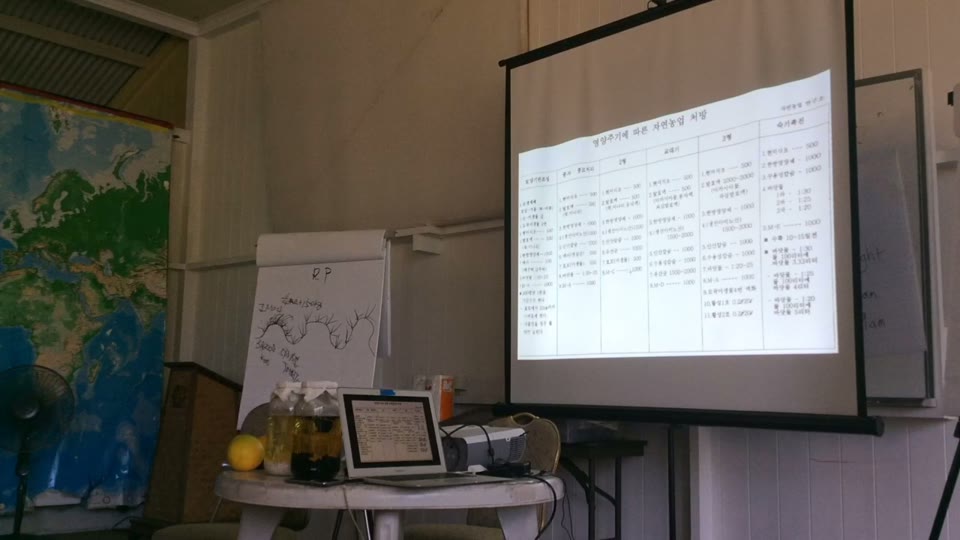
The last teaching block of the seminar. Cho and the interpreter stand at the projected table '영양주기에 따른 자연농업 처방', with columns for soil foundation, seed and seedling treatment, Type 2, changeover, Type 3 and ripening (숙기촉진); the frame at 32:45 is the clearest. Jars of solutions sit on the table in front. From 31:16 the interpreter walks the table in English herself. An audience member's lost notes interrupt at 32:37. At 49:59 the interpreter tells Cho in Korean that certificates and cleanup are waiting.
- Seedling soak (how to dip) — Cho: only the roots go in the solution. Keep the leaves out, and don't sink the plant past its 'nose'. The recipe itself is on page one of this session.
- Type 2 (after transplanting) — Cho names Type 2; the interpreter says Fuel (FAA) for nitrogen. No rate spoken. The table's Type 2 column is too blurry on video to read reliably. The Type 2 column was read aloud and checked against the handout photo on Saturday morning (session 6): BRV 1:500, FPJ 1:500, OHN 1:1,000, (FAA) 1:1,000, WCP 1:1,000, LAB 1:1,000, yeast 1:500, Mineral C 1:1,000.
- Changeover (교대기), from the projected table — Spoken: Structure (WCP) plus Mineral D. Read off the frame (low resolution): BRV 1:500; fermented juice 1:500 (acacia flower, fruit); OHN 1:1,000; FAA 1:1,500–2,000; WCP 1:1,000; WCA 1:1,000; LAB 1:1,500–2,000; Mineral D 1:1,000. The transcribed handout table for this column is jumbled with the Type 3 column, so this frame reading is the better source. It matches the handout photo used on Saturday morning (session 6).
- Type 3 (3형), from the projected table — Spoken: lots of calcium, and water-soluble calcium phosphate. Read off the frame (low resolution): BRV 1:500; fermented juice 1:2,000–3,000 (acacia flower, fruit); OHN 1:1,000; FAA 1:1,500–2,000; WCP 1:1,000; WCA 1:1,000; seawater 1:20–25; Mineral A 1:1,000; liquefied IMO4; 활성 1호 and 2호 at 0.2 L per 20 L (names as on the slide).
- Ripening (숙기촉진), from the projected table — Clear on the frame and the same as the transcribed handout table: Cleanser (BRV) 1:500; Medicine (OHN) 1:1,000; Reproduction (WCA) 1:1,000; Minerals (seawater) 1:30 the first time, 1:25 the second, 1:20 the third; Mineral E 1:1,000. Start 10–15 days before harvest. Seawater: 3.33 L in 100 L of water for 1:30, 4 L for 1:25, 5 L for 1:20. On Saturday morning (session 6) Cho said to start a week before harvest; three sprays a week apart fit the printed 10–15 days better.
- Shine on fruit (as the interpreter gave it) — Food (FPJ) 1:1,000, given here by the interpreter. Cho gave it himself on Saturday morning (session 6): purslane Food (FPJ) at about 1:1,000 for color and shine. It isn't on the table's ripening column.
-
The most important thing in farming is the soil: love it
The room answered 'love'; Cho: 'the soil, the soil'. Soil is like a mother: all life comes up from it. Make it rich first and the farming is abundant.
▶ 29:47 As spoken
-
Building the soil starts with cover cropping (초생재배)
The interpreter put it as 'start growing corn first'. The table's soil column also starts with cover cropping. She adds: plant corn, give IMO4, let it grow, knock it down, then the soil treatment solution.
▶ 30:27 As spoken
-
The season runs: soil solution, vegetative growth (nitrogen), flowering, fruiting, harvest, each with its own column
The interpreter walking the projected table.
▶ 31:40 From the slides
-
Soak only the roots; if the solution wets the leaves, the plant 'catches cold'
Water evaporating off the leaf takes heat from the plant (기화열, heat of vaporization), and then the roots develop poorly. Like getting rained on and needing cold medicine.
▶ 35:11 As spoken
-
Don't sink the seedling too deep: its 'nose' stays above the line
You don't pull the blanket over a baby's face. Think of the crop as your baby and you'll know what to do.
▶ 37:01 As spoken
-
After transplanting: Type 2, Fuel (FAA) for nitrogen
Cho names the stage; the interpreter names FAA. No rate spoken.
▶ 38:28 As spoken
-
At 'marrying age', prepare the plant for the changeover and lots of flowers open
Cho: 시집갈 나이 (marrying age). The interpreter: the changeover solution goes on at the start of flowering.
▶ 38:56 As spoken
-
For lots of fruit next year, apply it this year from the end of June to early July
Cho's Korean (Korean seasons). The interpreter said only 'the year before'. He goes straight on to calcium phosphate. On Friday morning (session 3) he put the start at June 24, a week before June 30.
▶ 39:20 As spoken
-
Fruit takes a lot of calcium phosphate: give Structure (WCP) and Mineral D
The table's changeover column lists Mineral D 1:1,000.
▶ 39:47 As spoken
-
Mineral D is phosphate-rich rock, dissolved so the water inside the rock comes out
Told with Moses striking the rock for water. Cho offers to show CGNF Hawaiʻi how to make it from local Hawaiʻi rock, take a little himself, and have it sold cheap. 'Let's do it while I'm young.'
▶ 40:06 As spoken
-
Once the plant is 'pregnant', Type 3: lots of calcium and water-soluble calcium phosphate
The baby has to grow in there; growing is the principle of life.
▶ 43:23 As spoken
-
Ripening feed raises sugar and color; the sourness goes and consumers welcome the fruit
The sourness and consumer point wasn't interpreted.
▶ 43:54 As spoken
-
Ripening: seawater 1:30, then 1:25, then 1:20, with BRV 1:500, OHN 1:1,000, WCA 1:1,000 and Mineral E 1:1,000, 10–15 days before harvest
Read off the projected table. 1:30 = 3.33 L seawater in 100 L water; 1:25 = 4 L; 1:20 = 5 L.
▶ 32:45 From the slides
-
Cho would rather come to Hawaiʻi and visit your farms than have everyone fly to Korea
Classes like this raise the level a lot. The interpreter said 'once every two months'; Cho's Korean was heard only as 'once in between'.
▶ 45:22 As spoken
-
Cho's view: mainland merchants will come asking for Hawaiʻi's food, and should need CGNF Hawaiʻi's permission to buy it
This is his opinion, not a plan anyone agreed. The interpreter questioned it in Korean ('that doesn't make sense') and gave it in English as CGNF Hawaiʻi vouching for product quality.
▶ 47:50 As spoken
-
Cho's view: put out a little less than people want: if Hawaiʻi eats 10,000 eggs a day, sell 8,000 Natural Farming eggs
A small shortage lifts the price. Also his opinion; no figures from a real market.
▶ 49:09 As spoken
-
Don't try to build paradise at once: start small, and it may be your children's or grandchildren's time
'Who is the owner of this paradise?' The room said God. Cho: 'No, it's you.'
▶ 52:03 As spoken
- Cho reads no dilution aloud on this page; the interpreter gives one (FPJ 1:1,000). All other rates come from the projected table, and only the ripening column is sharp on video. Changeover and Type 3 are low-resolution readings.
- 'End of June to early July' is Korean timing. Cho doesn't say how to shift it for Hawaiʻi.
- FPJ 1:1,000 'for shine' isn't on the table's ripening column. Here only the interpreter gives it; on Saturday morning (session 6) Cho named it himself as purslane FPJ.
- The CGNF Hawaiʻi permission idea and the egg example are Cho's business opinions; the interpreter herself pushed back.
- About a minute (32:37–33:47) is side talk about lost notes.
- The interpreter also says Natural Farming crops and meat 'heal your body'; this wasn't tested and we don't repeat it as advice.
- Start with the soil: cover crops first.
- When you soak seedlings, put only the roots in. Keep the leaves dry and the 'nose' above the solution.
- Plan next year's fruit this year: Cho feeds Structure (WCP) the season before, and Mineral D with it at the changeover.
- In Type 3, Cho gives calcium (WCA) and calcium phosphate (WCP) to assist the fruit as it grows.
- For sweetness and color, the table steps seawater up from 1:30 to 1:25 to 1:20 over the last 10–15 days before harvest.
- Start small and grow it.
What the room didn't hear
Where the English in the room left out or changed what Master Cho said in Korean.
-
▶ 30:27
The room heard So to make it healthy, your soil, you start growing corn first.
Cho said When you make the soil that way, you have no choice but to look at cover cropping (초생재배).
Cho named the practice; corn is one example of it.
-
▶ 39:20
The room heard If you want to have lots of fruits, you need to give these nutrients the year before already.
Cho said If you want it to set lots of fruit next year, you apply it this year from the end of June to early July.
The timing window was dropped.
-
▶ 40:06
The room heard Mineral D, where we collect it, is a certain rock that has calcium phosphate. We collect from there.
Cho said Mineral D is rock with a lot of phosphate in it; you dissolve it and draw out the water held inside the rock.
How it's made (dissolve the rock, draw the water out) became 'we collect it from a rock'.
-
▶ 44:18
The room heard You use this formula with the first line... fermented plant juice.
Cho said The sourness goes away too, and because the sugar goes up, consumers welcome it.
Why ripening matters to the buyer was replaced with a solution name.
-
▶ 47:50
The room heard You have to make it up to there. ... He wants to have a CGNF authority to sell this product.
Cho said Merchants from the mainland who want to come to Hawaiʻi should have to get permission from CGNF Hawaiʻi; that's how the price goes up.
Cho's view on control of supply; the interpreter questioned it in Korean and softened it to a quality mark.
-
▶ 49:15
The room heard Let's say the consumer wants about 10,000 eggs, and then we only produce 8,000 eggs.
Cho said Say in Hawaiʻi 10,000 eggs a day sell; then you put out only up to 8,000 Natural Farming eggs.
'A day' dropped, and the 8,000 are the Natural Farming share, not all production.
Next to Master Cho's books
-
Agrees
Seedling soak: keep the leaves out of the solution His 2005 column says the same, for the same reason: don't let it touch the leaves, or they dry out from the heat of vaporization. Here he adds the 'nose' and the cold-medicine picture.
CGNF Advanced (2005.05) (English translation), p. 16
-
Agrees
Feed calcium phosphate the year before for next year's fruit His 2005 column says weak branch tissue spoils next year's flower bud differentiation, and to center feeding on WCP. The end-of-June-to-early-July timing here is new detail and wasn't interpreted.
CGNF Advanced (2005.05) (English translation), p. 21
-
Agrees
Ripening: seawater 1:30, 1:25, 1:20 before harvest At his 2016 Hawaiʻi seminar he gave the same steps, a week apart: 1:30, then 1:25, then 1:20, to ripen the fruit.
2016/Cho - Hawaii/seminar @ 0:32:03 (translated)
-
Goes further
Mineral D: water drawn from rock, and CGNF Hawaiʻi could make it from local rock His recipe book says Mineral is derived from rocks and reflects their structure; Janong describes Natural Mineral as a product made from 12 rocks, developed in Japan and supplied by Janong. Making it in Hawaiʻi from local rock is a new offer.
Cho, Natural Farming Agricultural Materials (Recipe), p. 83
“You have to love the soil.”
▶ 29:57
“If its leaves touch this solution, it catches cold.”
▶ 36:42
“When you grow crops, think: what would I do if this were my baby?”
▶ 37:59
“Let's do it while I'm young.”
▶ 42:37
“Who is the owner of this paradise? They say God. No, it's you.”
▶ 51:36
In this part
- 29:35What matters most? Love the soil
- 31:30The season on one table
- 32:37Lost notes (side talk)
- 33:49Seedling soak: roots in, leaves dry
- 38:20Type 2, changeover, and next year's fruit
- 40:06Mineral D: water from the rock
- 43:17Type 3 and ripening
- 44:37Cho's wish: classes in Hawaiʻi, a CGNF quality mark
- 49:0910,000 eggs wanted, 8,000 sold
- 51:25Who owns paradise
Transcript
English translation, checked against the Korean as spoken.
29:35 Master Cho: Everyone, when you farm, what's the most important thing?
여러분은 농사지을 때 가장 중요한 게 뭐예요?
29:44 Kim Chang (interpreter): What is the most important thing when you farm?
29:46 Master Cho: They say 'love.' Love. The soil, the soil.
사랑이래요. 사랑. 땅이야, 땅.
29:50 Kim Chang (interpreter): No, it's the soil. You have to love the soil.
30:02 Master Cho: That soil is just like a mother … [it brings life up].
그 땅이 엄마나 마찬가지로 … 살려 올리 …
30:02 Kim Chang (interpreter): So soil is just like a mother, because all the life is coming up.
30:12 Master Cho: So the soil has to be rich first; [then] the farming becomes abundant.
그래서 땅이 먼저 풍부해야 … 농사가 풍요가 됩니다.
30:26 Kim Chang (interpreter): So to make it healthy, your soil, you start growing corn first.
30:27 Master Cho: So when you make the soil that way, you have no choice but to look at cover cropping (초생재배). [mostly unclear] … IMO (Microbes) …
그래서 그 땅을 그렇게 만들 때, 초생재배에 대해서 볼 수밖에 없습니다. (불명확) … 토착미생물 …
30:56 Kim Chang (interpreter): So after you plant the corn and then put IMO 4 on the corn, then your corn will grow 1.10 [unclear]. So after they grow, you put it down, and then you put the SOS, the first solution, we call it
31:19 Master Cho: [unclear] … planted it, and while it grows …
(불명확) … 심어 오고, 자랄 때에 …
31:39 Kim Chang (interpreter): soil treatment solution. And then next one is vegetative growth, where vegetative growth has nitrogen, that's the solution you need. And then, um, when they start the flowering stage, then you give this solution, and then they start flowering and then fruiting, then you give this solution. And then when harvest time, you start giving this solution. And then Master Cho said, if you want to make your fruit shine,
32:27 you use first... fermented plant juice. You dilute 1 to 1,000.
That's the first few minutes. Members read all 189 lines, with the Korean as spoken, and watch along.
Become a member