Corn + IMO4 = No Till, No Weeds; Then a Four-Season Farm
Master Cho Han-kyu, interpreted by Kim Chang, Founder of Korean Natural Farming (Janong)
Master Cho spoke Korean, with an interpreter. We translated every Korean line again and checked it, so you read what he said, not only what the room heard.
Members watch every session
The whole seminar, as it happened, with the checked English beside the video. Membership is $60 a year.
This part runs from 0:00 to 29:35 of the session video. Keep watching and the next part plays on.
Now playing the next part: The Season on One Table: Soil, Soak, Flowers, Sugar
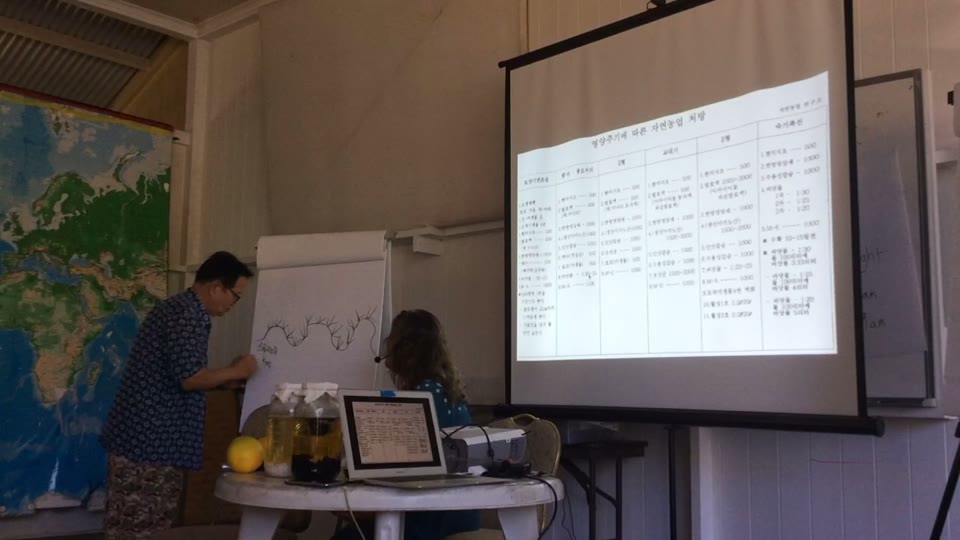
Back at the projected prescription table, Cho goes over the first two columns again: a corn cover crop with Microbes (IMO4) under it, laid down as no-till mulch, and the seedling soak. Then he leaves the table for his picture of a Natural Farming farm in Hawaiʻi that visitors come to: something blooming or fruiting in every season, a guesthouse, good food, and a place to learn.
What he taught
How do you build the soil and start the plants before the season begins, and what kind of farm does Cho want Hawaiʻi to have?
Saturday afternoon, the last session. Cho stands at the projected Korean prescription table, '영양주기에 따른 자연농업 처방' (Natural Farming prescriptions by the nutritive cycle), and starts over from its first column, 토양기반조성 (soil foundation). From about 3:00 to 6:00 he draws the corn timeline on the flip chart; the writing is too small to read on video. A rice nutritive-cycle slide flashes up around 8:00, then it's back to the table for the second column, 종자·종묘처리 (seed and seedling treatment). From 11:50 he leaves the table for his vision of Natural Farming agritourism in Hawaiʻi. At 29:15 he's told they must finish at 3 pm.
- Corn cover crop bed (soil foundation) — Cho's Korean and the interpreter: sow corn about 2 months before the crop (his example: corn on March 20, tomatoes around May 10). Before cutting it, scatter Microbes (IMO4) evenly, about 150 kg per quarter acre (here the 150 kg is heard only in the interpreter's English because Cho's Korean is garbled; Cho gave the same 150 kg per 300 pyeong in his own Korean on Friday morning, session 3). Cut the corn and lay it down; Cho says the layer comes to about 7 cm. Don't till. Open small gaps and plant into them; open the mulch as the plants come up and close it again once they grow. The table's soil column (transcribed) also lists grass cover (rye in winter, clover in summer), charcoal, IMO4, BRV 1:500, FPJ 1:500, OHN 1:1,000, malt 1:500, seawater 1:20–25 and Mineral A 1:1,000, at about 1 ton of the diluted solution per 300 pyeong, soaking the top 20 cm (in drought add only more water). Cho doesn't read those rates aloud.
- Seedling and young-tree soak — The solution from the table's 종자·종묘처리 column. The transcribed table gives Cleanser (BRV) 1:500, Food (FPJ, mugwort or dropwort) 1:500, Medicine (OHN) 1:1,000, Fuel (FAA) 1:1,000 if needed, Structure (WCP) 1:1,000, malt 1:500, yeast 1:500, Minerals (seawater) 1:20–25 and Mineral A 1:1,000. The frame matches as far as it can be read. The interpreter: at the seedling stage swap Mineral A for 'root power'. Vegetables 20–30 minutes, or overnight if you plant the next morning. Cho's Korean: mango, papaya, banana and coconut soak from the evening before, 12 hours or more.
-
Soil prep starts with a cover crop, and in Hawaiʻi the best one is corn
First column of the projected table. Hawaiʻi is always warm, so sow it about two months before the crop, any time of year.
▶ 0:34 As spoken
-
At about two months, cut the corn and lay it flat; the layer is about 7 cm
Cho: 한 7센티 (about 7 cm); the interpreter said 6 to 7 cm. She gave the corn's height at two months as '1.10', unit unclear (probably 1.1 m).
▶ 1:39 As spoken
-
Corn breaks down fast and turns into fertilizer, and no weeds come up under it
Cho: 옥수수는 발효가 빨리, 분해가 빨리 돼서 거름이 되고. Tomato, paprika, eggplant, watermelon, melon: plant whatever you like into it.
▶ 2:10 As spoken
-
Worked example: corn sown March 20, tomatoes planted into it around May 10
Drawn as a timeline on the flip chart. The May 10 date is in Cho's Korean only; the interpreter didn't repeat it.
▶ 3:47 As spoken
-
Before cutting the corn, scatter IMO4 at about 150 kg per quarter acre
Spread it first, then cut the corn and lay it on top. Here the 150 kg is heard only from the interpreter, as Cho's Korean is garbled (it seems to say 300 pyeong, about a quarter acre). On Friday morning (session 3) Cho said 150 kg per 300 pyeong himself, and there the interpreter first said 300 kg.
▶ 5:04 As spoken
-
Don't till: lay the corn on the IMO4, open small gaps and plant
Cho: 갈지를 말고 그대로 (don't till, leave it as it is). The interpreter left out 'don't till'.
▶ 5:36 As spoken
-
Open the mulch as the plants come up; close it around them once they grow
As interpreted, with 'ventilation is very important'. Cho's Korean here is only partly clear.
▶ 6:51 As spoken
-
With IMO4 underneath and the corn breaking down, no more fertilizing for a while
Cho: the microbes have started working and it turns into fertilizer, and no weeds come up. 'For a while' is the interpreter's own hedge.
▶ 7:23 As spoken
-
Dip seedlings in the seedling solution for 20–30 minutes, or overnight if planting tomorrow
Interpreter. She adds: at this stage swap Mineral A for 'root power', and the roots grow much faster. What 'root power' is isn't explained.
▶ 9:03 As spoken
-
Mango, papaya, banana and coconut: soak 12 hours or more before planting
Cho: from this evening, 12 hours or more (12시간 … 이상), and the others won't keep up with them. The interpreter said 'about 12 hours' and dropped papaya.
▶ 10:11 As spoken
-
Treated plants grow twice as fast as untreated ones
Interpreter. Cho says they grow 'vigorously, completely differently'. No trial was described.
▶ 11:29 As spoken
-
Apples and pears don't fruit in Hawaiʻi because there's no winter: feed them and make a winter
Cho: 겨울이 없어서 안 되는 건데, 영양분을 줘서 겨울을 만드는 거예요. The interpreter said only that with Natural Farming you can grow them.
▶ 14:13 As spoken
-
Even a small farm can show four seasons: canola and cherry in spring, plums and apricots in summer, apples and pears in fall
Cho: make it four kinds (네 가지 종류). Add a guesthouse so people come to visit and to learn Natural Farming.
▶ 12:50 As spoken
-
A farm visitors love pleases all five senses: the mouth first, then the eyes, then the heart
And it shows a way of life that secures their children's future. Cho pictures Steve's farm (fish, taro, lotus) with camping, a restaurant and a training ground for Natural Farming.
▶ 25:01 As spoken
-
Waikiki is a place of consumption, not production
Send your children on honeymoon somewhere that produces; consuming alone has no joy in it.
▶ 27:50 As spoken
- On this page the IMO4 rate is heard only in the interpreter's English; Cho's Korean around it is garbled in both transcriptions. It matches the 150 kg per 300 pyeong Cho gave in his own Korean on Friday morning (session 3).
- The corn height at two months ('1.10') has no clear unit, and it isn't clear whether 7 cm is the depth of the laid-down mulch. On Friday evening (session 5) Cho gave green corn as 1 m 10 cm at two months, so 1.1 m is likely. On Friday morning (session 3) he said 6–7 cm of laid-down corn stops grass, and the interpreter gave the layer as about 10 cm.
- 'Root power' replacing Mineral A is only in the interpreter's English and is never explained.
- The table's solution rates are read from the transcribed table and a blurry frame; Cho doesn't read them aloud here.
- 'Twice as fast' is the interpreter's phrase; no trial or measurement is shown.
- About 17 minutes of the page (11:50 to 29:05) is Cho's vision of agritourism, not farming technique; the one farming point in it is 'make a winter' (14:13).
- Cho also says people from cold countries will come to Hawaiʻi and live longer; this wasn't tested and we don't repeat it as advice.
- Sow corn about two months before the crop, scatter Microbes (IMO4) over it, then cut it and lay it down so the microbes and the breaking-down corn assist the soil.
- Don't till: open small gaps in the mulch and plant into them.
- Soak seedlings in the seed and seedling solution 20–30 minutes, or overnight if you plant the next morning; Cho soaks fruit trees and coconut 12 hours or more.
- Where there's no winter, Cho feeds apples and pears to assist them in doing what the cold would do.
- If you want visitors, give them something in every season: flowers, fruit, color, good food.
What the room didn't hear
Where the English in the room left out or changed what Master Cho said in Korean.
-
▶ 4:06
Cho said Around May 10th, around the 10th: tomatoes.
The planting date in his worked example (corn March 20, tomatoes about 7 weeks later) never reached the room.
-
▶ 5:36
The room heard Then you cut the corn and lay it down, like you use it as a mulching.
Cho said After that, don't till. Leave it just as it is.
'Don't till' is the point of the method.
-
▶ 1:39
The room heard Once you cut that corn and then lay it down, the height will be about 6 to 7 cm.
Cho said Cut it and lay it down; once it's cut, laid and covered, it comes to about 7 cm.
Small, but Cho gave one number, not a range.
-
▶ 10:16
The room heard Mango or banana, those fruit trees, you soak them about 12 hours, like the night before.
Cho said Mango, papaya, banana: if you plant tomorrow, you soak from this evening, 12 hours or more.
Twelve hours is the minimum, not the target; papaya dropped.
-
▶ 14:13
The room heard We don't have a winter, but if we use natural farming input, you can grow all those crops.
Cho said They don't fruit because there's no winter. You give nutrients and make a winter.
The reason, nutrition standing in for the winter chill, was lost.
-
▶ 28:07
The room heard So when parents send this young couple to Hawaii for honeymoon, you want to send them to a productive place.
Cho said Wouldn't you want them to spend their time somewhere that produces? If it's only about consuming, there's no joy in it.
His reason, that consuming alone has no joy, was dropped.
Next to Master Cho's books
-
Agrees
Corn cover crop, IMO4 sprayed first, then cut and laid down His January 2016 Hawaiʻi notes give the same steps: corn is the best cover crop, spray IMO4 first, then chop and drop. They give 1,300 lb per acre, which is about 150 kg per quarter acre, the same as the interpreter's figure. A 2018 note says 300 kg per quarter acre, double that.
Master Cho Conference , p. 16
-
Agrees
Don't till; cover the soil and the weeds don't come Janong says tilling brings buried weed seeds to the surface and the war against weeds never ends; mulch with straw and leaves instead.
Cho, Janong Natural Farming (2003), p. 158
-
Differs
Seedling soak 20–30 minutes; fruit trees 12 hours or more Janong gives a 15-second soak for seedlings and 4–8 hours for seeds. In 2018 he gave mango 4 hours. Twenty to thirty minutes for seedlings and 12-plus hours for fruit trees are much longer than his books.
Cho, Janong Natural Farming (2003), p. 155–156
-
Goes further
No winter in Hawaiʻi: feed the trees to make a winter His Advanced columns treat good dormancy as a nutritional state (a high carbohydrate-to-nitrogen ratio), not only a matter of cold. Using nutrition to stand in for winter in the tropics goes further than the books, which give no tropical method.
CGNF Advanced (2005.11) (English translation), p. 42
“There's no winter, so they don't fruit. You give nutrients and make a winter.”
▶ 14:13
“The flower you never tire of, however often you look, is the baby flower.”
▶ 16:50
“First the mouth has to be happy. And the eyes have to be happy.”
▶ 25:24
“Waikiki is not a place of production. It's a place of consumption.”
▶ 27:50
In this part
- 0:00Back to the prescription table
- 0:34Corn cover crop and Microbes (IMO4): building the bed
- 8:36Soaking seedlings and fruit trees
- 11:50A farm for all four seasons; feed the trees to make a winter
- 16:06The baby flower
- 18:54Dr. Park's farm, Nami, Joe and Steve
- 25:01Five senses, and why not Waikiki
- 29:06Admin: two more minutes, then certificates
Transcript
English translation, checked against the Korean as spoken.
0:00 Master Cho: The materials. The materials. Isn't it this one? Oh, the materials?
자재, 자재. 이거 아니에요? 오, 자재?
0:11 Kim Chang (interpreter): Slide?
0:17 Master Cho: All right, let me take this and go over it once more.
자, 그럼 요걸 갖다가 지금 다시 한번 풀게요.
0:21 Kim Chang (interpreter): He is going to explain this one more time. The first one is prep for your planting.
0:34 Master Cho: The first one is cover crop. So in Hawaii the best [cover crop] is corn. Hawaii is always warm, so before you plant the crop, two months before,
첫 번째는 커버 크롭. 그래서 하와이에서 가장 좋은 [커버 크롭은] 옥수수. 그래서 이제 하와이는 항상 따뜻하니까, 작물 심기 전, 두 달 전에
0:58 Kim Chang (interpreter): So Hawaii is always warm, so just before, two months before you're planting the crop, you plant this cover crop. So you plant the corn; about two months later they're high, about 1.10 [meters?].
1:31 Master Cho: Then you cut it and lay it down. Cut it and lay it down; cover with the big corn. Once it's cut, laid and covered, it comes to about 7 cm.
그때 그걸 베어서 깔아요. 베어서 깔고, 옥수수 큰 거 덮어요. 베어서 깔고 덮으면 그것이 한 7센티 정도 됩니다.
1:44 Kim Chang (interpreter): Once you cut that corn and then lay it down, the height will be about 6 to 7 cm.
1:59 Master Cho: You part it, part it [and plant]... [unclear] If you plant [tomato], paprika, eggplant, mostly... no weeds come up [under it],
그것을 헤집고, 헤집고 [심고] … [불명확] [토마토], 파프리카 심으면, 가지 심으면, 대부분 … 그 [밑에는] 풀이 나지 않고
2:14 Kim Chang (interpreter): So after you lay down the corn leaves, you open the space and plant any crop you want.
2:19 Master Cho: and the corn ferments fast, breaks down fast, and becomes fertilizer.
옥수수는 발효가 빨리, 분해가 빨리 돼서 거름이 되고
2:37 Kim Chang (interpreter): And then the corn will break down and become their food. Director, when do the microbes [go on]?
원장님, 미생물은 언제?
That's the first few minutes. Members read all 231 lines, with the Korean as spoken, and watch along.
Become a member