Plump, Slim, Plump Again: Feed Every Stage
Master Cho Han-kyu, interpreted by Kim Chang, Founder of Korean Natural Farming (Janong)
Master Cho spoke Korean, with an interpreter. We translated every Korean line again and checked it, so you read what he said, not only what the room heard.
Members watch every session
The whole seminar, as it happened, with the checked English beside the video. Membership is $60 a year.
This part runs from 1:16:11 to 1:49:19 of the session video.
Cho walks through how a child goes plump, slim and plump again with age, and says young paprika, tomato, papaya, pigs and chicks should be raised plump too. Miss the balance at the changeover and the crop gets sick, so he has had his stage-by-stage chart translated for this level-3 seminar. Then fermentation heat (an IMO 4 pile runs 60-70 °C), a seminar notice, and an open Q&A: seawater 1:30 for all crops, salt blocks, no seawater nearby, and 'the crop is the professor'.
What he taught
Why does Cho say a crop has to be fed by its stage, and how widely does seawater 1:30 apply?
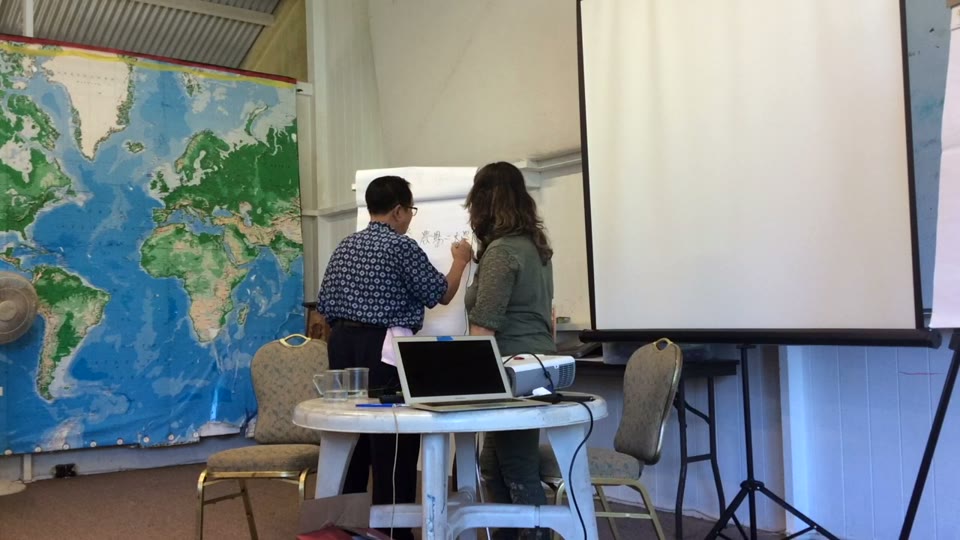
Last stretch of Thursday morning. Cho, seated, uses the ages of a growing child as his picture of the nutritive cycle, then says his stage-by-stage chart (the prescription handout) has been translated for this seminar. After a seminar notice and the lunch call, the floor opens for questions; Cho stands once to write 農場=大學 / 作物-教授 / 學生 農民 on the flip chart. The projector stays blank.
- Seawater (Minerals) for crops — 1 part seawater to 30 parts fresh water, the same for all crops. Cho's Korean; the interpreter only said 'He's trying to give you a prescription.'
- No seawater nearby — Make your own seawater; Cho says there is a method and will teach it later. The interpreter and the room add 'from sea salt'. No amounts given.
- Brought-in feed — A farmer asks whether feed from elsewhere can be fermented with microbes before feeding; Cho points to a slide for the evening session (not recorded). No method given here.
- Chlorinated water — Let bleach-treated tap water sit a day, or overnight, before watering; rainwater is best. Given by the interpreter in English; no exchange with Cho is audible.
-
A newborn, plump or skin and bones, fills out on mother's milk by one or two years old.
Cho: mother's milk is rich in protein. The start of his life-stage picture.
▶ 1:16:50 As spoken
-
Raise young paprika, tomato and papaya so the plant fills out.
'When they're young, you have to raise the plant so it fills out.'
▶ 1:17:44 As spoken
-
Pigs and chicks too: plump when young, slim once grown, then fattened again.
The interpreter dropped this livestock example.
▶ 1:18:07 As spoken
-
People go plump at 2-4, slim at 5-6, plump at 10-13, slim at 14-16, plump then thin at 19-21.
Cho's ages; the interpreter said 11-13 and 14-18. He carries the picture on into marriage.
▶ 1:18:41 As spoken
-
Give nutrition matched to the stage, not more.
Cho makes the point about children, then applies it to crops.
▶ 1:21:36 As spoken
-
If the balance isn't kept at the changeover period (교대기), too much or too little growth brings disease.
'At that stage it should grow true to its stage.'
▶ 1:22:12 As spoken
-
Time each stage of paprika and tomato exactly and feed it then: a big harvest and no disease.
Otherwise they get sick. So charts were made for fruiting crops.
▶ 1:22:36 As spoken
-
Natural Farming has a chart of what to give at each growth stage, translated for this level-3 seminar.
Cho had never presented it before. This is the nutritive-cycle prescription handout.
▶ 1:23:15 As spoken
-
A plant's body changes with age just like a person's; feed it by its stage of life.
▶ 1:24:19 As spoken
-
Microbial fermentation heat reaches 60-70 °C.
Cho contrasts it with sun heat or hot-spring water at that temperature. The interpreter said 'up to 60 Celsius'.
▶ 1:27:23 As spoken
-
An IMO 4 (Microbes 4) pile heats up to about 60 °C as it ferments.
In Korea and Japan this waste heat is used as a 'microbe sauna'; afterwards the pile goes on the field. Slide promised for the evening.
▶ 1:28:34 As spoken
-
Seawater 1:30 is the same for all crops.
Cho: '1대 30으로 바닷물을 세운 다음에 모든 작물에 똑같이 해 줍니다.' On Saturday morning (session 6) he uses 1:25 for a weekly fruit-skin spray and steps the ripening spray 1:30, 1:25, 1:20.
▶ 1:35:35 As spoken
-
Far from the sea? Make your own seawater.
Cho says there is a method and it will be taught later.
▶ 1:37:15 As spoken
-
Feeding for seed is a little different from feeding for fruit.
Cho gave no method; the interpreter: he would have to visit the farm and taste the soil first.
▶ 1:39:39 As spoken
-
The farm is the university, the crop is the professor, the farmer is the student.
Cho's answer to 'how often should I apply seawater to healthy soil?', written on the flip chart. The crop tells you.
▶ 1:42:31 Written on the board
-
In drought, grass turns acidic; seawater brings it back to neutral before it is fed to livestock.
The interpreter corrected a questioner who thought it was about nutrient uptake.
▶ 1:44:14 As spoken
-
Seawater does not replace salt blocks: animals lick the block to replenish salt, and the block has other things mixed in.
So salt blocks are still used for livestock.
▶ 1:44:56 As spoken
-
If you make salt water, use pure salt.
Cho's Korean is partly unclear; the interpreter said 'use pure ocean water' and that processed salt like the block is not the same.
▶ 1:46:04 As spoken
-
This seawater teaching is for crops, not for giving to livestock.
Cho, after a farmer said she adds seawater to her goats' water.
▶ 1:47:40 As spoken
- Cho says IMO 4 fermentation heat is used to treat people, including cancer; this was not tested and we don't repeat it as advice. His ages for children's weight are his own observation, not measured.
- The chart itself is not shown on video; Cho says it will be gone through in an evening session (Thursday evening was not recorded).
- Several promised answers (making seawater, fermenting brought-in feed, storing IMO 3, feeding for seed) were deferred to later sessions.
- In the Q&A much of the talk is the interpreter's English with short Korean relays; Cho's own words are not always separable.
- Raise young crops and young stock well filled out, then feed each stage for what it is.
- Watch the changeover from growth to fruiting: too much or too little at that turn brings disease.
- Minerals (seawater) go on at 1:30 for all crops; inland farmers can make their own seawater.
- Keep salt blocks for livestock; the seawater spray is for crops.
- Let the crop teach you how often: the farm is the university, the crop the professor.
What the room didn't hear
Where the English in the room left out or changed what Master Cho said in Korean.
-
▶ 1:18:07
The room heard So in our life cycle, when certain cycle they are plump, then skinny, then plump again.
Cho said Pigs and chicks too: fattened up plump when young, slim once grown, then at a certain point fattened again.
The livestock example was dropped.
-
▶ 1:22:12
The room heard So when you don't give a right nutrient, if you get too much or too little, they start to get sick.
Cho said If the balance isn't kept at the changeover period, too much or too little growth brings disease.
The English lost 'changeover period' (교대기), the key stage of the nutritive cycle.
-
▶ 1:27:23
The room heard Sometimes it goes up to 60 Celsius.
Cho said The heat microbes give off when they ferment goes up to 60 to 70 °C.
The upper figure, 70 °C, was dropped.
-
▶ 1:35:35
The room heard He's trying to give you a prescription.
Cho said Set seawater at 1 to 30, and do it the same for all crops.
The questioner's actual answer, 'yes, all crops', never reached her in English.
-
▶ 1:44:56
The room heard So animals, you let them lick the salt block to absorb the minerals.
Cho said No. The animals lick the salt block to replenish their salt. It isn't something seawater replaces.
Cho's plain 'seawater doesn't replace it' was left out; a follow-up question had to ask again.
Next to Master Cho's books
-
Agrees
Crops need different nutrition at each life stage The nutritive cycle as in Janong: crops need different nutrients according to their life cycle. The plump-slim ages for children are new here.
Cho, Janong Natural Farming (2003), p. 116
-
Agrees
Seawater 1:30, the same for all crops CGNF's seawater sheet gives 1/30 as the standard dilution and 1/30, 1/25, 1/20 to enhance ripening, the same steps Cho gives on Saturday morning (session 6), where he also uses 1:25 for a weekly fruit-skin spray. So 'the same for all crops' is the general rule, not the ripening or fruit-skin rule.
Seawater-and-Fermented-Seawater, p. 1–5
-
Agrees
Use real seawater or pure salt, not refined salt Janong says refined salt is not good, sun-dried salt is better, and the rule is seawater itself.
Cho, Janong Natural Farming (2010 draft), p. 51
“Even crops have a life cycle. You have to follow according to their life cycle.”
▶ 1:24:29
“The farm is the university, the crop is the professor, and the farmer is the student.”
▶ 1:43:04
“What I'm talking about is not giving seawater to livestock. It's giving it to the crops.”
▶ 1:47:40
In this part
- 1:16:11Plump and slim: life stages in people, animals and crops
- 1:21:36Feed the stage or get sick; the new chart
- 1:25:44Microbe heat and the IMO 4 sauna (health claims)
- 1:31:02Admin: Korea tour, December seminar, lunch notice
- 1:32:45Q&A: seawater 1:30 for all crops, chlorine, IMO 3
- 1:35:50Q&A: salt blocks, no seawater nearby, imported feed, seed crops
- 1:41:36Q&A: how often seawater? The farm is the university
- 1:43:51Q&A: drought, salt blocks, pure salt, crops not livestock
- 1:48:28Lunch break: 'E hoʻi'
Transcript
English translation, checked against the Korean as spoken.
1:16:11 Master Cho: Here we go! But there's one thing here you really have to understand: haven't you had babies and raised them? When a mother gives birth, whether the baby is chubby or just skin and bones,
시작! 그런데 여기서 한 가지 딱 알아줘야 될 것은 여러분들이 애기를 낳아서 길러 보지 않았나요? 엄마가 애기를 낳을 때 통통하게 살찐 거나, 뼈하고 가죽만 남은 [애기나]
1:16:28 Kim Chang (interpreter): So when you are a mom, I mean woman who give birth, the baby is kind of chubby or just skin with a bone when baby just born. Skin with bone.
1:16:46 Master Cho: Bone and skin. even a skin-and-bones baby puts on weight drinking its mother's milk, doesn't it? And by one or two years old, doesn't it get chubby?
뼈하고 가죽. 뼈, 가죽만 남은 [애기도] 엄마 젖 먹으면 살이 찌지 않나요? 그래서 한 살, 두 살 되게 되면 통통해지지 않나요?
1:16:50 Kim Chang (interpreter): After they are born, they drink mom's milk and gain weight. So when they are one or two years old, they start to really plump.
1:17:09 Master Cho: So is it only people? Tomatoes too...
그러면 사람만 그렇고 토마토도…
1:17:10 Kim Chang (interpreter): So not only human, tomato and paprika and all those crops are that way too.
1:17:33 Audience: Yes.
1:17:34 Master Cho: It's all protein. Drinking mother's milk, the baby takes in plenty of protein, so it puts on weight.
다 단백질이에요. 엄마 젖을 먹을 때는 단백질을 풍부하게 먹으니까 아이가 살이 찌잖아.
1:17:35 Kim Chang (interpreter): Same with livestock.
1:17:37 Audience: Yes.
1:17:44 Master Cho: Paprika, tomato, papaya too: when they're young, you have to raise the plant so it fills out.
파프리카나 토마토나 파파야도 어렸을 때는 나무를 갖다 살이 찌게 길러야 되지.
1:17:54 Kim Chang (interpreter): So in nature, like human babies, when they're young, they are kind of chubby. So you need to grow your young crop kind of chubby too.
1:18:07 Master Cho: So pigs and chicks too: when young they're fattened up plump, then once they've grown big they turn slim, and at a certain point you have to fatten them [again].
그래서 돼지고 병아리고 어렸을 땐 살이 통통하게 찌웠다가, 어느 정도 크게 자라면 또 날씬한 형이 되었다가 어느 정도 되면 [다시] 살을 찌워야 되지.
1:18:21 Kim Chang (interpreter): So in our life cycle, when certain cycle they are plump, and then certain cycle they are skinny and then certain cycle they became a plum again. So if I compare with human beings, when they are up to 3 to 4 they are kind of chubby,
1:18:36 Master Cho: It's the same raising people. A baby at 2, 3, 4 years old, isn't it chubby? But at 5 or 6 it [grows and] slims down.
그래서 사람을 키우는 [것도], 애기가 2살, 3살, 4살 된 애는 살찌지 않아? 그런데 5살, 6살 되면 [크면서] 날씬해지지.
1:19:01 Kim Chang (interpreter): And then up to six years old they start to slim. Are they [like that] or not?
That's the first few minutes. Members read all 350 lines, with the Korean as spoken, and watch along.
Become a member