Feed 5–7 Days Early: Ripening, Flower Buds, Leaf Shape
Master Cho Han-kyu, interpreted by Kim Chang, Founder of Korean Natural Farming (Janong)
Master Cho spoke Korean, with an interpreter. We translated every Korean line again and checked it, so you read what he said, not only what the room heard.
Members watch every session
The whole seminar, as it happened, with the checked English beside the video. Membership is $60 a year.
This part runs from 1:54:45 to 2:28:45 of the session video.
With the prescription handout projected, Cho goes through the stage columns and the ripening spray: seawater 1:30, then 1:25, then 1:20 a week apart, sugar up 2–3%, plus purslane Food at 1:1000 for shine. Then the rule: give each stage's prescription 5 days, or a week, before the stage. Questions follow: flowers are made the summer before, the moon calendar, rice by leaf count, reading the stage from leaf shape, and alternate bearing. It ends at lunch.
What he taught
When should each stage's prescription go on, and how do you read from the plant which stage it is in?
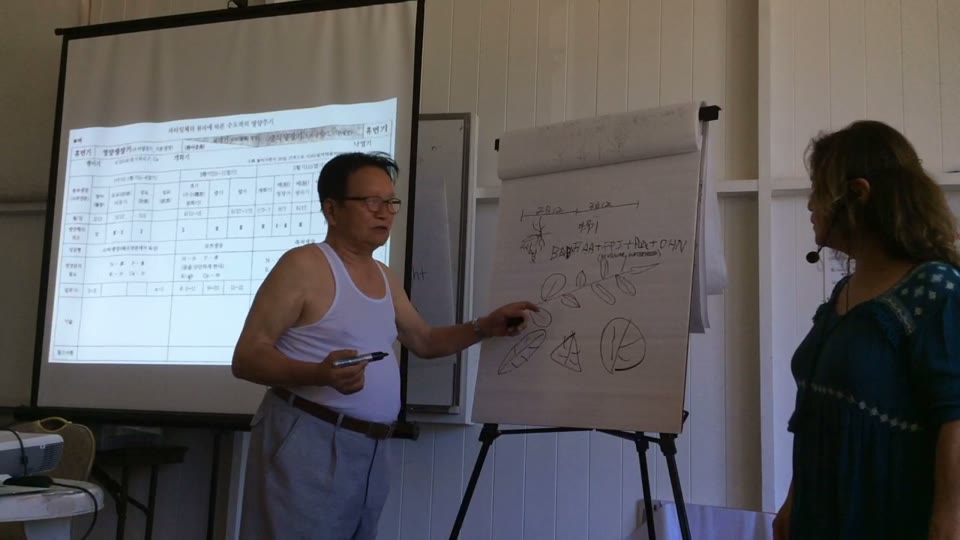
The Korean prescription handout (XFLH5606) is projected until about 2:02:40, then the rice chart (DJSS5255) again. Audience members ask about missed timing, coffee and papaya, the moon calendar, and avocado and lychee years, mostly relayed in Korean by the interpreter. From about 2:18:00 Cho draws leaf shapes on the flip chart: a long leaf, a triangle and a round leaf, then a branch carrying all three.
- Changeover (교대기): flower buds — Handout (shown, not read item by item): BRV 1:500; fermented juice 1:500 (acacia flower, 동자액, fruit ferment); OHN 1:1000; (FAA) 1:1500–2000; WCP 1:1000; WCA 1:1000; LAB 1:1500–2000; Mineral D 1:1000. Spoken: give it one week before the flower-bud date (June 24 for June 30). Cho stresses calcium phosphate (Structure, WCP) here, and says trees that flower and fruit at once, like coffee, need the changeover feeding for longer. No spoken rates.
- Type 3 (3형): sizing the fruit — Handout (shown, not read item by item): BRV 1:500; fermented juice 1:2000–3000 (acacia flower, fruit ferment); OHN 1:1000; (FAA) 1:1500–2000; WCP 1:1000; WCA 1:1000; seawater 1:20–25; Mineral A 1:1000; IMO No. 4 liquefied; 활성 1호 0.2 L / 20 L; 활성 2호 0.2 L / 20 L (the last two not explained). Spoken: give it a week before Type 3 begins (June 30 example). No spoken rates.
- Ripening promotion (숙기촉진): the brix shot — Handout: BRV 1:500; OHN 1:1000; water-soluble calcium (WCA) 1:1000; seawater 1st spray 1:30 (3.33 L per 100 L water), 2nd 1:25 (4 L), 3rd 1:20 (5 L); Mineral E 1:1000; '※ harvest 10–15 days before'. Spoken: Cho starts it 'a week before harvest' for mango, banana or papaya, sprays a week apart, and says sugar rises 2–3% (the interpreter later says 3%). The start differs: one week spoken, 10–15 days printed. Cho adds purslane (쇠비름) Food (FPJ) at about 1:1000 for color and shine; it is not on the Korean handout. Green-plant FPJ is left out because its nitrogen delays ripening.
- Rainy-year correction — Cho: in a rainy, cloudy year, give about double the calcium phosphate you'd give in a dry year. Interpreter: give calcium and water-soluble calcium phosphate together, extra. No base rate given here.
-
The prescriptions go by stage: seed and seedling, Type 2 for the trunk, changeover, Type 3 for the fruit, then ripening
Cho points at each column of the projected handout.
▶ 1:55:10 From the handout
-
Ripening spray a week before harvest of mango, banana or papaya raises sugar 2–3%
Cho says a week before harvest; the handout says 10–15 days before. Seawater gets stronger each time: 1:30, then 1:25, then 1:20, a week apart (3.33, 4 and 5 L per 100 L on the handout).
▶ 1:55:57 As spoken
-
Green-plant Food (FPJ) is left out at ripening: its nitrogen delays ripening
Cho's answer to an audience member who noticed no FPJ in the column. Never put into English.
▶ 1:57:57 As spoken
-
The exception: purslane Food (FPJ) at about 1:1000 in the ripening spray, for color and gloss
Mango and papaya get good color and a shiny skin; 'it makes very high-grade fruit.' Cho: a purslane leaf is brilliant against the sun. Coffee gets its color too.
▶ 2:01:06 As spoken
-
Seawater, calcium and Medicine (OHN) at ripening raise the sugar; coffee tastes much better
Cho's sentence breaks off at 'the sugar…'; the interpreter gives 'like 3% higher'.
▶ 2:01:28 As spoken
-
Give each stage's prescription 5 days to a week before the stage begins
'If you give it then it won't line up, because there's time needed to absorb it. So give it five days ahead, it fits exactly, and you hit a home run.' He read the whole type sequence off the rice chart while saying it. Here (2:03:07) he says five days; at 2:10:00 and 2:17:16 he says a week, as he did for June 24 on Friday morning.
▶ 2:03:07 As spoken
-
Missed the window? Still give it
Answer to an audience question about missing the 5 days from inexperience.
▶ 2:06:03 As spoken
-
The flower is made during the changeover (보전생장), long before it opens; give calcium phosphate then
An open flower means 'the baby is already born'. A living thing that isn't the mother grows in her body, so prepare: give calcium phosphate. On trees that flower and fruit together, like coffee, the changeover feeding runs longer.
▶ 2:06:52 As spoken
-
Flowers that open this spring were made last year, between the end of June and July 5
Heard as '6월 31일' (June 31, no such date). The interpreter said only 'June to July'.
▶ 2:07:47 As spoken
-
If flower buds form June 30, give the changeover prescription June 24, a week before, and many buds are made
Here Cho says a week ahead; at 2:03:07 he said 5 days. Both are kept.
▶ 2:10:00 As spoken
-
Repeated changeover sprays on papaya, eggplant and tomato worked because one of them hit the timing
A farmer said giving it more often worked better. Cho: it isn't that more often is better; early, middle or late, one application hit the right moment, because these plants flower and fruit at once.
▶ 2:11:04 As spoken
-
The date matters, but watching the growth stage matters more
Answer to a question about moon phases. 'When you get married, do you fix the number of days until you have a baby?'
▶ 2:12:28 As spoken
-
Rice: one leaf at planting, two after about a week, transplant at 5–6 leaves, pregnant at 10–11; late pregnancy June 27 to July 2
Matches the chart (말기 6/27–7/2). If by those dates the plant hasn't reached 10–11 leaves, compare date and leaves and take the middle.
▶ 2:13:10 As spoken
-
Read the stage from the leaf: long = Type 2 (spring), triangle = Type 3 (summer), round = Type 4 (fall)
Drawn on the flip chart. On one fruit-tree branch the lowest leaves are round, the middle triangular, the tip leaves long. New leaves look like Type 2.
▶ 2:18:02 Written on the board
-
Many long leaves at harvest mean too much nitrogen, and lower-sugar fruit
Phosphate and calcium are short; nitrogen-loving bugs and disease come.
▶ 2:21:29 As spoken
-
Alternate bearing (해거리) follows last year's weather
After a dry year, many flowers and heavy fruit; if the year before was rainy, the tree doesn't bear. Asked about avocado and lychee years in Hawaiʻi.
▶ 2:24:49 As spoken
-
In a rainy, cloudy year, give about double the calcium phosphate
Clouds cut photosynthesis, so fewer stored nutrients are made and fewer flowers form; heavy rain also brings nitrogen down.
▶ 2:25:57 As spoken
-
Bring a rice plant or a cut branch to the next seminar; Cho can read it at a glance
Two courses a year for five or six years and natural farming will be settled in Hawaiʻi. Japanese farmers bring their crops.
▶ 2:27:55 As spoken
- Ripening start: Cho says one week before harvest; the handout says 10–15 days. Three sprays a week apart can't all fit in one week, so the printed window fits the series better.
- The 2–3% sugar rise (3% from the interpreter) is Cho's claim; no measurement was shown.
- Purslane FPJ is not on the Korean handout; the 1:1000 rate is spoken only.
- Cho says '5 days ahead' at 2:03:07 and 'a week ahead' at 2:10:00 and 2:17:16. Both are kept.
- The changeover and Type 3 columns were shown, not read item by item; 활성 1호 and 2호 are not explained.
- The June dates are Cho's examples, probably from Korea; 'June 31' is as heard.
- An audience member said the leaf shapes don't fit papaya leaves; that wasn't resolved before lunch.
- Cho also mentions purslane juice as a face toner and in lipstick; that's off-topic and not tested.
- Give each stage's prescription 5 to 7 days before the stage, so the plant has time to absorb it.
- If you missed the window, give it anyway.
- Next year's flowers are made in this year's changeover; feed WCP then, about a week before buds form.
- For the brix shot, step the seawater up 1:30, 1:25, 1:20 a week apart before harvest, and leave out green FPJ.
- Read the leaves: long leaves late in the season mean too much nitrogen.
- After a rainy year, expect a light crop and give more calcium phosphate.
What the room didn't hear
Where the English in the room left out or changed what Master Cho said in Korean.
-
▶ 1:57:57
Cho said If you use green juice at this time, the nitrogen… so ripening gets delayed.
The room heard only the question about missing FPJ, never the reason.
-
▶ 2:03:07
The room heard So actually, he says there's a… to the harvesting, there is a date. But all these nutrients, you give these nutrients 5 days before this date.
Cho said What's prescribed here, for each period, you give it five days ahead of that period.
The rule covers every stage, not just harvest.
-
▶ 2:07:28
The room heard So he said actually that flower and fruit, that nutrient length is a little bit longer.
Cho said You have to prepare for that, so you give calcium phosphate; for trees like that, the changeover feeding runs a bit longer.
Which solution to give, calcium phosphate, was dropped.
-
▶ 2:07:47
The room heard The previous year between June to July we need to give that nutrient already.
Cho said The flowers that bloom this spring were made last year, between the end of June ('June 31') and July 5.
The exact window was dropped.
-
▶ 2:10:00
The room heard Actual flowering starts June 30th, so you need to give June 24th, one week before.
Cho said It's June 30, so a week before is June 24. If you give this prescription on June 24, lots of flower buds get made.
What the June 24 spray does, set flower buds, was left out; 'flowering' was Cho's bud formation.
-
▶ 2:11:04
The room heard So because it is flower and fruit, you need to give more often on a changeover.
Cho said It's not that giving it often made it work; he hit the timing because he did it many times. Early, middle or late, one of them hit.
The room heard the opposite lesson: timing, not frequency.
-
▶ 2:24:52
The room heard So when it's dry, then that year it will give you lots of flower and fruit. But then this one year it has lots of rain, then they wouldn't give you fruit.
Cho said A heavy year comes because last year was dry; if it rained a lot the year before, the tree won't bear.
The one-year lag, which ties to flowers being made the summer before, was dropped.
-
▶ 2:25:57
The room heard So to correct that, if it's rain or not, you need to give a double amount of water-soluble calcium phosphate.
Cho said In a rainy year give about double the calcium phosphate of a year without rain, because clouds cut photosynthesis, so fewer stored nutrients and fewer flowers.
The condition (a rainy year) and the reason were muddled.
Next to Master Cho's books
-
Differs
Ripening spray: one week before harvest, seawater 1:30, 1:25, 1:20 a week apart The dilutions match the prescription table, but the table says start 10–15 days before harvest, and his recipe book says seawater with water-soluble calcium 15–20 days before. Spoken here: one week.
Cho nutrient cycle prescription table (Oct 2017, transcribed) — Maturity Promotion (숙기촉진)
-
Agrees
Give each stage's solution 5 days early, for absorption He repeats the 5-day shift at the 2017 advanced fruit class: move each treatment forward so there's time to absorb it.
2017/Advanced Cho/advanced fruit/IMG_3202 @ 0:35:35 (translated)
-
Agrees
Changeover spray about a week before flower buds form His book treats the changeover as the plant's 'morning sickness' around floral differentiation and calls for phosphate then.
Cho, IMO and Vital Power of Crops and Livestock, p. 39–40
-
Agrees
Rainy, cloudy year: more calcium phosphate, fewer flower buds next year His 2005 text: low temperature and heavy rain weaken branches and hurt next year's flower-bud differentiation. 'Double' is a new number here.
CGNF Advanced (2005.05) (English translation), p. 21
“So give it five days ahead, it fits exactly, and you hit a home run.”
▶ 2:03:56
“You still have to give it.”
▶ 2:06:03
“If you say you farm by the calendar: when you get married, do you fix the number of days until you have a baby, and then have it?”
▶ 2:11:58
“One look and I can tell right away: ah, this one got too much of some fertilizer.”
▶ 2:28:06
In this part
- 1:54:45The prescriptions by stage, projected
- 1:55:52Ripening: seawater 1:30, 1:25, 1:20; sugar up 2–3%
- 1:56:55Purslane Food for shine; why no green FPJ
- 2:02:18Give it five days early
- 2:05:12Questions: missed timing, coffee and papaya
- 2:06:24Flowers are made the summer before: June 24
- 2:11:34The moon calendar vs the growth stage
- 2:12:50Rice by leaf count
- 2:17:42Reading leaf shape: long, triangle, round
- 2:21:18Long leaves at harvest: too much nitrogen
- 2:24:04Alternate bearing and rainy years
- 2:26:52Come twice a year, bring your crops; lunch
Transcript
English translation, checked against the Korean as spoken.
1:54:46 Kim Chang (interpreter): The other one. The other one? Here, here, I got it. Oh.
1:54:50 Master Cho: So here...
그래서 여기...
1:54:50 Kim Chang (interpreter): Yeah. Oh. You saw the chart as a type 2 and type 3. Number 2 and 3 you saw, yeah? And then there's a changeover.
1:55:10 Master Cho: At changeover time you use this prescription.
교대기 때는 이런 처방으로 [하는 거죠].
1:55:14 Kim Chang (interpreter): So, changeover stage, the flowering stage, you give this nutrient.
1:55:24 Master Cho: At Type 2, when you're building the trunk, you use this prescription. And here is the seed and seedling treatment.
이형 때는, 몸통을 만들 때는 이걸 가지고 처방을 하고 그리고 여기는 종자, 종묘.
1:55:33 Kim Chang (interpreter): That's when you're treating the seed and the seedling. You give that nutrient. And here, it's sam-hyeong (Type 3). That's the type 3. The maturing stage of the fruit is getting big. That's the stage you give this nutrient.
1:55:52 Master Cho: This is the ripening treatment. For example, for mango, banana or papaya, a week before harvest, If you give this prescription a week before harvest, the sugar goes up 2 to 3 percent.
이건 숙기 처리인데, 예를 들어서 망고나 바나나, 파파야나, 수확기를 일주일 앞두고 수확기를 일주일 앞두고 이 처방을 하면은 당도가 2~3% 올라가.
1:56:11 Kim Chang (interpreter): So when harvesting stage, you give this, about one week before harvest, you give this nutrient, this part, then sweetness goes up two to three percent. And even the water, sea water, the ratio is starting to change to much stronger. The first you give a 1 to 30, second one use 1 to 25 ratio, third one is 1 to 20 ratio, A week apart each time? Yes. Wait a week each time. each time you wait one week, each time.
일주일마다 [간격이] 있겠죠? 네. 1주일에 한 번씩 기다리세요.
1:56:55 Master Cho: And you'll see purslane growing around here. 쇠비름 is purslane. So you make Food (FPJ) from that purslane, put it in with this ripening spray and spray it, and the mango gets a really good color, and here it turns glossy.
그리고 쇠비름을 보고 나오는데, 쇠비름이 퍼슬레인. 그래서 이제 그 쇠비름을 가지고 천혜녹즙을 만들어서 이 숙기 촉진 때 같이 넣어서 뿌려주면은 망고는 색깔이 아주 좋아지고, 여기가 빤딱빤딱해져.
1:57:18 Kim Chang (interpreter): Make a fermented plant juice with purslane, then your mango, in case of a mango, it has a beautiful color like a citrus skin, it shines. So grow your purslane and make a fermented plant juice for this stage.
1:57:41 Audience: I don't see FPJ in that stage.
That's the first few minutes. Members read all 319 lines, with the Korean as spoken, and watch along.
Become a member