Well-Fed Diversity = Healthy Soil: KNF in Scientists' Words
Drake Weinert, Pure KNF; organizer of the seminar
Members watch every session
The whole seminar, as it happened, with the checked English beside the video. Membership is $60 a year.
This part runs from 1:00:49 to 1:38:18 of the session video. Keep watching and the next part plays on.
Now playing the next part: Teach It as You Got It: Lineage and Certification Levels 0–5
Drake Weinert brings back what soil scientists said at the Hawaii Farmers Union state convention and maps it onto Cho's solutions: Microbes (IMO) as biodiversity, Food (FPJ) as concentrated root exudates, fungi that build soil aggregates. Then questions: why FPJ is like an exudate, fixing deficiencies, the fungus-to-bacteria ratio, sprayers, and spraying a mixed garden where crops sit at different stages.
What he taught
How do Cho's solutions line up with what soil scientists now say about biodiversity, root exudates and fungi?
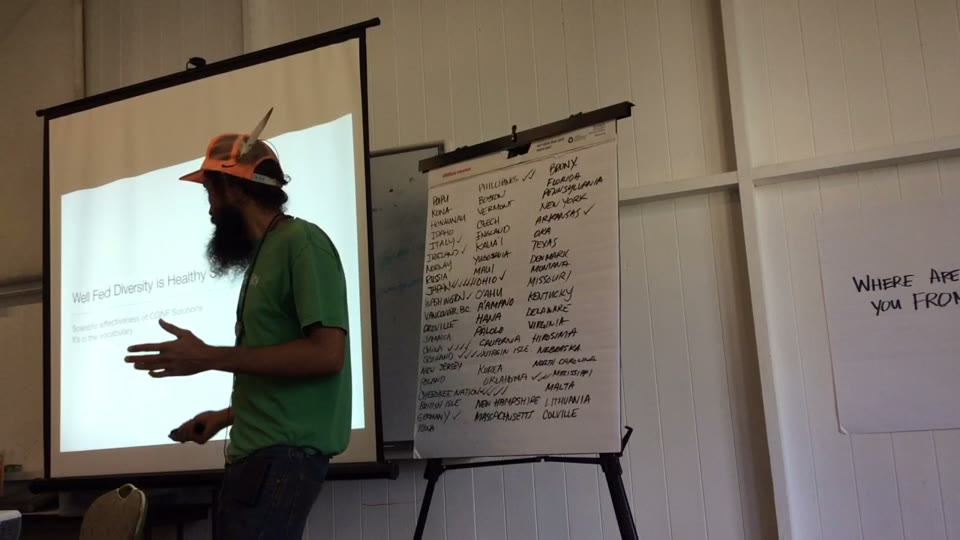
Drake Weinert's slide talk, in English, right after Joe McGinn: 'Well Fed Diversity is Healthy Soil' (subtitle: the scientific effectiveness of CGNF solutions). The slides are photos of talks at the Hawaii Farmers Union state convention by Gabe Brown, a soil restoration speaker and a USDA soil scientist; most aren't legible in the frames, so numbers are as Drake read them. Cho doesn't speak. These are Drake's readings of other people's work, not Cho's teaching.
- Food (FPJ) in a prescription — Where a growth-stage prescription says FPJ, you can use two FPJs, half and half, for different effects. Comfrey grows well in Hawaiʻi and is full of nutrients. (Drake, spoken; no dilution given here.)
- Steering Microbes (IMO4) with mulch — Same IMO4 everywhere; wood chips push it fungal (slower lettuce, good for fruit trees), grass clippings keep it suited to lettuce. (Drake, spoken.)
-
Work on the rhizosphere, the soil right around the root, not the whole field
Instead of correcting pH across a field with calcium or seawater, the plant exudes sugars that shift pH in that micro-region, low to take up iron or aluminum. Diverse microbes work with the roots to build it.
▶ 1:04:06 As spoken
-
Microbes (IMO) = biodiversity; tell a scientist that and you're speaking their language
Benefits listed from the USDA talk: breaking disease cycles, more soil organic matter, more nutrient cycling.
▶ 1:05:55 As spoken
-
Food (FPJ) = concentrated root exudates, made by fermentation
Polycultures feed diverse soil life with diverse exudates. Drake's claim: IMO on the surface plus FPJ from several plants (sweet potato, comfrey) gives a monoculture above biodiversity below. He put this to Gabe Brown, who asked how; Drake answered 'fermentation'.
▶ 1:07:55 As spoken
-
The microbes in soil weigh as much as livestock
Slide of cows: the equivalent weight of microbes in 2.3 acres, as Drake read it. 'We actually have the cows grazing under the ground.'
▶ 1:09:29 From the slides
-
Protect and feed soil life; KNF also introduces it
Microbes (IMO) and Protectors (LAB) introduce microorganisms. Then always feed: Food (FPJ), Cleanser (BRV, acids that dissolve and balance), Medicine (OHN). 'We always need food plus medicines.'
▶ 1:10:22 As spoken
-
In a drought year (2 inches of rain instead of 7) the cash crop alone failed; with five cover crops it held
Slide from the convention. Drake says IMO4 gives the same effect without the polyculture; he showed no trial of his own.
▶ 1:12:38 From the slides
-
Keep soil covered: bare soil is an open wound and weeds are the scab
Mulch is a band-aid; a living cover crop is always good.
▶ 1:14:14 As spoken
-
Gabe Brown's soil test: 281 units of available nitrogen against about 2 for a tilled USDA-organic neighbour
No-till low diversity and no-till medium diversity with synthetics scored in between. Gabe Brown: no-till, high diversity, no synthetic fertilizer, livestock, nothing thrown on the soil for 20 years. Units weren't given; tested in Temple, Texas.
▶ 1:16:33 From the slides
-
Mycorrhizal fungi build soil aggregates, so collect Microbes (IMO) from rich forest
Rice left on a table gives 'cotton candy' mould, not the soil-building fungi.
▶ 1:18:38 As spoken
-
Drake's reason for Cho's low-temperature rule for IMO: you're growing fungi
High heat shifts the fungal-to-bacterial ratio toward bacteria. Drake's explanation, not Cho's words.
▶ 1:20:07 As spoken
-
Most fertilizer, whatever its form, goes through microbes before the plant
Slide. Kill the soil life and fertilizer works less each year.
▶ 1:22:22 From the slides
-
Why FPJ is like a root exudate: no heat, no pressure, bound in sugar
Only the natural heat of fermentation; only osmotic pressure, which pulls juice out without rupturing the cell wall; sugar preserves it and becomes more food once diluted.
▶ 1:27:42 As spoken
-
Cho recommends different FPJs for different growth stages; you can mix two, half and half
Drake treats FPJ as food. Calcium, calcium phosphate and Fuel (FAA) are what 'change what's happening'.
▶ 1:29:07 As spoken
-
Drake: deficiencies are mostly fixed by feeding and re-inoculating the biology, not by a specific FPJ
With enough diverse IMO4 you shouldn't have deficiencies.
▶ 1:30:46 As spoken
-
The right fungus-to-bacteria ratio depends on the crop
Fast weeds are bacterial; old-growth forest is fungal; crops want the middle. Hawaiʻi soils are very fungus-deficient, so more fungus in your IMO is almost always better. Drake isn't sure of Elaine's exact figures.
▶ 1:32:58 As spoken
-
In a mixed planting with crops at different stages, alternate the growth-stage sprays week by week
In Korea a greenhouse is all one crop at one stage, so the formulas fit. Drake's practice so far: one week push growth, the next push flowering. He says he isn't the expert on it.
▶ 1:37:17 As spoken
- These are Drake Weinert's readings of other speakers' slides; most slides aren't legible in the video, and the units for the nitrogen comparison weren't given.
- Drake's claim that IMO4 matches a polyculture cover crop is his view; no side-by-side result was shown.
- The fungus-to-bacteria figures are from memory and Drake says so.
- Drake also touches on human health (moringa, gut diversity); we don't repeat that as advice.
- Feed diverse soil life and keep the soil covered; the plants and microbes do the rest.
- Collect Microbes (IMO) where fungi are rich, such as old forest leaf mould.
- Use Food (FPJ) from more than one plant when a prescription calls for it.
- Choose mulch for the crop: woody for trees, grassy for quick greens.
Next to Master Cho's books
-
Agrees
FPJ is drawn out by osmotic pressure, not force or heat Cho writes that plant juices are extracted by osmotic pressure, with sugar and plant pressed close under a weight. Drake's 'no heat, no pressure except osmotic' matches.
Cho, Janong Natural Farming (2003), p. 114
-
Agrees
Different FPJs for different growth stages Cho's Type II (vegetative) treatment names particular FPJs: mugwort, dropwort, bamboo shoot, arrowroot. Mixing two half and half is Drake's own practice.
Cho, Janong Natural Farming (2003), p. 160–162
-
Goes further
Keep IMO temperature low Cho says to turn the IMO3 pile at 40-50°C so it doesn't climb further. The reason Drake gives, protecting fungi, is his own reading, not Cho's text.
Cho, Cho Han-Kyu's Natural Farming (Theory), p. 55
-
Differs
Deficiencies are fixed by feeding the biology, not targeted solutions Cho reads specific symptoms as specific shortages and prescribes for them; for premature fruit and leaf drop he names calcium phosphate (WCP). Drake leans on the biology more than Cho does, though he also says calcium, calcium phosphate and FAA 'change what's happening'.
Cho - DVD rips/NAT_FARM_9 @ 0:05:42 (translated)
“Well-fed diversity is healthy soil.”
▶ 1:02:11
“We actually have the cows grazing under the ground.”
▶ 1:09:52
“If you do it right, you cannot stop people from copying you.”
▶ 1:25:43
“It's what's feeding your microbes once they're in your system.”
▶ 1:35:02
In this part
- 1:00:49Well-fed diversity is healthy soil
- 1:03:33The rhizosphere and root exudates
- 1:05:40Microbes (IMO) as biodiversity, Food (FPJ) as root exudate
- 1:10:09Protect, introduce, feed
- 1:12:30Drought plots and cover crops
- 1:15:32Gabe Brown's nitrogen numbers
- 1:18:24Mycorrhizal fungi and low-temperature IMO
- 1:22:16Fertilizer goes through microbes
- 1:24:33Q&A: being heard; why FPJ is like an exudate
- 1:29:51Q&A: deficiencies; feed the biology
- 1:32:36Q&A: fungus vs bacteria; mulch steers the IMO
- 1:35:07Q&A: power sprayers and mixed plantings
Transcript
Transcribed and checked by hand against the recording.
1:00:49 Drake Weinert: So the presentation I wanted to do was, I just went to the, I'm also part of the Hawaii Farmers Union, and I just went to the state convention, And they had a lot of really good scientists there, talking about all these high-level concepts. Does Master Cho want to talk now, or are you missing something? So what I put up here and why the thing that I thought would be most relevant to present
1:01:35 to you guys since you guys have all been practicing is to connect the vocabulary of what the scientific terminology is to what we've been talking about. Because we often talk about FPJ and all this stuff, we have our own language. And I believe that one of the struggles with getting natural farming out is that it's a vocabulary issue. Like we're speaking French and these people understand Japanese, right? And we're saying the same thing, we're just saying a different language. So that's kind of what the presentation wanted to give here a little bit.
1:02:10 And the key to me, well-fed diversity is healthy soil, is kind of the bottom line of what everyone's saying. You have well-fed diversity, and that is healthy soil, which then creates everything on top of that becomes healthy, as we went in this morning. And I wanted to underline kind of a scientific effectiveness of the solutions that we got. So I just went to the conference and this guy here is Gabe Brown. He is kind of nationally being recognized right now as a forward thinker and just a leader in what he's talking about. So he goes around and lectures nationwide.
1:02:55 This is one of the first slides he talked about. If your grandparents are eating bacon and we're eating a product that's called bacon, it's not the same bacon. It used to be like lean stuff with good fat that wasn't harmful antibiotics. And we'd eat that. And it used to be you could eat some bacon and be healthy. Nowadays, you go fry up that bacon and it's like right here in the market, like, you know, right away. And so the same thing, the nutrient value has just declined, declined, declined. And this is the story that's even well-recognized by all kinds of scientists. The USDA studies this.
1:03:33 But really what the answer is, this is Bob Shaffer, another superstar in the bioreclamation, you know, bringing your soil back to fertility. And he's talking about growing rhizosphere health and food quality.
That's the first few minutes. Members read all 518 lines, with the Korean as spoken, and watch along.
Become a member