Spray Once a Week, Price It High: Growing Farmers on Oʻahu
Joe McGinn, Hawaii Natural Farming, Oʻahu
Members watch every session
The whole seminar, as it happened, with the checked English beside the video. Membership is $60 a year.
This part runs from 27:43 to 1:00:50 of the session video. Keep watching and the next part plays on.
Now playing the next part: Well-Fed Diversity = Healthy Soil: KNF in Scientists' Words
Joe McGinn's second deck: how he came to natural farming through Dr. Hoon Park and the 2011 Makapala course, what the Oʻahu network has learned (a food-safety test of the solutions, family classes, shared Medicine, chefs and home pig processing), and its challenges: doing it every week, getting to market, and making it pay. Questions on pigs, chickens and rabbits close it; his advice is to start with chickens.
What he taught
After you can make the solutions, what does it take to farm with them and make a living?
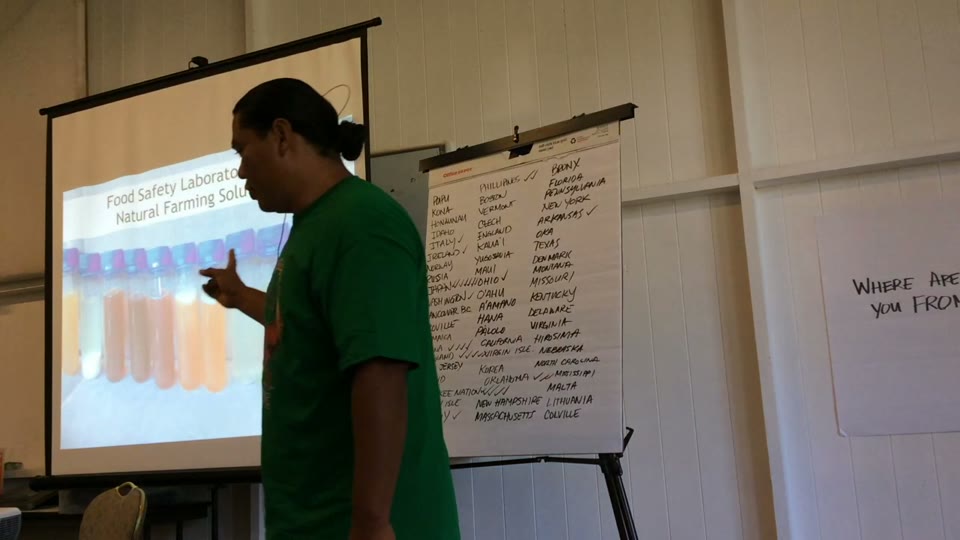
Joe McGinn's second slide deck, in English: 'Challenges and Breakthroughs: Growing a Natural Farming Network on Oʻahu, Hawaiʻi'. Slides read from the frames include Waikīkī in the 1920s and 2016, 'Hoon Park, MD, United Methodist Church, Honolulu, May 16-20, 2011', 'Cho Natural Farming Advanced Certification Course, Kohala, Makapala, July 12-16, 2011', 'Soil Test BEFORE + AFTER IMO#4, Dr. Koon-Hui Wang', 'Food Safety Laboratory Tests, Natural Farming Solutions', and 'Me ke aloha pau ʻole: The Love That Never Ends'. Drake hosts the Q&A. Cho doesn't speak.
- Protectors (LAB) from raw milk — Skim the cream off first; otherwise the LAB comes out too thick and the curd doesn't form properly. (Joe, spoken; no other quantities.)
- Weekly spray — Food (FPJ) and seawater on plants, soil and animals at least once a week, on a fixed schedule. Dilutions not given here. (Joe, spoken, citing Cho's 2016 Hawaiʻi training.)
- Rabbits (an audience member's practice) — Feed greens and weeds; add Protectors (LAB) and sometimes Medicine (OHN) to the drinking water. Mainland pellets can't really be fermented. (Audience, spoken.)
-
Korea gets one chance a year: if the crop fails, winter comes and there's no food
Hawaiʻi gets several tries. Joe's reason for studying Korean practice.
▶ 29:07 As spoken
-
Taro left in the field too long turns its starch to sugar and water
Buyers paid by weight, so farmers left it longer; the overripe taro runs through poi machines but won't pound by hand.
▶ 30:29 As spoken
-
Spray Reproduction (WCA) on taro for good starch
Joe: 'it's amazing'. No trial shown.
▶ 31:04 As spoken
-
Oʻahu grew from about 200,000 people in 1977 to over a million
Joe's own research, shown with Waikīkī in the 1920s (taro and rice) and 2016.
▶ 31:24 From the slides
-
Cho's previous advanced course was July 12-16, 2011, in Makapala, Kohala; about 50 people took it
Slide; Joe calls it 'six years ago'. His own start was Dr. Hoon Park's workshop, May 16-20, 2011.
▶ 32:50 From the slides
-
Apple snails cleaned pig-pen runoff before it reached the Waimea River on Kauaʻi
The pens tested positive for kukai but the river didn't; a trough between them was full of very large apple snails.
▶ 34:56 As spoken
-
Pablo built an odorless pig pen about two months after a two-day class
On Kauaʻi; he planned to take it back to the Philippines.
▶ 35:52 As spoken
-
UH CTAHR sent the solutions to a food-safety lab: most came back safe; only Protectors (LAB) showed coliform
Tested for E. coli, coliform and a third organism Joe couldn't recall. Both LAB samples showed warning levels. The raw-milk LAB was 'about 90% less', 'ten times lower', than the commercial-milk LAB, though that cow had mastitis. Mike DuPonte's explanation: unwashed udders contaminate commercial milk.
▶ 37:35 From the slides
-
For LAB from raw milk, skim the cream first
Otherwise it's almost too thick and the curd doesn't form.
▶ 39:28 As spoken
-
Joe reports Cho saying that in Hawaiʻi, with Food (FPJ) and seawater there's no reason not to succeed
From Cho's previous Hawaiʻi training (February of the year before, per the room). Joe: the biggest challenge is actually doing it.
▶ 40:28 As spoken
-
Spray plants, soil and animals once a week and you'll have success
Build a system and a schedule so the weekly spray doesn't get skipped.
▶ 41:14 As spoken
-
Natural farmers should charge a high price: price is artificial, costs are real
Undercutting other natural farmers hurts everyone; a fair, high price tells buyers the value.
▶ 41:39 As spoken
-
Grow crops that fit the place: kale is a cold-weather plant and struggles with whiteflies in Hawaiʻi
'Place appropriate and culturally relevant' was one of the network's breakthroughs.
▶ 43:50 As spoken
-
One shared batch of Medicine (OHN) per class, with a portion passed to the next class
Buying the ingredients new costs one person 'just under $1,000... probably like seven, almost $800'; spread over 10 people, Joe says 'about 40 bucks', one gallon each. (As spoken; $700-800 over 10 would be $70-80.)
▶ 47:46 As spoken
-
In farming you control only two things: genetics and feed
Good genetics (Steven Boloson's Moi kalo in Waialua) plus the feed, which is the natural farming solutions.
▶ 50:50 As spoken
-
Home processing of pigs avoids the USDA slaughterhouse, but the meat can't be sold
On Oʻahu the facility was shut down at least four times in the past year for disease. Own table, own knife, own microbes.
▶ 52:17 As spoken
-
Start a small family farm with chickens, not pigs
A small farm lacks the capital, land, labor and machinery for pigs. Start with broilers and layers; culls and eggs become protein for the pigs. Keep only as many pigs as you need to clean up after the chickens. Joe says Cho writes this in his book.
▶ 59:06 As spoken
-
Drake: Cho started people on pigs as 'a trick', because pigs make you grow the plants to feed them
Also: people use powdered milk for LAB because other milks have a higher market value.
▶ 1:00:30 As spoken
- This is Joe McGinn's experience and teaching, not Cho's; Cho doesn't speak in this part.
- The food-safety result is reported from a slide and memory; the third organism tested and the exact counts weren't given.
- Which pig pen did better in Mike DuPonte's trial can't be recovered: the recording says 'above the ground' for both.
- Joe also makes a few remarks about human health (poi and diabetes, children tasting the solutions, feeling better in the pig pen); these were not tested and we don't repeat them as advice.
- Put the weekly spray on a fixed schedule; skipped weeks are the commonest failure.
- If you make LAB from raw milk, skim the cream first.
- On a small farm, start with chickens; keep only as many pigs as you need to clean up after them.
- Grow crops that suit your place before fighting the climate.
- Share the costly solutions, like Medicine (OHN), across a class or a group.
Next to Master Cho's books
-
Goes further
Skim the cream before making LAB from raw milk Cho's book says the starch, protein and fat that float up after 5-7 days are removed and the yellow liquid kept. Skimming the cream first is Joe's own tip for raw milk.
Cho, Janong Natural Farming (2010 draft), p. 43
-
Goes further
Spray WCA on taro for good starch Cho uses WCA for the turn from vegetative to reproductive growth and for firm, sweet fruit. Using it on taro corms is Joe's application; the book doesn't name taro.
Cho, Janong Natural Farming (2003), p. 132
-
Unclear
In Hawaiʻi, FPJ plus seawater is enough to succeed Joe reports it from Cho's 2016 Hawaiʻi training. Cho's book treats seawater as an essential nutrient, but we found no line saying FPJ and seawater alone are enough.
Cho, Janong Natural Farming (2003), p. 142–143
-
Unclear
Start livestock with chickens Joe says Cho writes this. Cho's livestock book covers poultry and swine and a manure loop in which poultry feeds into the pigs, which fits Joe's plan, but we found no line telling beginners to start with chickens.
자연농업 양계·양돈·축산 (Natural Farming poultry, swine, livestock) (English translation), p. 40
“This is my proof that natural farming works. These are my three keiki.”
▶ 29:27
“Remember one thing, price is artificial. Costs are real.”
▶ 41:39
“Rather than focus on the products, focus on the people. We need to grow more farmers.”
▶ 45:10
“In life and in farming we only have control over two things: that's genetics and feed.”
▶ 50:50
In this part
- 27:43Beyond making solutions: Korea and Hawaiʻi
- 29:46Kalo, poi and what Oʻahu lost
- 32:10Dr. Hoon Park, the 2011 Kohala class, Kim Chang and Mike DuPonte
- 34:50Pablo, apple snails and the odorless pig pen
- 36:53Soil tests and the food safety lab
- 39:58Challenges: doing it, selling it, making it pay
- 43:28Breakthroughs: place-appropriate crops, farming farmers
- 46:25Family classes and shared Medicine (OHN)
- 48:46Chefs, pigs and home processing
- 54:30Me ke aloha pau ʻole; sign-up sheet
- 55:32Q&A: pigs, chickens and rabbits
- 1:00:04Drake: powdered milk, and why Cho started us on pigs
Transcript
Transcribed and checked by hand against the recording.
27:43 Joe McGinn: You guys want to see some pictures real quick?
27:46 Audience: Yeah.
27:47 Joe McGinn: So one of the things we're trying to do is move beyond input making. I'll introduce you to the rest of the guys in the class later on. You'll probably see the pictures in here. It's about time we get beyond inputs. I think inputs is just the first stage we got to start doing. But we've also run into some challenges when it came to, okay, so what's next? We made all these things, what do we do? So let's share just a little bit about this. So Korea, where Korea is in comparison to Hawaii, we're kind of far from Korea. There are some similarities though between the two cultures of the places.
28:33 Korea has a really strong cultural heritage, actually a really strong agriculture heritage in terms of farming. very similar to Hawaii. Hawaii is surrounded by water, we're on islands. Korea is surrounded by water on three sides, so some similar things there happening. But in terms of where we're at, in terms of north and south, Korea is kind of up here, so they have winters, the snows. Hawaii, we're a little bit down here, we have a warmer climate, the snows. Hawaiʻi, we're a little bit down here, we have a warmer climate,
29:07 One chance. If your crop doesn't grow well, winter comes. Guess what? You die. No food. So you gotta get them right. Here in Hawaii, stuff doesn't grow well. Let me try again. So, looking at Korea, you gotta get it right to survive. So that's one reason I've been really interested in the farming practices in Korea. This is my proof that natural farming works. These are my three keiki. I have one more. one girl who was actually born on Master Cho's birthday this past February 14th Master Cho is a Valentine's baby and so is my daughter and actually both of them are Year of the Rooster as well.
29:46 I have some kalo that my keiki have been growing. They absolutely love kalo for us. I realized that if I wanted to feed my children kalo, I couldn't afford to buy it at over three sometimes four dollars a pound so and even the stuff that they were selling it wasn't that good anyway. So growing kalo with natural farming has been a passion of mine. And also getting back to the traditional ways of preparing kalo. So what you see here is a traditional way of preparing poi, where the kalo is actually mashed on a board and stoned. The commercial industry did horrible things to taro
30:23 because they were buying taro from taro farmers based upon weight. So what taro farmers would do is let the crop sit in the field longer than it should have, those healthy starches converts to sugar, converts to water, which means more weight, and it'll get easier to run through the poi machines. So this poi that they make in the machines
That's the first few minutes. Members read all 539 lines, with the Korean as spoken, and watch along.
Become a member