Same Rice Seed, 180–240 Grains vs 80–140: Crop Results
Master Cho Han-kyu, interpreted by Kim Chang, Founder of Korean Natural Farming (Janong)
Master Cho spoke Korean, with an interpreter. We translated every Korean line again and checked it, so you read what he said, not only what the room heard.
Members watch every session
The whole seminar, as it happened, with the checked English beside the video. Membership is $60 a year.
This part runs from 2:21:07 to 2:44:27 of the session video.
Cho's results slides: conventional rice at harvest looks like orphanage children, natural-farming rice like children raised by both parents; the same seed gives 180–240 grains a panicle against 80–140, about 30% more yield at a 50% better price. Then the stories behind the photos (cooked rice, Amore cosmetics, a melon farmer caught using agrochemicals, Ehime lemon leaves at $1 each) and crops fed at each 'morning sickness': pepper, beans, broccoli, cauliflower, corn and strawberries. Lunch follows.
What he taught
What does a crop fed on time, with fewer seeds and no chemicals, give back?
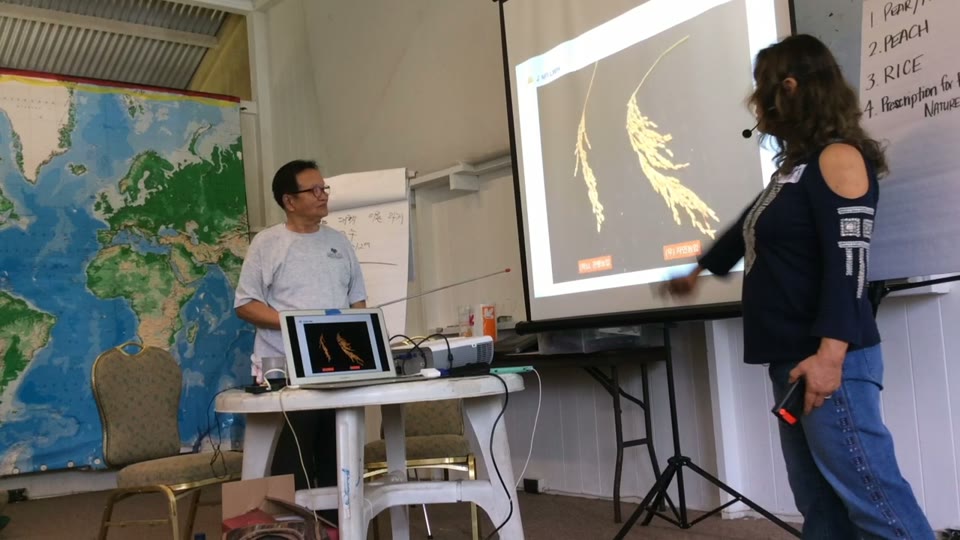
Cho comments from his chair and with the pointer while the interpreter runs his slide deck of paired photos: rice at harvest, two panicles from the same seed, cooked rice in jars, then pepper, beans, broccoli, a man holding a huge cauliflower, corn, Indonesian rice and strawberries. The board behind lists the four handouts. Strawberries are handed round at the end.
- Feeding at each 'morning sickness' (results slides) — Cho: chili pepper was fed 'before pregnancy'; the interpreter named water-soluble calcium phosphate, Structure (WCP), before flowering. Beans, broccoli and strawberries go through morning sickness five times and are fed at each. No dilutions spoken; the changeover column of the handout gives WCP 1:1,000 with OHN 1:1,000 and the rest.
-
At harvest, conventional rice has dead, dry leaves, like orphanage children; natural-farming rice is raised by both parents
Harvest slide.
▶ 2:21:12 From the slides
-
Same seed: natural farming 180–240 grains a panicle, conventional 80–140
Slide of two panicles. The interpreter first guessed 200–260, then gave Cho's 180–240.
▶ 2:25:01 From the slides
-
Conventional rice was planted 8–12 a hill, natural farming 2–3
The same pair of plantings shown before the break; there Cho said 8 to 12 seeds a hill, here only 'planted 8 to 12'.
▶ 2:25:34 As spoken
-
Greedy conventional farming gives less harvest and costs more; natural farming costs less, takes less work and yields more
Cho frames it with James 1:15: desire conceives sin, and sin brings death.
▶ 2:26:30 As spoken
-
Natural farming yields about 30% more than conventional
The interpreter added a soybean trial at 'exactly 30%', not in Cho's captured Korean.
▶ 2:27:09 As spoken
-
Natural-farming rice sells for 50% more than conventional
Interpreter: with lower costs, 'about 80%' more profit.
▶ 2:27:36 As spoken
-
A Korean grape farmer kept about $30,000 income but profit rose from $3,000–5,000 to over $25,000 after switching
The interpreter's own story ('let's say $30,000'); no Korean original.
▶ 2:28:39 As spoken
-
Cooked rice left out: conventional rotted, natural-farming rice grew microbes and mushrooms
Slide of cooked rice; the test was done by Amore, Korea's largest cosmetics company.
▶ 2:30:00 From the slides
-
Amore makes cosmetics with natural-farming rice and contracted a natural-farming melon grower for the fragrance
▶ 2:31:26 As spoken
-
Cho smelled agrochemicals on the contract melon farm and told Amore not to take the melons
The husband had used them, the wife hadn't; they couldn't sell the melons.
▶ 2:32:23 As spoken
-
In Ehime, Japan's only chemical-free lemon grower sells leaves to Shiseido at $1 a leaf
Shiseido harvests the leaves itself and blocks other companies from buying.
▶ 2:34:53 As spoken
-
Chili pepper fed before 'pregnancy' (before flowering) set heavy fruit
Interpreter: water-soluble calcium phosphate before flowering.
▶ 2:36:58 From the slides
-
Beans go through morning sickness five times; each time fed, pods set
Cho: two bean seeds were planted; the interpreter said one.
▶ 2:37:55 From the slides
-
Broccoli: 2–3 per plant normally in Korea or Japan; 12–15 when fed at each of its five morning sicknesses
The interpreter said 1–3 and 10–15.
▶ 2:38:33 As spoken
-
Natural-farming cauliflower about 8 kg against about 500 g normal
Interpreter's figures on a slide of a man holding a huge cauliflower; a Tokyo hotel ordered it.
▶ 2:39:58 From the slides
-
Corn: 2–3 ears a stalk normally, 13–15 with natural farming
The interpreter said 10–15.
▶ 2:41:24 As spoken
-
In Indonesia, the natural-farming rice panicle grows much longer
Cho's Korean over this slide is unreadable.
▶ 2:42:29 From the slides
-
Strawberries also go through morning sickness five times; Hawaiʻi's strawberries are 'leather'
Interpreter: one sells for $2.50 (per berry or per pack not clear).
▶ 2:42:56 As spoken
- These are slides and Cho's figures; no trial design, plot sizes or measurements were shown.
- The 30% yield and 50% price are Cho's general figures; the soybean trial and the grape farmer are the interpreter's own additions.
- The cauliflower weights and the $2.50 strawberry are the interpreter's figures only.
- The Ehime grower's name was heard as Izumi-san; Izumi Seiichi is our guess from Cho's Japanese book.
- Cho's Korean over the Indonesia rice slide is unreadable.
- Know your crop's flowering times and feed Structure (WCP) just before each one.
- Fewer seedlings per hill can carry more grains per panicle.
- Lower costs count as much as yield when you judge a method.
- Grow the good food yourself rather than paying hotel prices for it.
What the room didn't hear
Where the English in the room left out or changed what Master Cho said in Korean.
-
▶ 2:39:28
The room heard Usually, normally they harvest one to three. After all those treatments, they harvest 10 to 15.
Cho said From one plant that would only give 2 or 3, you get 12 to 15.
Both ends of Cho's broccoli numbers were changed.
-
▶ 2:41:49
The room heard that way you can harvest ten to fifteen ears.
Cho said Look at natural farming: on one stalk it's 13 to 15.
Cho said 13–15 ears, as he does elsewhere.
-
▶ 2:37:49
The room heard Anyway, this is only from one seed.
Cho said Here, two bean seeds were planted.
The seed count was changed.
-
▶ 2:32:36
The room heard and he went to check, they put a chemical fertilizer in there
Cho said When I went and looked, they had used agrochemicals. I smelled it and they had definitely used them.
Agrochemicals (농약), not fertilizer, and Cho caught it by smell.
-
▶ 2:27:31
The room heard And we did try with the soybean, exactly 30% more.
Cho said Compared with conventional farming it yields 30% more.
No soybean trial in Cho's captured Korean; the interpreter added it.
Next to Master Cho's books
-
Agrees
Feed water-soluble calcium phosphate before flowering ('morning sickness') His posters say plants have morning sickness just before flower-bud formation and must be fed about a week before.
CGNF posters (Korean) (English translation), p. 3
-
Agrees
Broccoli 2–3 → 12–15 per plant In 2018 Cho gives the same numbers. The interpreter's 10–15 here is her rounding.
2018/Cho - advanced hawaii/cho advanced 2018 2-3 @ 1:52:05 (translated)
-
Agrees
Corn 2–3 → 13–15 ears per stalk His Papaikou talk the same week gives 2–3 conventional against 13–15 natural farming.
2017/Cho - Papaikou/IMG_9605 @ 0:00:00 (translated)
-
Goes further
Ehime lemon grower farming without chemicals Cho's Japanese FPJ book profiles lemon grower Izumi Seiichi of Nakajima, Ehime; the Shiseido $1-a-leaf deal isn't in the book.
FPJ book (Japanese) (English translation), p. 9
“These are children taught with past-tense theory, and these are children taught by future-tense nature.”
▶ 2:22:42
“This one was raised in an orphanage, and this one was raised in a family home.”
▶ 2:24:15
“Don't go to a Tokyo hotel and eat it somewhere expensive. Make it on your own farm and eat the expensive stuff yourselves.”
▶ 2:40:35
“Hawaiʻi's strawberries aren't strawberries. They're leather.”
▶ 2:43:02
In this part
- 2:21:07Harvest: orphanage rice vs rice with parents
- 2:24:15Same seed: grains per panicle
- 2:26:04Greed, 30% more yield, 50% higher price
- 2:28:38A grape farmer's profit (the interpreter's story)
- 2:29:37Cooked rice test and Amore cosmetics
- 2:32:14The melon farmer who used agrochemicals
- 2:33:56Ehime lemon leaves for Shiseido
- 2:36:51Morning sickness results: pepper, bean, broccoli, cauliflower
- 2:41:03Corn ears, Indonesian rice, Hawaiʻi strawberries
- 2:43:56Lunch break
Transcript
English translation, checked against the Korean as spoken.
2:21:07 Kim Chang (interpreter): Next. Next video?
2:21:11 Master Cho: The harvest. The reason this rice looks like this now is these leaves are all dead, see. What that is,
수확하는 거. 지금 이 벼가 이렇게 된 것은 이런 이파리가 다 죽었잖아. 그게 뭐냐면
2:21:22 Kim Chang (interpreter): If you look at the conventional side, there's lots of dry leaves.
2:21:23 Master Cho: It's like the children in an orphanage.
고아원의 아이들, 아이들 같은 거야.
2:21:29 Kim Chang (interpreter): It's like an orphanage, this side. So it's an orphanage, children's situation looks like that.
2:21:38 Master Cho: So it's the lot of babies in an orphanage. Here, this one has both parents, dad and mom, alive and healthy, and
그래서 고아원에 [있는] 아기들 신세인 거예요. 여기 이거는 양부모, 아빠 엄마가 다 건강하게 살아 계시면서
2:21:58 Kim Chang (interpreter): So in natural farming, there's a mom and dad, and then they raise children with lots of love until they mature. That's the natural farming field. Do you have any feeling when you look at these two crops? How they are raised? Do you have any feeling? What kind of feeling do you have?
2:22:25 Audience: Sad.
2:22:29 Kim Chang (interpreter): [Relaying to Cho:] They say looking at the orphanage child makes them so sad.
고아원에 있는 애를 보니까 너무 슬프대요.
2:22:34 Master Cho: These are children taught with past-tense theory,
과거형 이론으로 가르친 아이들이고,
2:22:37 Kim Chang (interpreter): So these children, they use past, they taught the children that way, and these side children,
2:22:42 Master Cho: and these are children taught by future-tense nature.
이거는 미래형 자연으로 가르치는 아이들이고.
2:22:56 Kim Chang (interpreter): they use the future, looking at the future and then taught them. That's why they are so different. The future is bright. That's right.
2:23:10 Audience: Where can we buy that kind of rice? Rice.
2:23:22 Kim Chang (interpreter): Buy in Hawaii. So he meant he'd been growing in Hawaii.
2:23:29 Audience: Yeah, rice grows in Hawaii. They used to grow rice. So grow CGNF Hawaii rice! Stand up so we know who you are. Yay!
2:24:03 Kim Chang (interpreter): So this is the conventional, the orphanage rice, and that one is the natural farming, grown
That's the first few minutes. Members read all 259 lines, with the Korean as spoken, and watch along.
Become a member