Ōinoue's Theory, Cho's Chart: Where the Cycle Came From
Master Cho Han-kyu, interpreted by Kim Chang, Founder of Korean Natural Farming (Janong)
Master Cho spoke Korean, with an interpreter. We translated every Korean line again and checked it, so you read what he said, not only what the room heard.
Members watch every session
The whole seminar, as it happened, with the checked English beside the video. Membership is $60 a year.
This part runs from 43:10 to 58:54 of the session video. Keep watching and the next part plays on.
Now playing the next part: Seed Milk, Not Cow's Milk: The Seed Soak and Weaning Feed
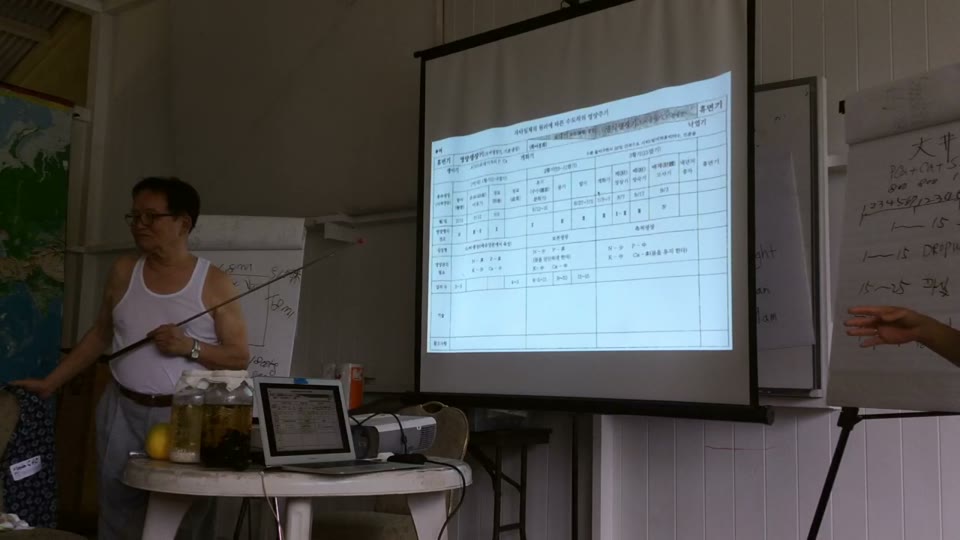
With the rice chart back on the screen, Cho says every crop has a life, and rice's starts with sprouting on February 12. After a stretch break he credits the nutritive cycle to Ōinoue Yasushi, who bred the Kyoho grape, tells his own story of Ōinoue's persecution and death, of learning from the widow and son, and of refusing to be the successor. The chart itself is Cho's, and he asks Hawaiʻi to fit its own crops into it, with Joe McGinn leading.
What he taught
Whose theory is the nutritive cycle, and what does Cho want Hawaiʻi to do with it?
The projector is now up with the rice chart (photo DJSS5255). After a short stretch break and roll call led by the interpreter, Cho tells the history standing by the screen. The flip chart behind him carries '大井上康' and '新栽培技術の理論体系' (frames around 54:00). Someone in the room reads the book title from the Japanese; an audience member brings up a book Cho signed earlier.
-
Every crop has a life of its own: papaya, mango, banana and coffee as much as rice
Cho: even if you don't grow rice, the projected chart shows how to read any crop's life.
▶ 43:22 As spoken
-
Rice is sprouted around February 12
The projected chart (DJSS5255) has 발아 (sprouting) at 2/12. The interpreter didn't give the date here.
▶ 43:40 From the slides
-
The nutritive cycle theory is Ōinoue Yasushi's, the man who made the Kyoho grape
Cho names him (오이노우에 야스시) and the Kyoho (거봉) grape; the interpreter said only 'a teacher in Japan… a giant grape'.
▶ 46:21 As spoken
-
Cho's story: Japanese professors had Ōinoue branded a thought criminal, and he died in prison. The record differs
Cho's word is 사상범 (thought criminal); 'communist' came from someone in the room. Japanese sources have Ōinoue sidelined as heterodox and dying on 23 September 1952; no arrest or prison has been found. See cho_check.
▶ 48:01 As spoken
-
Cho learned the theory from Ōinoue's widow, and later his son, after Ōinoue had died
He visited the house after Ōinoue's death; at 55:38 he says he studied under the son and the mother.
▶ 48:38 As spoken
-
Cho was named Ōinoue's successor and refused
'If you become the successor, the responsibility is enormous… I wanted to be free.' Now he spreads the theory worldwide and lectures on it in Japan; even the family can't.
▶ 49:26 As spoken
-
Civil servants who attended Ōinoue's lectures were dismissed, by Cho's account
Cho: that's how much the Japanese professors refused his theory.
▶ 50:32 As spoken
-
Ōinoue's book: The Theoretical System of New Cultivation Technology (新栽培技術の理論体系)
Cho: one book, tremendously difficult. Read it if you want to farm properly; understand it and you'll see the present system is all wrong.
▶ 52:30 As spoken
-
The theory is Ōinoue's; turning it into this chart was Cho's own work
Ōinoue's disciples in Japan resented Cho, asking how come they never made the chart themselves. 'This nutritive cycle theory isn't mine.'
▶ 56:03 As spoken
-
Fit Hawaiʻi's climate into this chart and it becomes Hawaiʻi's way of farming
Cho names Joe McGinn to do it, someone (name unclear) to assist and Steve to pull the group along. 'It takes Americans to see it right away.'
▶ 57:30 As spoken
- Ōinoue 'died in prison' is Cho's story. Japanese sources show a scientist sidelined as heterodox who died on 23 September 1952; no arrest or imprisonment has been found.
- The dismissal of civil servants and the successor offer are Cho's accounts, not checked here. Whether the family or Ōinoue's followers named him successor isn't clear in the audio.
- Cho says the son is 'the same age as me'; one transcript hears the opposite. Not settled.
- The name of the second helper Cho names after Joe McGinn can't be made out.
- The nutritive cycle comes from Ōinoue Yasushi; the chart that lays it out by date and stage is Cho's.
- A chart from Korea is a starting point. Hawaiʻi farmers are asked to fit their own crops and climate into it.
What the room didn't hear
Where the English in the room left out or changed what Master Cho said in Korean.
-
▶ 43:40
The room heard So, this is the life cycle of the rice.
Cho said For example, in the case of rice, it's sprouted around February 12.
The first date on the chart was dropped here (given later, at 59:25).
-
▶ 46:21
The room heard So in Japan, there's a teacher. He developed a giant grape.
Cho said The man behind this theory is in Japan, Ōinoue Yasushi: the man who made the Kyoho grape made this theory.
The room never heard the name of the man the theory comes from.
-
▶ 48:01
The room heard Oh, they accused him like a communist, something like that.
Cho said He was branded a thought criminal (사상범) and died serving time in prison.
'Communist' came from someone in the audience, not from Cho. The prison part is Cho's story; the record differs.
-
▶ 56:15
The room heard So, he had a mentor in Japan and they saw what he developed. They were surprised, but they also had a jealousy.
Cho said When I made this chart and used it, Ōinoue's disciples in Japan asked how come they never made it, and actually resented me.
Who was jealous, and of what (the chart), got blurred.
-
▶ 57:06
The room heard My teacher… I cannot read this one. Yeah, my teacher developed it.
Cho said This nutritive cycle theory isn't mine. Ōinoue Yasushi made it.
The interpreter couldn't read the name and dropped it.
-
▶ 58:06
The room heard You help it. And then Steve, you hold their hand and then pull them.
Cho said Fit it into this chart and it becomes Hawaiʻi's way of farming. That is for Joe McGinn to do; [someone] assists, and Steve pulls them along.
Cho named Joe McGinn to lead the Hawaiʻi chart; the room didn't hear it.
Next to Master Cho's books
-
Differs
Ōinoue jailed as a thought criminal and died in prison Cho told the same prison story from about 2010 to 2018, but the Japanese record shows a scientist sidelined as heterodox who died on 23 September 1952, with no arrest or prison found.
01-the-scientist — Two accounts of the end
-
Agrees
Ōinoue's book and the Kyoho grape The book Cho names is Ōinoue's 『新栽培技術の理論體系』; Ōinoue bred and named the Kyoho grape.
appendix-e-bibliography — Ōinoue Yasushi Yasushi (大井上康)
-
Agrees
Cho learned from the widow, after Ōinoue's death Cho never studied under Ōinoue himself; he came to the house more than a decade after the death and told it this way in 2017 and 2018.
01-the-scientist — Cho in the study
“With this material, if you doze off even a little while listening, you won't follow what comes next.”
▶ 46:01
“I wanted to be free, so I refused to be the successor.”
▶ 49:44
“So this nutritive cycle theory isn't mine. Ōinoue Yasushi made it.”
▶ 57:06
In this part
Transcript
English translation, checked against the Korean as spoken.
43:13 Master Cho: This is the life of the rice plant. So even if you don't grow rice, papaya, mango, banana, and coffee too, they have a life too, a whole life. For example, in the case of rice, it's sprouted around February 12.
이건 벼의 일생이에요. 그러니까 여러분들이 벼농사를 안 짓는다 하더라도 파파야나, 망고나, 바나나나, 거기다 커피나 그것도 일생이 있잖아요, 일생이. 예를 들어서 벼의 경우에는 발아시키는 게 2월 12일경에 발아시킨다고.
43:45 Kim Chang (interpreter): So, this is the life cycle of the rice. But even banana, papaya, or other crops, they have their own life cycle. So this one is rice plant's life cycle. But each plant has their own life cycle. Just take a breath here. Stretch, stretch. You're all ready to go.
44:32 We are ready to continue our class. Please come back. Hey, booyah!
45:17 Is everyone here? No? Check your neighbor. Good job. Oh, there he is. The Chinese sister. She's here? What? What's that? Okay, hurry up, come on! Looks like everyone's here now. They carried it in from outside; they're coming in now.
다 온 것 같아요 이제. 저 바깥에서 들고 왔잖아요. 지금 들어오는데요.
46:00 Master Cho: With this material, if you doze off even a little while listening, you won't follow what comes next.
여기 내용은 듣다가 조금만 졸아도 다음을 모르는 거예요.
46:01 Kim Chang (interpreter): So when I explain this life cycle, you cannot fall asleep, you are going to miss out.
That's the first few minutes. Members read all 128 lines, with the Korean as spoken, and watch along.
Become a member