Seed Milk, Not Cow's Milk: The Seed Soak and Weaning Feed
Master Cho Han-kyu, interpreted by Kim Chang, Founder of Korean Natural Farming (Janong)
Master Cho spoke Korean, with an interpreter. We translated every Korean line again and checked it, so you read what he said, not only what the room heard.
Members watch every session
The whole seminar, as it happened, with the checked English beside the video. Membership is $60 a year.
This part runs from 58:54 to 1:24:33 of the session video. Keep watching and the next part plays on.
Now playing the next part: Send a Dowry at Transplant, Then Read the 180-Day Chart
Cho walks the first stages of the rice chart: sprouting February 12, weaning March 12. A seed grows on its own seed milk, so base fertilizer is like raising a baby on cow's milk; raise seedlings in poor soil. When the milk runs out, start feeding, beginning with Fuel (FAA). Then he puts up the prescription handout and the seed soak and Type 2 columns are read out, with two errors in the English copy caught; Dr. Park ends on the Mineral products and clay jars.
What he taught
What does a seedling live on before you feed it, and what goes into the seed soak and the first feeding?
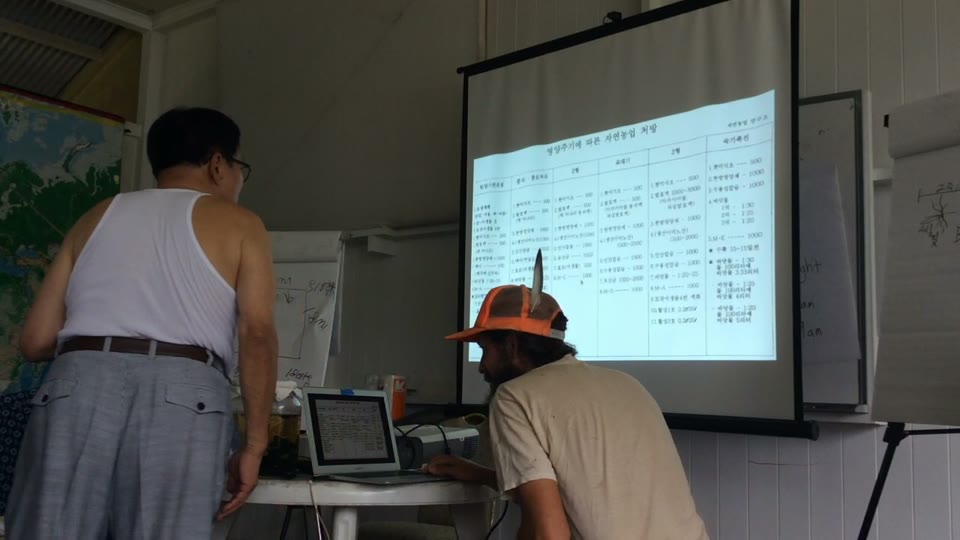
The rice chart (DJSS5255) is projected. At about 1:00:50 Cho draws a rice seed on the flip chart, the germ (씨눈) and the seed milk (씨젖). At about 1:09:30 he writes at March 12 on the flip chart: '? + FAA + FPJ + PCa + OHN (mugwort, watercress)', the first term overwritten. From about 1:14:15 the Korean prescription handout (XFLH5606) is projected and the interpreter reads the seed and seedling column and the Type 2 column aloud; the first column (soil foundation) is not read. Every number read out matches the photo of the handout.
- Seed and seedling treatment (종자·종묘처리), soak then plant — Read aloud by the interpreter off the handout; all match the photo: 1) brown rice vinegar (Cleanser, BRV) 1:500; 2) Food (FPJ) of mugwort or water dropwort 1:500; 3) Medicine (OHN) 1:1000; 4) Fuel (FAA) 1:1000, in parentheses on the handout; 5) Structure (WCP) 1:1000; 6) malt (맥아, 엿질금) 1:500, read out only as 'Mega'; 7) yeast (효모, 미생물) 1:500; 8) seawater 1:20–25; 9) Mineral A 1:1000. Cho: soak the seed in it, then plant. No soak time is given on tape.
- Weaning feed (rice, March 12; flip chart) — Cho, in Korean only: when the seed milk runs out, start feeding; in Natural Farming you give amino acid, Fuel (FAA). The board lists '? + FAA + FPJ + PCa + OHN (mugwort, watercress)'. No rates; Cho then says to give nutrients close to Type 2.
- Type 2 (2형), vegetative growth — Read aloud off the handout; all match the photo: 1) BRV 1:500; 2) Food (FPJ) 1:500 of mugwort, water dropwort, or 동자액 (juice of young green fruit); 3) OHN 1:1000; 4) (FAA) 1:1000; 5) WCP 1:1000; 6) Protectors (LAB) 1:1000; 7) yeast 1:500; 8) Mineral C 1:1000. The English handout printed item 6 as 'malt'; it is LAB. Cho: 'I'll explain this again later, so just take it as written here.'
-
In Hawaiʻi you can grow rice twice a year; this chart follows Korean weather
Cho's opening caution before reading the dates.
▶ 59:07 As spoken
-
Rice: sown and sprouting February 12; young seedling and weaning March 12, a month later
Chart: 발아 2/12 (type VI, 2–3 leaves); 유묘·이유기 3/12 (type III–II). Cho compares March 12 to a baby coming off the breast.
▶ 59:25 From the slides
-
A seed has a germ (씨눈) and seed milk (씨젖); every living thing grows on its seed milk first
Drawn on the flip chart. 'Until it can carry on its own hard life, it is made to grow on this seed milk.'
▶ 1:00:49 Written on the board
-
Base fertilizer under a seed is like raising a baby on cow's milk instead of its mother's
The seedling grows big and fat but 'can't run, it huffs and puffs': its vitality drops. Build its ability on the seed milk first, then fertilize.
▶ 1:03:26 As spoken
-
Give no fertilizer at the sprouting stage
The interpreter's summary of Cho's point. Fertilized early, the body grows big but 'puffed up with water'.
▶ 1:05:00 As spoken
-
Raise tomato, paprika, bell pepper and papaya seedlings in poor soil, not fertile soil
Poor soil makes the life force strong. Korean proverb: 'Hardship in youth is worth buying.'
▶ 1:06:25 As spoken
-
When the seed milk runs out (weaning, March 12 for rice), start feeding, with Fuel (FAA)
Never interpreted. Cho: 'Now that the mother's milk has run out, this is when you have to give fertilizer… in Natural Farming we give amino acid… F-A-A.'
▶ 1:09:46 As spoken
-
Seed treatment keeps the sprouting seed from tearing and makes up any loss right away
Cho compares a sprouting seed to a birth. 'If you do it by the prescription, there's no tearing when the seed sprouts.'
▶ 1:12:40 As spoken
-
Seed soak: BRV 1:500, FPJ 1:500, OHN 1:1000, (FAA) 1:1000, WCP 1:1000, malt 1:500, yeast 1:500, seawater 1:20–25, Mineral A 1:1000
Handout column 종자·종묘처리, read aloud and checked against the photo. Soak the seed, then plant.
▶ 1:14:42 From the handout
-
The prescription came to Cho in a dream, after the Japanese asked him for one
He woke, wrote it down, and was startled himself. 'If you just use it exactly as written, you won't make mistakes.'
▶ 1:16:42 As spoken
-
At weaning, give nutrients close to Type 2
Rice chart: III–II at 3/12, II at 5/5. Type 2 is vegetative growth.
▶ 1:18:44 As spoken
-
Type 2: BRV 1:500, FPJ 1:500, OHN 1:1000, (FAA) 1:1000, WCP 1:1000, LAB 1:1000, yeast 1:500, Mineral C 1:1000
Read aloud and checked against the handout photo. Item 6 is LAB, not malt as the English copy said.
▶ 1:20:17 From the handout
-
Seawater does not replace the Mineral products (Mineral A, C, D, E): 'seawater is seawater, and mineral is mineral'
Asked whether ocean water can stand in for Mineral C. Only Cho's institutes in Japan and Korea make the Mineral products; if Natural Farming takes off in Hawaiʻi, he'll make them here.
▶ 1:21:48 As spoken
- Two errors in the overnight English handout: it calls 쑥 'wormwood' (it is mugwort; Drake corrected it aloud at 1:16:05), and its Type 2 item 6 says 'malt' (it is LAB 1:1000; malt belongs only in the seed treatment column).
- The interpreter and the board call 미나리 'watercress'; it is water dropwort.
- No soak time is given on tape. Cho's books give times by seed (rice about 7 hours); see cho_check.
- FAA sits in parentheses on the handout in both columns; why is not explained on this page.
- The first term of the weaning list on the flip chart is overwritten and can't be read (probably BRV).
- The dream origin of the prescription is Cho's own account.
- Cho compares sprouting to childbirth, says care before a birth makes delivery easy, and says babies raised on formula get sick in old age. Those are claims about people, not tested, and we don't repeat them as advice.
- Dr. Park's prices ($20 a bottle) and dates are 2017 arrangements.
- Let the seedling live on its own seed milk; skip fertilizer at sprouting.
- Raise seedlings in lean soil so they come up strong.
- Soak seed in the seed treatment solution before planting.
- When the seed milk runs out, start feeding: Fuel (FAA) first, then the Type 2 prescription.
- Seawater and the Mineral products are not the same thing.
What the room didn't hear
Where the English in the room left out or changed what Master Cho said in Korean.
-
▶ 1:06:25
The room heard So this is another reason we don't use very nutrient soil when we are planting the seed.
Cho said When you raise seedlings of tomatoes, paprika, bell peppers, papaya and so on, don't raise them in fertile soil. Raise them in poor soil, and their life force gets strong.
The crops Cho named and his reason were dropped.
-
▶ 1:09:46
Cho said At this point the mother's milk has run out. This is weaning. Now is when you have to give fertilizer, and in Natural Farming we give amino acid: F-A-A.
The first feeding, Fuel (FAA) at weaning, was never put into English.
-
▶ 1:15:20
The room heard Mega. Well, that's my translation. Be careful. 500. Maybe.
Cho said 맥아 (malt, barley malt) 1:500.
Item 6 of the seed soak is malt; the room heard only the Korean word.
Next to Master Cho's books
-
Goes further
Seed treatment formula His 2003 book gives a shorter seed soak (FPJ 500, BRV 500, OHN 1000, Mineral A 1000, FAA if weak) with soak times by seed, rice about 7 hours. The 2017 handout adds WCP, malt, yeast and seawater.
Cho, Janong Natural Farming (2003), p. 155–156
-
Agrees
No fertilizer while the seed feeds on its own reserves His 2005 text: the early stage runs on nutrients stored in the seed, which form the roots, leaves and stems.
CGNF Advanced (2005.08) (English translation), p. 26
-
Agrees
Weaning marks the switch to outside nutrition His rice theory: the seedling enters independent nutrition after weaning from the seed's stored nutrients.
CGNF Fruit Tree Textbook (English translation), p. 25
“In human terms, it should grow up on its mother's milk, but they raised it on cow's milk.”
▶ 1:03:26
“Don't raise them in fertile soil. Raise them in poor soil, and their life force gets strong.”
▶ 1:06:25
“If you just use it exactly as written, you won't make mistakes.”
▶ 1:18:05
“Seawater is seawater, and mineral is mineral.”
▶ 1:21:48
In this part
- 58:54Rice twice a year here; sprouting Feb 12, weaning Mar 12
- 1:00:49The seed's own milk
- 1:03:11Cow's milk under the seed
- 1:06:25Raise seedlings in poor soil
- 1:07:52Weaning: the milk runs out, give Fuel (FAA)
- 1:11:20Sprouting tears the seed open: why seed treatment
- 1:14:04The seed soak, off the handout
- 1:16:18A prescription from a dream
- 1:18:37Type 2 at weaning, and an error in the English copy
- 1:21:37Seawater is not a Mineral product; Dr. Park on clay jars
Transcript
English translation, checked against the Korean as spoken.
58:54 Master Cho: So you take the rice and sow this seed, the seed. But in Hawaii you can grow rice twice a year.
그래서 그 벼를 갖다가 이 씨를 [뿌리잖아], 씨를. 그런데 하와이는 벼농사 짓는 건 두 번 짓지.
59:07 Kim Chang (interpreter): So in Hawaii, I'm looking at it with your weather, You can harvest two times. You can plant two times.
59:18 Master Cho: This is according to Korean weather.
이것은 한국의 날씨에 따라서입니다.
59:24 Kim Chang (interpreter): So when we plant and then sprout young baby, that's February 12th.
59:24 Master Cho: So the rice seed is sown, and it sprouts on February 12.
그래서 볍씨를 뿌려가지고서 발아할 때가 2월 12일이야.
59:39 Kim Chang (interpreter): So when they start to grow, it became a baby seedling in March, about one month later.
59:39 Master Cho: Then from sprouting it grows into a young seedling,
그런데 이것이 이제 발아에서 자라는 유묘, 어린 모가
59:52 Kim Chang (interpreter): So that time, if I compare to the human baby, you can stop milking them.
59:53 Master Cho: and it reaches the weaning stage, when it comes off the milk.
이유기가 된다고, 젖 떨어질 때가.
1:00:06 Kim Chang (interpreter): And people will stop eating their meal. Director, you mean up to here it grows on the nutrition in the seed?
원장님, 여기까지는 씨에 있는 영양으로 [자란다는] 소리예요?
1:00:49 Master Cho: You plant a rice seed like this. This part is the [germ, the embryo]. And this part of the seed is the [seed milk]. It's the same as the mother's breast milk. This little one is the baby's life force.
이런 볍씨를 심어서, 심어가지고서, 이게 그냥 [씨눈, 배]야. 이 씨는 그 [씨젖]이죠. 엄마의 모유나 마찬가지야. 요거는 애기 생명력이 [있는 데야].
1:01:16 Kim Chang (interpreter): If you look at this rice seed, there's two parts. There's a little corner, very small area, that's seed... seedling. Not the seedling. Where the life of the seed is coming from, and this part is like the milk of the seed. You know, when you look at, observe your seed, the rice, there's a little tiny thing on top and then there's a body. So the big body is the milk of the seed, and the top little thing is giving the life to the seed.
That's the first few minutes. Members read all 217 lines, with the Korean as spoken, and watch along.
Become a member