Seawater + Calcium Weekly = Skin Bees Can't Break
Master Cho Han-kyu, interpreted by Kim Chang, Founder of Korean Natural Farming (Janong)
Master Cho spoke Korean, with an interpreter. We translated every Korean line again and checked it, so you read what he said, not only what the room heard.
Members watch every session
The whole seminar, as it happened, with the checked English beside the video. Membership is $60 a year.
This part runs from 0:00 to 21:54 of the session video. Keep watching and the next part plays on.
Now playing the next part: Baby Food by Age: Mugwort FPJ First, Fruit FFJ Later
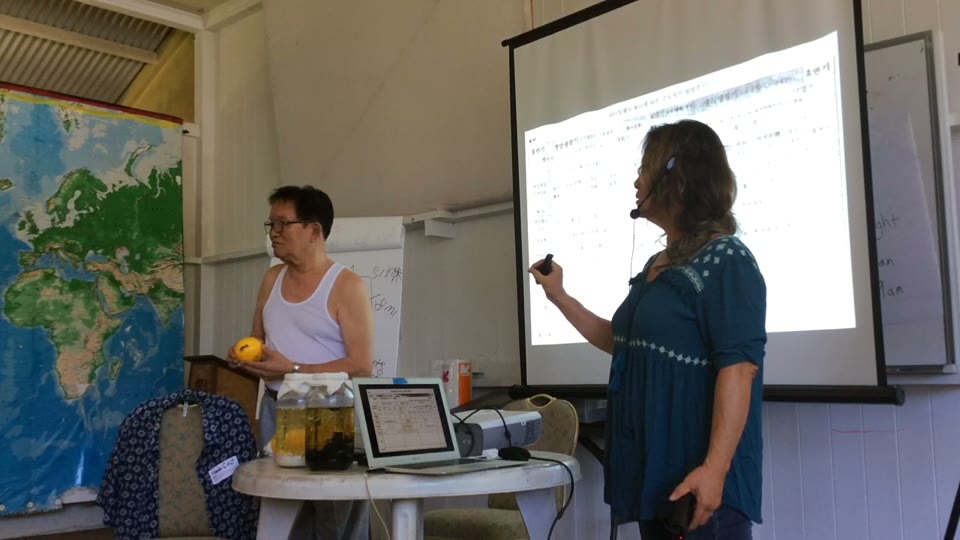
Cho opens with the rice chart on the screen and says upland rice would grow here on mountain moisture. Then he holds up a damaged citrus fruit: it didn't crack, a bee stung it, because too much nitrogen made the skin thin. The fix is a weekly fine-mist spray of Structure (WCP), Reproduction (WCA) and seawater, given before the plant's mid-week dip, which he writes on the flip chart for a quarter acre.
What he taught
Why do bees get into thin-skinned fruit, and what weekly spray assists the plant in building a firm skin?
Saturday morning, the first session of the day. Cho teaches in Korean and Kim Chang puts it into English. The rice nutritive-cycle chart is projected at the start, but no numbers are read off it yet. At about 4:45 Cho picks up a yellow citrus fruit with a hole in its skin from the table, next to the jars. From about 14:00 he draws three weeks of days (1234567 three times) on the flip chart, and at about 20:00 writes the spray: 'PCa + Ca + SW ¼AC – 100ℓ / 800 800 1:25'.
- Weekly skin spray for thin-skinned fruit (board, 20:05) — Per 300 pyeong (a quarter acre): 100 L water with water-soluble calcium phosphate (Structure, WCP) 1:800, water-soluble calcium (Reproduction, WCA) 1:800 and seawater 1:25 (board and interpreter). Spoken earlier: Cho's Korean gives calcium phosphate at '700 to 800 times'; only the interpreter gives WCA at the same 1:700–800 and seawater at 1:25 'instead of 1:30'. Adding Medicine (OHN) makes it better (interpreter); Cho adds Food (FPJ) and vinegar (Korean only, 21:49). Fine mist, straight onto the fruit, never in hot sun, once a week. Handout difference: the printed prescription (photo XFLH5606) puts WCP and WCA at 1:1000 in every column, so Cho's spoken 1:700–800 is stronger than the paper. Seawater 1:25 matches the printed 1:20–25 of Type 3 and the second ripening spray (4 L per 100 L).
- When to start it — Cho: one month before the flower forms, not before it blooms; in his example flowers form from the end of June to early July. The interpreter told the room 'at least two weeks ahead'. Solid calcium phosphate needs 22 days (three weeks) ahead (Cho); water-soluble works given two weeks, even one week, ahead (interpreter).
-
Mountain humidity here is about 70%, enough to grow upland rice; IMO No. 4 holds 80% moisture
Cho: 70% is the moisture all living things need to grow, so anywhere corn or sugarcane grows, rice will. Farm with IMO No. 4 (Microbes) and anywhere microbes live can be farmed. He offers to bring upland rice seed for people to save and share. (On Thursday, session 2, he gave microbes' moisture as 70%.)
▶ 2:19 As spoken
-
The damaged tangerine didn't crack: a bee stung it and sucked out the juice
People had called it fruit cracking (열과). Cho holds it up.
▶ 4:39 Shown in the room
-
The skin got thin and soft because of too much nitrogen
A thin, soft skin is what lets the bee in.
▶ 5:47 As spoken
-
Calcium phosphate (Structure, WCP) with seawater firms the skin; add water-soluble calcium (Reproduction, WCA)
The skin gets firm and gains elasticity, so it doesn't split easily.
▶ 6:02 As spoken
-
Never foliar-feed fruit while the sun is hot
The droplets become convex lenses, focus the sun and burn the skin; sap weeps out and bees and butterflies come to suck it.
▶ 6:25 As spoken
-
Seawater 1:25 instead of 1:30; calcium phosphate 1:700–800; water-soluble calcium the same
Calcium phosphate '700 내지 800배' is in Cho's Korean. The seawater ratio and the WCA rate were heard only in the interpreter's English. The board later settles on 800 / 800 / 1:25.
▶ 8:18 As spoken
-
Give it one month before the flower forms (not before it blooms)
Cho corrects himself mid-sentence. In his example the flower forms from the end of June to early July. The interpreter said 'at least two weeks ahead'.
▶ 10:02 As spoken
-
Solid calcium phosphate must go on 22 days (three weeks) ahead; water-soluble works two weeks, even one week, ahead
The 22 days is Cho's; the two weeks / one week is the interpreter's. Water-soluble forms are taken up fast.
▶ 10:56 As spoken
-
With this spray the skin stays clean, bees can't settle and anthracnose (탄저병) doesn't come
Cho describes anthracnose as black spots set into the leaves and black streaks on the fruit. The interpreter said 'blight'.
▶ 11:35 As spoken
-
Spray lightly, straight onto the fruit, as a fine mist, not like rain
Turn the sprayer nozzle to the mist setting; open it up and the drops come out too big.
▶ 12:15 As spoken
-
Even before any disease, give seawater + calcium phosphate (+ OHN?) once a week, and disease won't come
A baby grows differently week by week; so does a plant. The third ingredient was not clearly heard (probably 한방영양제, OHN).
▶ 13:37 As spoken
-
Within each week a plant's nutrition rises, then dips mid-week like a menopause; feed before the dip
Drawn as three weeks of 1–7 on the flip chart. The soil has this dip too. 'God worked for a week and rested on the Lord's day'; plants work a week too.
▶ 14:51 Written on the board
-
Not on day 7: give it before the dip, so it is absorbed and the plant passes over it
Cho points on the board and says 'here'. The interpreter said 'around the fifth day', then 'around the third day'; the day Cho meant is not clear in his Korean.
▶ 17:42 Written on the board
-
When a stage needs a particular nutrient, give it exactly on time; otherwise spray once a week
Steady uptake means the mid-week dip disappears and the plant doesn't get sick.
▶ 18:19 As spoken
-
Weekly formula: per 300 pyeong (1/4 acre), 100 L water, WCP 1:800, WCA 1:800, seawater 1:25
Board: 'PCa + Ca + SW ¼AC – 100ℓ / 800 800 1:25'. Spray it all through the crop's growth: 'no disease and no bugs'. 'It's really, really important.'
▶ 19:49 Written on the board
-
Just these three; Medicine (OHN) makes it better; Food (FPJ) and vinegar can go in too
The OHN is the interpreter's; 'FPJ and vinegar' was said in Korean only and never put into English.
▶ 21:35 As spoken
- The rates were given out loud and on the board; no measurement or trial was shown. 'No disease and no bugs' is Cho's experience.
- Cho's Korean gives calcium phosphate at 1:700–800. The WCA rate and the seawater 1:25 'instead of 1:30' were heard only in the interpreter's English.
- The printed handout gives WCP and WCA at 1:1000; the spoken and board rate (1:800) is stronger.
- Timing conflicts: Cho says a month before the flower forms; the interpreter says at least two weeks. The June–July dates are Cho's example, probably from Korea.
- Which day of the week to spray is not settled: the interpreter said day 5, then day 3, and Cho's own number can't be made out.
- The third ingredient of the weekly mix at 13:42 is not clearly heard; OHN is a guess.
- Thin, soft fruit skin and stung fruit point to too much nitrogen.
- A weekly fine mist of WCP, WCA and seawater assists the fruit in building a firm, elastic skin.
- Spray in the cool of the day, straight onto the fruit, never in hot sun.
- Start before the flower forms. Cho says a month ahead; water-soluble calcium works within one to two weeks.
- Feed before the plant gets hungry, not after it gets sick.
What the room didn't hear
Where the English in the room left out or changed what Master Cho said in Korean.
-
▶ 10:02
The room heard So you need to give this nutrient at least two weeks ahead, at least.
Cho said Give it from one month before the flower forms. Not a month before it blooms: a month before it forms. From the end of June to early July.
The room heard half the lead time Cho gave.
-
▶ 10:56
The room heard If you just use regular calcium phosphate, you have to give them way ahead.
Cho said Solid calcium phosphate you'd have to give 22 days ahead, three weeks ahead.
The number was dropped.
-
▶ 11:42
The room heard And then you will prevent the blight.
Cho said Anthracnose won't come: the disease that sets black spots into the leaves and black streaks on the fruit.
'Blight' is a different disease; Cho named anthracnose and its signs.
-
▶ 13:37
The room heard If you mix this right input with ocean water, every week your plant wouldn't have a disease.
Cho said Even if no disease has come, mix seawater, calcium phosphate and [OHN?] and give it once a week, and disease won't come.
The ingredients and 'before any disease' were dropped.
-
▶ 17:42
The room heard So you give her your nutrient around third day (earlier: 'around a fifth day').
Cho said No. Not on day 7: you give it here, so the nutrition is absorbed and it gets over the dip.
Two different days reached the room; Cho pointed at the board instead of naming one.
-
▶ 21:49
Cho said Do you put FPJ in too? FPJ and vinegar.
Never put into English; the room heard only 'OHN makes it better'.
Next to Master Cho's books
-
Agrees
Fruit skin: WCP 1:800 + seawater 1:25 from late June/early July His 2016–17 Hawaiʻi citrus program starts late June/early July with seawater 1:25 + WCP 1:800 + OHN 1:1000. Here he adds WCA at the same rate. The printed prescription handout puts WCP and WCA at 1:1000.
notes: cho-hawaii-2016-2017 — Recipes & methods demonstrated
-
Goes further
Seawater 1:25 'instead of 1:30' His recipe book gives seawater at 1:30 as the standard and 1:30, 1:25, 1:20 for ripening; here 1:25 becomes the weekly skin mix.
Cho, Natural Farming Agricultural Materials (Recipe), p. 82
-
Agrees
Thin skin from excess nitrogen; the answer is WCP and WCA In his 2006 Q&A excess nitrogen is the diagnosis, and the fix includes foliar water-soluble calcium phosphate and water-soluble calcium.
CGNF Advanced (2006.02) (English translation), p. 57
“Hawaiʻi is the country receiving the most of God's grace.”
▶ 4:25
“It isn't that; a bee came and stung it and sucked out the juice inside.”
▶ 4:39
“You need to eat something before you get hungry so you have strength to work.”
▶ 21:01
In this part
- 0:00Seating, then the rice chart: upland rice will grow here
- 3:26Hawaiʻi is the best place to farm
- 4:33The stung tangerine: thin skin, too much nitrogen
- 6:25No spraying in hot sun; seawater 1:25, calcium 1:700–800
- 9:24When: a month before the flower forms
- 12:09Spray a fine mist, right on the fruit
- 13:07Once a week, before the mid-week dip
- 19:03The board: 1/4 acre, 100 L, 800 / 800 / 1:25
Transcript
English translation, checked against the Korean as spoken.
0:00 Kim Chang (interpreter): The important information you're going to get for this seminar is a life-nutrient cycle and according to life cycle, nutrient. Where's Joe? Joe is here? Okay. We don't want to be serious. You can grab a chair and put it here so I can... So you have all those copies, yeah? Can you bring this chair here or if you want to sit there? Yes, just like that. If you can't see this writing that well, you look at your copy. The copy has English, but it's very tiny. So this one is for the rice nutrient cycle.
0:49 Master Cho: Ah, the rice cycle. But nobody here farms rice? You don't eat rice here?
아, 벼 사이클. 그런데 여기 벼농사 짓는 사람은 없나요? 여기 밥을 안 먹어요?
0:53 Kim Chang (interpreter): Anybody growing rice here?
0:55 Audience: A little bit.
1:02 Kim Chang (interpreter): So there's not only wet rice farming, there's dry land rice farming.
1:04 Master Cho: Farming rice in paddies, farming rice in dry fields…
논에서 농사짓기, 밭에서 농사짓기…
1:17 Kim Chang (interpreter): There's two different kinds of rice farming.
1:21 Master Cho: Paddy rice, upland rice.
물벼, 밭벼.
1:22 Kim Chang (interpreter): One is wetland, one is dry land. So if you want to grow dry-land rice, he will find the seed for you. So when I bring those seeds for you, you just keep propagating and then share among us,
1:40 Master Cho: I'll go home [to Korea] and bring a little here too; if you keep saving the seed, many people can use it.
여기 집에 갔다 여기도 조금 갖다가, 자꾸 씨를 받으면은 많은 사람이 쓸 수 있으니까.
1:57 Kim Chang (interpreter): among you, us, that means.
2:01 Master Cho: The humidity up on that mountain right now — with that much moisture alone you can grow upland rice well enough.
그 습도는 지금 산에 있는 저… 그 정도의 수분만 가지고 충분히 밭벼를 키울 수가 있다고.
2:01 Kim Chang (interpreter): So we have lots of moisture on this island, so you can use just dry-land rice.
2:18 Master Cho: On the mountain the humidity is 70%.
산에는 습도가 70%야.
2:24 Kim Chang (interpreter): I was looking at it, your moisture level in the mountain is about 70%.
2:30 Master Cho: The moisture every living thing needs to grow is 70%.
모든 생명체가 자라는 데 필요한 수분은 70%야.
2:35 Kim Chang (interpreter): All the crops, anything grows, they need 70% moisture. 70% moisture. So anywhere you can grow corn or sugarcane, you can grow rice. So where microorganisms reside, their body moisture content is 80%.
2:54 Master Cho: So when you farm using IMO No. 4 — because IMO No. 4 holds 80% moisture —
그래서 여러분들이 토착미생물 4번을 써서 농사짓는 데는, 토착미생물 4번이 수분이 80%이기 때문에
That's the first few minutes. Members read all 200 lines, with the Korean as spoken, and watch along.
Become a member