Liquor + Air = Vinegar: Make It From What Grows Here
Master Cho Han-kyu, interpreted by Kim Chang, Founder of Korean Natural Farming (Janong)
Master Cho spoke Korean, with an interpreter. We translated every Korean line again and checked it, so you read what he said, not only what the room heard.
Members watch every session
The whole seminar, as it happened, with the checked English beside the video. Membership is $60 a year.
This part runs from 2:05:29 to 2:27:24 of the session video. Keep watching and the next part plays on.
Now playing the next part: Living Liquid, Not Enzyme: Collect at Dawn, Face South
The question held since Joe's talk comes back: must the vinegar be brown rice vinegar? Kim Chang, the interpreter, answers first in her own voice (4-5% acidity, and why competency matters), then Cho takes the flip chart. Don't insist on brown rice: carbohydrate plus nuruk makes liquor, the air's acetic acid bacteria turn it to vinegar in 3 to 5 days, and the material sets the quality. He adds coconut vinegar, a little cooked brown rice in banana liquor, why koji isn't IMO, and why brown rice beats white.
What he taught
Does the Cleanser (vinegar) have to be brown rice vinegar, and how do you make it from local fruit?
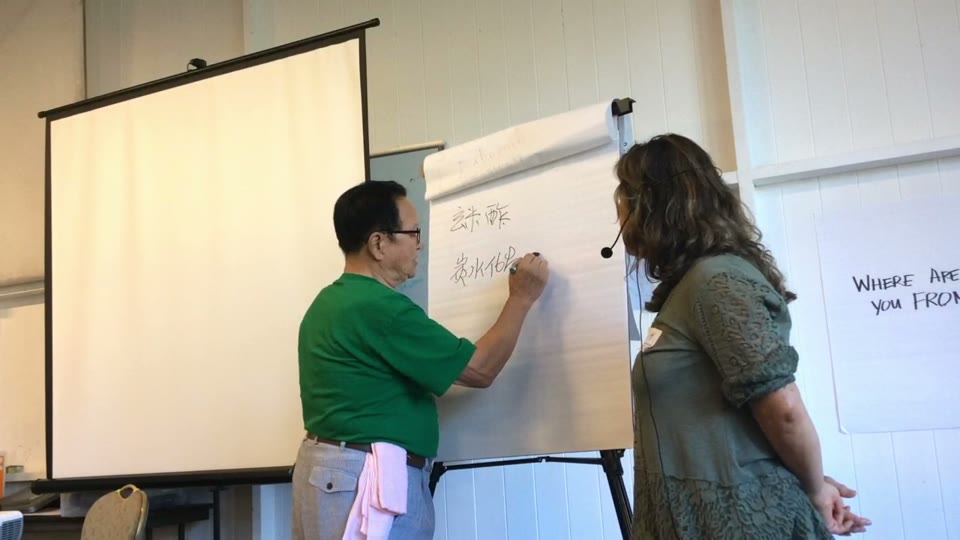
End of Drake's Q&A. An audience member asks whether brown rice vinegar is needed or whether banana vinegar, more local to Hawaiʻi, will do. Kim Chang, the interpreter, first answers in her own voice. Cho had followed the room without English and takes over at the flip chart, writing 玄米酢 (brown rice vinegar) / 炭水化物 × 누룩 (carbohydrate × nuruk) / 술 + 酢酸菌 (liquor + acetic acid bacteria). She then interprets, standing beside him.
- Vinegar (Cleanser), the general method — Carbohydrate (rice, banana, papaya, any fruit) × nuruk (koji or yeast) → liquor; leave the liquor open and acetic acid bacteria from the air turn it to vinegar in 3 to 5 days, depending on temperature. No quantities given. (Cho's Korean and the board; the interpreter dropped the 3-5 days.) The prescription handout doesn't cover vinegar making.
- Coconut vinegar — Draw off the coconut juice separately; add koji or yeast (nuruk also works) to make alcohol; it then turns to vinegar. Scrape in the white flesh too for better quality. Use the old (mature) coconut. No quantities. (Cho's Korean; the interpreter.)
- Banana vinegar with brown-rice power — When making the banana liquor, mix in a little (조금) cooked brown rice; the brown rice's power goes into the vinegar. Confirmed back to the questioner: 'you've learned well'. (Cho's Korean.)
- Acidity check (Kim Chang and an audience member) — At least 4-5% acidity to extract calcium and calcium phosphate (Reproduction, Structure). An audience member: pH 2.4 or lower on a strip is about 5% acetic acid.
-
Use local material for vinegar; it needs at least 4 to 5% acidity
Kim Chang, in her own voice: Cho uses what's available where he teaches if there's no brown rice; the acidity is what extracts the calcium and calcium phosphate.
▶ 2:05:57 As spoken
-
Teach the lineage first (brown rice vinegar), then the local adaptation (banana vinegar here), and keep track of your changes
Drake Weinert.
▶ 2:06:27 As spoken
-
Competency means high-quality solutions: make them, show them, keep notes, photograph the whole jar
Kim Chang: on projects, CGNF often found level 2 farmers' own solutions unusable and had to bring theirs. Then learn the nutritive cycle: 'you just look for the sign'.
▶ 2:07:16 As spoken
-
pH 2.4 or lower on a test strip means at least about 5% acetic acid; legal vinegar is 4 to 5%
An audience member's rule of thumb, not Cho's.
▶ 2:09:25 As spoken
-
Don't insist on brown rice vinegar alone; make it from whatever is around you
Cho says he caught the question by reading the room, without English.
▶ 2:11:39 As spoken
-
In Hawaiʻi: papaya, mango and banana all work; the best quality is 'mango-stick', probably mangosteen
The interpreter said 'mango skin'.
▶ 2:12:04 As spoken
-
Coconut vinegar: coconut juice plus koji or yeast makes alcohol, which turns to vinegar; scrape in the flesh; use the old coconut
Asked ripe or young: 'the old one', then Cho's question 'who's stronger, an old person or a young one?'
▶ 2:12:39 As spoken
-
Carbohydrate × nuruk → liquor; liquor + acetic acid bacteria → vinegar
Board: 玄米酢 / 炭水化物 × 누룩 / 술 + 酢酸菌.
▶ 2:14:39 Written on the board
-
The acetic acid bacteria come from the air
Banana, papaya, rice, it's all the same: once liquor forms, the air's bacteria get in with a little time. Same as makgeolli going sour.
▶ 2:16:22 As spoken
-
Liquor turns to vinegar in 3 to 5 days, depending on temperature
And, Cho adds, on how much of the Creator's loving power comes through. He frames it with the wedding at Cana: the creating power fills the air.
▶ 2:20:00 As spoken
-
Vinegar isn't made by technique but by the power of nature
▶ 2:20:27 As spoken
-
The material changes the quality; the vinegar itself is the same
Brown rice, papaya and banana carry different nutrients, so what's made differs in quality.
▶ 2:21:03 As spoken
-
For brown-rice power in a fruit vinegar, add a little cooked brown rice when making the banana liquor
▶ 2:21:33 As spoken
-
Healthy vinegar needs healthy, rich raw material
Like a healthy mother and a healthy seed making a healthy baby.
▶ 2:22:22 As spoken
-
Koji is not IMO: IMO are microbes collected from the soil
Bought koji may have been hung in the shade or come from a liquor factory; either way it isn't indigenous soil microbes.
▶ 2:24:22 As spoken
-
White rice is brown rice with its clothes stripped off; brown rice keeps the minerals and nutrients
So Cleanser made from brown rice makgeolli is far better (last word unclear).
▶ 2:26:26 As spoken
- No quantities were given for any vinegar here: not the carbohydrate, the nuruk, or how much cooked brown rice ('a little').
- 'Mango-stick' is our reading of the fruit's name (probably mangosteen); it isn't confirmed.
- The 4-5% acidity and pH 2.4 rules come from Kim Chang and an audience member, not from Cho.
- Cho's Korean between 2:10:33 and 2:11:39 is mostly unreadable in both machine passes.
- Make your Cleanser (vinegar) from the carbohydrate that grows near you: banana, papaya, mango, coconut, rice.
- Turn it to liquor with nuruk, koji or yeast, then leave it open to the air; expect vinegar in 3 to 5 days, faster when warm.
- Check the strength: about 4-5% acid (pH 2.4 or lower) before using it for Reproduction (WCA) or Structure (WCP).
- Add a little cooked brown rice to a fruit liquor if you want brown rice's qualities.
- Use mature, rich material; the vinegar is only as good as what went in.
What the room didn't hear
Where the English in the room left out or changed what Master Cho said in Korean.
-
▶ 2:12:04
The room heard You can use papaya, mango, banana, but the best one is mango skin.
Cho said Here in Hawaiʻi you have plenty of papaya, mango and banana, and the best quality is 'mango-stick' (probably mangosteen).
The best fruit became 'mango skin'. Both machine passes hear a fruit name, not 껍질 (skin).
-
▶ 2:12:39
The room heard So you only collect the juice of the coconut, and then you inoculate with nuruk or koji.
Cho said Take the coconut juice, draw off the liquid separately, and put koji or yeast into it, and alcohol forms. You can put in nuruk too.
Yeast, the easiest starter to buy, was left out.
-
▶ 2:20:00
The room heard That means, from the creator, how much love is coming through them.
Cho said Three to five days. But that depends on the temperature. It depends on how much of the Creator's loving power comes out.
The answer to 'how long?' (3-5 days, by temperature) never reached the room; only the Creator part did.
-
▶ 2:21:03
The room heard The nutrient is different, but when it comes to vinegar, it doesn't matter.
Cho said The nutrients in brown rice, papaya and banana are different, so the quality of what gets made is different. It's not that the vinegar itself is different.
The room heard 'it doesn't matter'; Cho said the material sets the quality.
-
▶ 2:21:33
The room heard When you make other fruit vinegar, you add some cooked rice in there, brown rice, cooked brown rice.
Cho said When you make the liquor from banana, mix in a little cooked brown rice, and you get brown rice vinegar.
Cho gives the timing (at the liquor stage) and the amount ('a little').
-
▶ 2:24:22
The room heard I don't know where you get it from, but it's collected from the air.
Cho said Was the koji made by hanging it in the shade, or brought from a liquor factory? It depends on the koji. But it isn't indigenous microorganisms; IMO are collected from the soil.
The room heard that koji comes 'from the air'; Cho's point was where it was made, and that it isn't soil microbes.
Next to Master Cho's books
-
Agrees
Make vinegar from local material when brown rice isn't there In Hawaiʻi again in 2018, Cho said banana vinegar works fine when there's no brown rice vinegar, apples less well, and to find suitable local material.
2018/Cho - advanced hawaii/cho advanced 2018 3-2 @ 0:28:00 (translated)
-
Goes further
Liquor + acetic acid bacteria = vinegar The BRV handout gives the same chain (makgeolli, yeast, then acetic acid bacteria). Here Cho adds that the bacteria come from the air and that the vinegar stage takes 3-5 days by temperature.
Brown-Rice-VinegarBRV, p. 1–6
-
Agrees
Koji is not IMO His book rejects microorganisms produced mechanically or artificially; only indigenous ones collected locally count.
Cho, Janong Natural Farming (2003), p. 89
-
Goes further
Coconut vinegar In 2018 Cho mentions knowing how to make coconut vinegar in the Philippines but gives no method; here he gives one.
2018/Cho - advanced hawaii/cho advanced 2018 3-2 @ 0:36:29 (translated)
“You were all talking, and since I don't know English, I caught it by reading the room.”
▶ 2:10:59
“The creating power that made everything in the universe, that power fills this air. Even now.”
▶ 2:18:23
“It isn't made by technique; it's made by the power of nature.”
▶ 2:20:27
In this part
- 2:05:29Brown rice vinegar or banana vinegar?
- 2:07:16Kim Chang on competency
- 2:09:11Testing vinegar: 4-5% acid, pH 2.4
- 2:10:59Cho: make vinegar from what's around you
- 2:14:39Carbohydrate × nuruk → liquor; liquor + acetic acid bacteria
- 2:17:20The wedding at Cana: creating power in the air
- 2:19:473 to 5 days, and a little cooked brown rice
- 2:23:55Koji is not IMO; brown rice keeps its clothes on
Transcript
Transcribed and checked by hand against the recording.
2:05:30 Audience: Yes, Joe said it's important for the brown rice vinegar to be used. Do you feel the same way because you, I'm not too sure if everybody's belief or, because you know, it's Korean, and Korea and Japan of course use rice, but over here maybe like things like banana vinegar is more indigenous.
2:05:57 Kim Chang (interpreter): Yes, so Master Cho always stress use local material, indigenous material. So when he goes to other country, they don't have brown rice. So he use whatever available in local. But then the percentage of vinegar, you need about at least 4% acidity to 5%. So he extract the calcium or also calcium phosphate.
2:06:26 Drake Weinert: And so the way I would teach that is to say, look, the way you study here is brown rice vinegar. Here in Hawaii, they recommend you use banana vinegar. So you pass on the integrity of the lineage of how we have them, and you say our local adaption for this space and this place is this. But if you're going to go to this other place and teach anyone that lesson that you've promulgated largely, then you got this, so keep track of your modifications. So yes, I agree with that.
2:06:59 Audience: I just want to know, like, Kim is probably close to what... maybe... [unclear] But since we have him here, can we ask him, is it important for it to be brown rice, or can it be a... [unclear] Sorry, I just wanted to ask the question and ask it for you.
2:07:15 Kim Chang (interpreter): OK. This competency is very important. That's, we focus on how to make high quality and good quality input. Without that, you cannot have a good crops or you cannot really feed the microbes with the good food. So that's why we have a high focus on the competency. That's why you need to go into make your input and show us you did right thing. And then also, you will help us to write some notes or so. And then take a picture. A little bit [back], so you can see the whole thing, not
2:08:03 like that. That really help us. And then... [unclear] That will make big difference for you. That's the from there. If you do well from there, then you can really blossom. And then learn nutrient cycle. That one is a little bit tricky, but also it's easy. You just look for the sign. Master Cho will tell you.
That's the first few minutes. Members read all 229 lines, with the Korean as spoken, and watch along.
Become a member