Microbes Digest, You Absorb: Keep Microbes and Feed Local
Master Cho Han-kyu, interpreted by Kim Chang, Founder of Korean Natural Farming (Janong)
Master Cho spoke Korean, with an interpreter. We translated every Korean line again and checked it, so you read what he said, not only what the room heard.
Members watch every session
The whole seminar, as it happened, with the checked English beside the video. Membership is $60 a year.
This part runs from 58:06 to 1:16:11 of the session video. Keep watching and the next part plays on.
Now playing the next part: Plump, Slim, Plump Again: Feed Every Stage
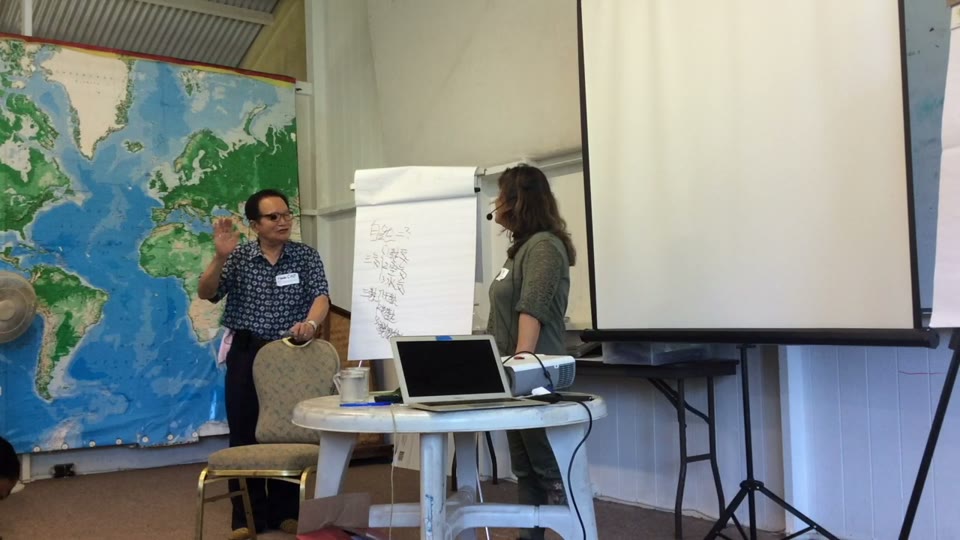
Seated now, Cho says a crop is a living being made of the same sun, air, water and soil as us, so farming starts with humility: 'natural farming is love'. He writes three chi and three heats on a fresh flip-chart page and says body heat is fermentation heat, because microbes digest our food and we absorb what they make. From there: collect microbes near you, and feed livestock what is made here, not shipped in.
What he taught
Why does Cho want microbes, and livestock feed, to come from close to home?
Thursday morning, about an hour in. Cho sits beside the flip chart and starts a new page: 自然 = ?, then 三氣 (熱氣, 空氣, 水氣) and 三熱 (天熱, 地熱, 醱酵熱). He questions the room and tells a Korean story about a daughter-in-law at a feast. He says the slides for this are coming in the evening session, which was not recorded.
- Microbes for the crop — Mix Protectors (LAB, lactic acid bacteria) with microbes from the nearby mountain valley and give them to the crop. Cho's Korean; the interpreter said 'feed the food from your area' instead of 'the microbes of that area'. No amounts given.
-
A crop is a living being like you, made of the same sun, air, water and soil.
Banana, papaya, mango and me: 'what we're made of is the same.'
▶ 58:06 As spoken
-
Put yourself in the crop's place and a conversation with the crop happens.
'If I were in its place, what would it be like?'
▶ 59:34 As spoken
-
Natural farming starts with humility: fit your mind to the crop, not the crop to your mind.
In love you change to fit the other. 'So natural farming is love.'
▶ 1:01:04 As spoken
-
Vague thinking about nature makes vague farming.
The room answered 'everything', 'God', 'us', 'energy'. Cho: know it clearly enough to use it freely.
▶ 1:03:02 As spoken
-
If this doesn't land, redo levels 1, 2 and 3.
If it does, the third-level course was worth it.
▶ 1:04:06 As spoken
-
Three chi: heat chi, air chi, water chi (三氣: 熱氣, 空氣, 水氣).
Written on the flip chart under 自然 = ?
▶ 1:04:45 Written on the board
-
Three heats: sky heat (the sun), earth heat (volcano), and fermentation heat (三熱: 天熱, 地熱, 醱酵熱).
Hawaiʻi is an island made by earth heat rising up.
▶ 1:05:22 Written on the board
-
Body heat is fermentation heat: microbes digest the food we eat, and we absorb what they digest.
'If you eat thinking I digest this food, that's wrong.'
▶ 1:07:23 As spoken
-
Gut microbes are used to the food that usually comes in; something new gives them a shock.
Cho tells it with a Korean story about a daughter-in-law at a feast (in the transcript), then applies it to livestock feed below.
▶ 1:08:55 As spoken
-
Collect microbes near you (indigenous), not from far away.
'That's exactly the microbes near your own body.' Slides promised for the evening.
▶ 1:11:31 As spoken
-
Pigs, chickens and cattle fed feed brought in from outside will, without fail, get sick: their gut microbes are shocked.
Cho asks whether Hawaiʻi Island feed comes from Hawaiʻi or the mainland; the room: from all over the world.
▶ 1:12:20 As spoken
-
Protectors (LAB) are good, but the microbes of that area are better; mix the two for the crop.
LAB plus mountain-valley microbes, given to the crop.
▶ 1:13:43 As spoken
-
Making feed here, instead of shipping it from the mainland, is the safest way.
How to make feed is to be taught later (interpreter: 'maybe tomorrow').
▶ 1:15:25 As spoken
- Cho also says that people who eat food grown within ten li (about 4 km) of home with local microbes don't get sick, and tells the diarrhea story about gut microbes; these were not tested and we don't repeat them as advice.
- Cho points to slides for the evening session (Thursday evening was not recorded).
- No rates or recipes for local microbes or feed are given on this page.
- Collect Microbes (IMO) from near your own farm; they already fit your place.
- Protectors (LAB) work best alongside your local microbes, not instead of them.
- Feed made on the island assists your animals' gut microbes more than feed shipped in; change feed slowly.
- Fermentation heat is the one of the three heats you can make and use on the farm.
What the room didn't hear
Where the English in the room left out or changed what Master Cho said in Korean.
-
▶ 59:34
The room heard So you think that crop or livestock, think as yourself, and then you start doing better.
Cho said Ask yourself, 'If I were in its place, what would that be like?', and a conversation with the crop happens.
The 'conversation with the crop' was dropped.
-
▶ 1:04:06
The room heard You gotta go back to level 1 and level 2.
Cho said If not, you have to do the first, second and third levels all over again.
Cho included level 3.
-
▶ 1:04:37
The room heard Heat body, air body, water body. There are three.
Cho said Heat chi, air chi, water chi (熱氣, 空氣, 水氣).
氣 is chi, energy; she said 'chi' a few seconds later.
-
▶ 1:12:20
The room heard When you bring food from the outside, lots of time your livestock gets sick.
Cho said If you bring in feed from outside, without fail (절대로) they get sick.
Cho's warning was absolute; the English softened it.
-
▶ 1:13:43
The room heard Lactic acid bacteria is good too, but then you need to feed the food from your area.
Cho said Lactic acid bacteria are good too, but feed the microbes of that area; mix them with microbes from the mountain valley and give them to the crop.
Cho said local microbes, not local food.
Next to Master Cho's books
-
Agrees
Three heats: sky, earth, fermentation Same three heats he taught at Papaikou earlier in 2017, where too fermentation heat is the one people miss.
2017/Cho - Papaikou/IMG_9591 @ 0:21:20 (translated)
-
Agrees
Collect microbes in your own farming region His recipe book says each microbe has its own habitat, so you must collect microorganisms in the farming region.
Cho, Natural Farming Agricultural Materials (Recipe), p. 9
-
Agrees
Feed livestock from what is at hand, not shipped feed His livestock book has a section on self-sufficient feed from local resources such as leaf-litter humus combined with Natural Farming solutions.
자연농업 양계·양돈·축산 (Natural Farming poultry, swine, livestock) (English translation), p. 132–135
“Don't try to fit the crop's mind to yours. Fit your mind to the crop's, and that's success.”
▶ 1:01:16
“So natural farming is love.”
▶ 1:02:04
“The microbes digest the food I eat, and what the microbes digest, I absorb.”
▶ 1:07:23
In this part
Transcript
English translation, checked against the Korean as spoken.
58:12 Master Cho: Looked at as a living being, my life and its life are the same.
그 생명체를 놓고 봤을 때 나의 생명체나 그의 생명체나 같은 거예요.
58:13 Kim Chang (interpreter): So, if you look at the crop's life, I mean living crop and then human living,
58:24 Master Cho: Living being, living being.
생명체, 생명체.
58:35 Kim Chang (interpreter): That is the same, it's really same. Crop and you are same.
58:42 Master Cho: Why? Because with the same sunlight, air, water and soil, we were made as their joint work, so we're all the same.
왜 그러냐면 같은 햇볕에 공기와 물과 흙과 […]의 합작품으로 만들어진 것이기 때문에 다 똑같은 거예요.
58:54 Kim Chang (interpreter): The reason is we use same sunshine, same soil, air, and we are all live in it, so we are all same, no difference.
59:05 Master Cho: So, reckoned that way, banana, papaya, mango, and me: what we're made of is the same.
자, 그러면 그걸로 따져 볼 때는 바나나나, 파파야나, 망고나, 나나, 이 구성원이 같다는 말이에요.
59:22 Kim Chang (interpreter): All those plant life stuff and us, we are same structure.
59:33 Master Cho: So if you ask yourself, 'If I were in its place, what would that be like?', a conversation with the crop happens.
그래서 내가 저 형편이라면 어떤 건가, 어떤 건가 생각해 보면 작물과 대화가 이루어지는 거예요.
59:33 Kim Chang (interpreter): That's why. So you think that crop or livestock, think as yourself, And then you start doing better. Yeah.
59:57 Master Cho: Can you talk and chat with them like friends and companions, or not?
친구하고 동무라고 대화하고 얘기할 수가 있어요, 없어요?
1:00:02 Kim Chang (interpreter): Do you think you can speak to plants and livestock?
1:00:07 Audience: Yes.
1:00:12 Kim Chang (interpreter): Yeah, that's really great and important to understand that.
1:00:16 Master Cho: Then do you know, or not, that the Creator's mind is inside your mind?
그러면 창조주의 마음이 내 마음에 들어가 있는 걸 알아요, 몰라요?
1:00:20 Kim Chang (interpreter): So do you know the creator is in within you? Do you know that or not?
1:00:31 Master Cho: Pretending not to know it is just not knowing because you're stubborn.
그걸 갖다가 모르는 척 하는 건 자기의 고집이 세기 때문에 모르는 것뿐이야.
1:00:36 Kim Chang (interpreter): Some people they ignore it because they are too stubborn.
1:00:43 Master Cho: Being a fool and saying I'm smart: that's me being cocky, arrogant.
내가 바보면서 나는 똑똑하다고, 내가 건방진 거야, 오만한 거지.
1:00:50 Kim Chang (interpreter): Actually you are a fool and then that person thinks I am so smart, that means you are very arrogant. Okay?
1:01:00 Audience: Okay. Yes, I understand.
1:01:03 Master Cho: So when we do this natural farming, the very first thing:
그래서 우리가 이 자연농업을 할 때는 제일 먼저
That's the first few minutes. Members read all 173 lines, with the Korean as spoken, and watch along.
Become a member