Living Liquid, Not Enzyme: Collect at Dawn, Face South
Master Cho Han-kyu, interpreted by Kim Chang, Founder of Korean Natural Farming (Janong)
Master Cho spoke Korean, with an interpreter. We translated every Korean line again and checked it, so you read what he said, not only what the room heard.
Members watch every session
The whole seminar, as it happened, with the checked English beside the video. Membership is $60 a year.
This part runs from 2:27:23 to 2:57:56 of the session video. Keep watching and the next part plays on.
Now playing the next part: Elementary School to 3:6 Rice: How Cho Found Natural Farming
Cho says what we make isn't an enzyme but a living fermented liquid, and tells the loaves and fishes as a picture of how one lump of Microbes covers 6,000 pyeong. He weeps, then says farming is done with love, not technique. The practical core: collect material when the plant holds the most of nature's power, in the morning, and collect IMO where the first sun falls; sunlight's far-infrared growth ray is why sprouts face south. He ends on three sets of parents: the crops that raise you, so pesticide is parricide.
What he taught
What makes a Natural Farming solution alive, and when and where should you collect for the strongest one?
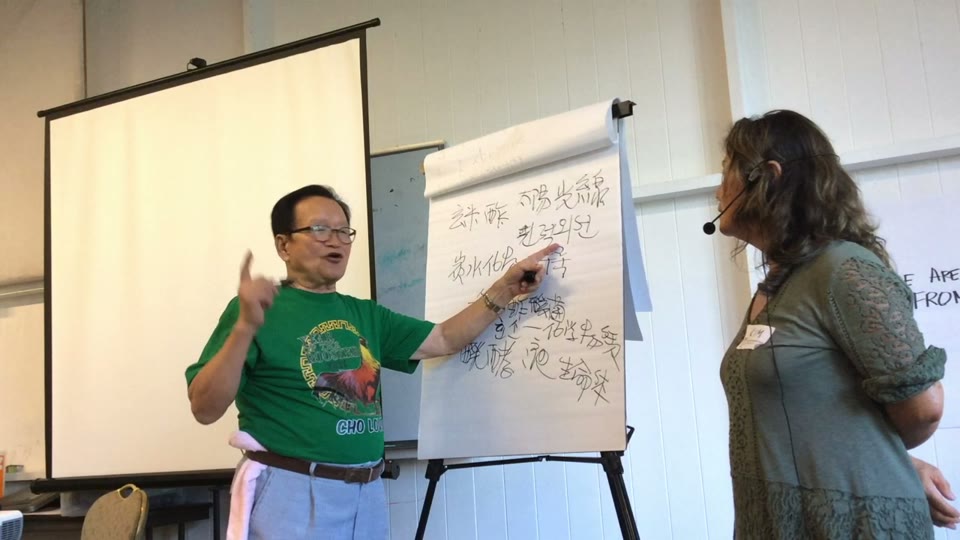
Cho at the flip chart with Kim Chang interpreting. He adds to the vinegar sheet: 酵素 — 化學物質 (enzyme = chemical substance), 醱酵液 — 生命體 (fermented liquid = living thing), then 太陽光線 / 遠적외선 (sunlight / far-infrared). Much of this stretch is Bible stories (the loaves and fishes, the widow's oil, Cana) used as parables; they're translated in the transcript. Around 2:35:15 Cho is in tears and the room is quiet. At the end he writes the three parents on a second chart, which isn't legible in the video.
- When to collect material — Pick papaya, banana or mango in the morning (the interpreter: before sunrise, at dawn), when the plant holds the most of nature's power. (Cho's Korean; the interpreter.)
- Where to collect Microbes (IMO) — On ground facing south (he also says east) where the sun comes in first. (Cho's Korean.)
-
What we make isn't an enzyme (효소) but a fermented liquid (발효액), and a fermented liquid is a living thing
Board: 酵素 — 化學物質; 醱酵液 — 生命體. The enzyme is the substance microbes produce; while the microbes are alive, the liquid is alive.
▶ 2:27:37 Written on the board
-
Cho's test for a professor who called it an enzyme: was it made by water, chemicals or microbes? If microbes, it's alive
Told as a joke: the professor 'went red in the face and ran off'.
▶ 2:29:01 As spoken
-
One fist-sized lump of Microbes (IMO) can be multiplied for about 6,000 pyeong
6,000 pyeong is about 2 ha, about 5 acres; the interpreter said '6,000 acres' and the room corrected it to 5 acres. Told with the loaves and fishes.
▶ 2:33:57 As spoken
-
Given with love, we can bring dying land back to life
The interpreter said 'change the whole universe'.
▶ 2:34:40 As spoken
-
Farming isn't done with technique; it's done with love that gives
Not interpreted. Cho had just been in tears.
▶ 2:35:30 As spoken
-
Solutions made after a fight, in anger, won't work for the crop
Same as a dinner cooked after a marital fight tasting bad. Farming goes well only when every living thing is happy.
▶ 2:36:56 As spoken
-
People's greed has overworked the crops
To satisfy greed, crops were made to work far too hard (혹사).
▶ 2:40:07 As spoken
-
Cho says his recipes came as revelations, written down from dreams, tried, and found to work
His Japanese book, 'Let's Bring Indigenous Microorganisms Back to Life', is 'not a best seller but a steady seller'; most agriculture professors there have it.
▶ 2:40:37 As spoken
-
When making materials, what matters most isn't which plant but when you collect it: when the plant takes in the most of nature's power
▶ 2:42:11 As spoken
-
Cabbage pulled in the morning makes better kimchi than cabbage pulled in the evening
Mothers know it by taste. The interpreter said 'afternoon'.
▶ 2:42:57 As spoken
-
Pick papaya, banana or mango in the morning to make your materials
Interpreter: before the sun comes up, at dawn; pick mature fruit early.
▶ 2:43:30 As spoken
-
Strongest Microbes (IMO): collect where the sun comes in first, facing south (or east)
Cho says he's telling this in Hawaiʻi for the first time, because now there are ears ready to hear.
▶ 2:45:03 As spoken
-
Sunlight holds far-infrared (원적외선); within it, the growth ray (생육광선) makes crops grow
Board: 太陽光線 / 遠적외선. The interpreter said 'ultraviolet'; Cho settled it in English: 'Infrared. No UV.'
▶ 2:45:46 Written on the board
-
Watch any sprouting seed: its head faces due south, to receive the growth ray
South is where it sees sun all day. If you looked at your seedlings with love, like your own child, you'd know; not knowing is a careless farmer's answer.
▶ 2:48:17 As spoken
-
God built our house, the earth, and we treat it carelessly with chemical fertilizer and pesticide
'We live on a star.'
▶ 2:52:31 As spoken
-
Everyone has three sets of parents: birth parents (생부모), raising parents (양부모) and teaching parents (사부모)
The crops that feed you, corn and tomatoes, are your raising parents. The interpreter said 'corn, papaya, or rice'.
▶ 2:54:51 As spoken
-
Spraying pesticide on the crops that raise you is parricide (존속 살해죄)
'Should you farm in a way that kills your raising parents, or in a way that loves them?'
▶ 2:56:47 As spoken
- Much of this page is faith and parable; the farming teaching sits inside it.
- The 6,000-pyeong figure is Cho's rule of thumb; no amount of IMO per area or trial was given.
- Several of Cho's Korean lines are garbled in both machine passes (marked … in the transcript), including the start of the growth-ray explanation.
- Cho also says anger puts poison in the body and that warmth from a cooking fire or campfire prevents illness; these were not tested and we don't repeat them as advice.
- Harvest material for your solutions in the early morning, from mature plants.
- Collect Microbes (IMO) where the first sun of the day lands, on south- or east-facing ground.
- Treat your solutions as living: they're made by microbes and stay alive while the microbes are.
- Make solutions in a calm, good mood; Cho says the maker's state goes into them.
- Watch which way your seedlings face; it tells you where their light comes from.
What the room didn't hear
Where the English in the room left out or changed what Master Cho said in Korean.
-
▶ 2:33:57
The room heard Even if you have a little bit of microorganism, you can inoculate and then 6,000 acres you can spread this microorganism.
Cho said With one lump of indigenous microorganisms about this big, you can make enough microorganisms for about 6,000 pyeong.
Pyeong became acres, about 1,200 times too big. Someone in the room corrected it to 5 acres; 6,000 pyeong is about 2 ha.
-
▶ 2:34:40
The room heard If you put God's power, put on your back, and we can change the whole universe.
Cho said We can bring the land that is dying right now all back to life.
Cho's point was reviving dying land, not the universe.
-
▶ 2:35:30
Cho said Our farming is not done with technique. It is done with love that gives.
Said through tears and never interpreted; it's the line the whole parable was leading to.
-
▶ 2:37:18
The room heard So when you work with a farm, you must use your love and give love to crop and then your farming will be successful.
Cho said When we do Natural Farming, we give with love, and only when every living thing is happy does the farming go well.
'Every living thing' widens it from the crop to the soil life and animals.
-
▶ 2:42:57
The room heard The one that we harvest in the morning, the one that we harvest in the afternoon.
Cho said Compare cabbage pulled in the morning with cabbage pulled in the evening.
Cho's comparison is morning against evening.
-
▶ 2:45:03
The room heard If you want to collect a very powerful microorganism, the sun hits on that part of the south.
Cho said On the side facing east, where the sun comes in earliest... a place facing south where the sunlight comes in first of all. Collect there and you get very strong ones.
The key word, 'first', and the east-facing option were dropped.
-
▶ 2:45:46
The room heard In the sunlight is ultraviolet.
Cho said In sunlight there is far-infrared. Within far-infrared, the part that acts on crops and makes them grow is the growth ray.
'Ultraviolet' stood for about four minutes until Cho said 'Infrared. No UV.' in English.
-
▶ 2:56:47
The room heard It's a murderer.
Cho said Parricide: the crime of killing your own parents.
Cho's charge is specific: pesticide kills the crops that raised you.
Next to Master Cho's books
-
Agrees
A fermented liquid is a living thing, not just an enzyme His 2005 advanced text calls FPJ 'a living entity of natural active substances'. Here he goes further: it shouldn't be called an enzyme at all.
CGNF Advanced (2005.08) (English translation), p. 10
-
Agrees
Collect materials in the morning His recipe book says to collect just before sunrise, when plants hold the most nutrients and vitality. The kimchi-cabbage comparison is new.
Cho, Natural Farming Agricultural Materials (Recipe), p. 34
-
Goes further
Strongest IMO from the spot the first sun hits, facing south In Hawaiʻi in 2018 Cho said to collect from both north- and south-facing ground and make separate batches. Here he names only the first-sun, south-facing spot as strongest. The two fit together but aren't the same advice.
2018/Cho - advanced hawaii/master cho 2018 1-2 @ 1:18:22 (translated)
-
Agrees
Materials made in anger won't work He says the same in the older DVD lectures: the anger is absorbed into the materials.
Cho - DVD rips/NAT_FARM_9 @ 1:18:59 (translated)
“What we make as Natural Farming materials is not an enzyme. It's a fermented liquid.”
▶ 2:27:37
“Our farming is not done with technique. It is done with love that gives.”
▶ 2:35:30
“If you had looked at it with real love, like your own baby, you'd know exactly which way its head is looking.”
▶ 2:47:44
“Should you farm in a way that kills your raising parents, or in a way that loves your raising parents?”
▶ 2:57:10
In this part
- 2:27:23Not an enzyme: a living fermented liquid
- 2:30:36Five loaves, two fish, one lump of Microbes
- 2:35:14Farm with love, not technique or anger
- 2:38:08The rice jar, the widow's oil, revelations in dreams
- 2:42:10Collect when nature's power peaks: morning harvest
- 2:43:58Strongest Microbes where the first sun hits
- 2:45:45Far-infrared, the growth ray; sprouts face south
- 2:49:54Fire's warmth; we live on a star
- 2:53:23Three sets of parents: pesticide is parricide
Transcript
English translation, checked against the Korean as spoken.
2:27:24 Master Cho: Now, when you make your materials, there are people who call this stuff an enzyme. What we make as Natural Farming materials is not an enzyme. It's a fermented liquid.
그래서 여러분이 자재를 만들 때 이걸 갖다가 효소라고 얘기하는 사람들이 있거든요. 우리가 자연농업 자재로 만드는 건 효소가 아니야. 발효액이야.
2:27:37 Kim Chang (interpreter): So, lots of people say that enzyme, when we make this stuff, but it is not enzyme, it's a fermented liquid. So like an enzyme is like a chemical substance.
2:28:14 Master Cho: But fermented liquid is a living thing.
그런데 발효액은 생명체야.
2:28:19 Kim Chang (interpreter): So fermented liquid is a living substance.
2:28:26 Master Cho: So enzyme and fermented liquid are completely different things.
그래서 효소하고 발효액은 전혀 다른 거야.
2:28:28 Kim Chang (interpreter): So the enzyme and the fermented liquid is totally different one.
2:28:46 Master Cho: There's a story about this. A university professor came to pick a fight with me over it.
무슨 얘기가 하나 있는데, 이걸 가지고 대학교 교수가 나한테 시비를 걸러 왔어.
2:28:46 Kim Chang (interpreter): There is a funny story, the university professor came to him to argue with him about this.
2:29:00 Master Cho: He asked why it isn't an enzyme. So I told him: what made it? Was it made from water, made from chemicals, or made by microorganisms? Did microorganisms make it? He said microorganisms made it. Then it's a living thing, so why call it an enzyme? When I said that, the professor went red in the face and ran off.
그래서 어째서 효소가 아니냐. 그래서 얘기를 했지. 그거 만들어진 게 물로 만들어졌냐, 화학물질로 만들어졌냐, 미생물이 만들었냐. 미생물이 만들었냐. 그래서 미생물이 만들었대. 그러면 생명체지 왜 효소냐. 내가 그렇게 얘기했더니 그 교수가 얼굴이 빨개져가지고 도망갔다고.
2:29:23 Kim Chang (interpreter): So this is made with fermented liquid, not enzyme. So this one has a life, that fermented liquid. So he explained to the professor, and he was so embarrassed, his face was turned red and went away. So, when microorganism is living,
2:29:47 Master Cho: The substance that microorganisms make out of this, that is the enzyme. As long as the microorganisms are alive, it is a living thing.
이것에서 미생물이 만들어낸 그 물질이 효소지. 미생물이 살아있는 동안은 생명체야.
2:30:08 Kim Chang (interpreter): that's a micro, I mean, liquid fermentation, liquid fermentation, the enzyme is just a microorganism.
That's the first few minutes. Members read all 274 lines, with the Korean as spoken, and watch along.
Become a member