Elementary School to 3:6 Rice: How Cho Found Natural Farming
Master Cho Han-kyu, interpreted by Kim Chang, Founder of Korean Natural Farming (Janong)
Master Cho spoke Korean, with an interpreter. We translated every Korean line again and checked it, so you read what he said, not only what the room heard.
Members watch every session
The whole seminar, as it happened, with the checked English beside the video. Membership is $60 a year.
This part runs from 2:57:56 to 3:27:08 of the session video. Keep watching and the next part plays on.
Now playing the next part: Charcoal + Microbes, No Deep Hole: Lava to Soil in 6 Months
With twenty minutes to dinner, Cho tells how he came to natural farming: elementary school only, 4-H, top of a 90-to-1 exam for the Gyeonggi livestock school, a vet license he gave up to prevent disease rather than cure it, Japan, and high school at 26. He names his three Japanese teachers, says Ōinoue first created the nutritive cycle, and calls Jesus his greatest teacher: 1 Corinthians 3:6 became the growing method and the name of his rice. Then the kimchi maker and a roofless church in Tanzania.
What he taught
Where did Cho's natural farming come from, in his own telling?
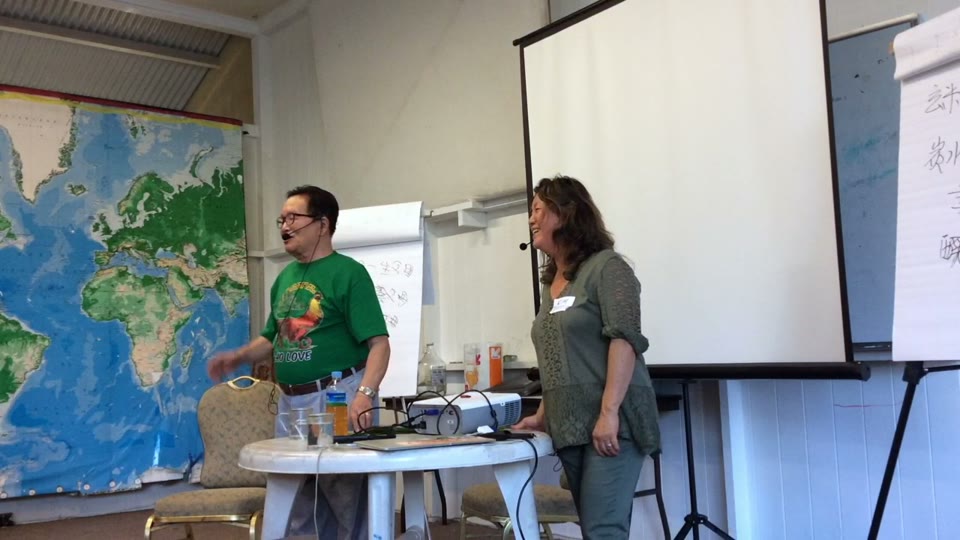
Late Thursday afternoon, Cho standing in front of the world map with Kim Chang interpreting. No slides; nothing legible on the flip chart until he writes 3章6節 (Chapter 3, Verse 6) near the end. This is his life story and his faith, told in his own order; a few dates in it don't match his books (see cho_check).
-
Cho went only as far as elementary school, then worked in 4-H as a young man
4-H's basic ideals, in Cho's Korean: 지덕노체, knowledge, virtue, labor, body. The room worked out head, heart, hands, health. The interpreter says he led 4-H in Gyeonggi-do; Cho's Korean there is unclear.
▶ 2:58:50 As spoken
-
After the Korean War brought in livestock from America, Gyeonggi Province opened a livestock technology training center
Entry needed a university degree or the local government head's recommendation. Cho had neither; the governor called him in and gave him his own recommendation.
▶ 3:00:46 As spoken
-
The entrance exam was 90 applicants to 1 place, and Cho passed at the top
▶ 3:02:52 As spoken
-
The course was six months; the top graduates got a veterinarian's license, and Cho also got an artificial-insemination license
The interpreter's line was heard as '26-month trainee'.
▶ 3:03:40 As spoken
-
A doctor's job is to keep disease from happening, not to cure it, so Cho quit veterinary work
He went looking for a way of farming in which disease doesn't happen.
▶ 3:04:56 As spoken
-
Cho went to Japan at the Japanese government's invitation, taught himself Japanese, and became a visiting professor at four Japanese universities
He lectured on natural farming. The interpreter called it a scholarship. Later he became an expert of the Asian Productivity Organization (APO) and spread natural farming across Asia.
▶ 3:07:02 As spoken
-
Feeling he had to study, he entered high school at 26 by a qualifying exam; his homeroom teacher was younger than him
'Age 26' comes from the interpreter. Then came Korea's May 16 (1961) revolution, which he joined; his role ('represent farmer', 'congressman') is only in the interpreter's English.
▶ 3:09:06 As spoken
-
He really learned natural farming in Japan, after high school, from three teachers
Yamagishi Miyozo (taught him a great deal), Shibada Genshi (enzyme fermentation), Ōinoue Yasushi (bred the Kyoho grape).
▶ 3:11:17 As spoken
-
Ōinoue Yasushi was the first person on earth to create the nutritive cycle
Cho says he'll explain it tomorrow (Friday).
▶ 3:13:04 As spoken
-
His greatest teacher was Jesus; more than 95% of what led him to natural farming he found in the Bible
Key verses: 1 Corinthians 3:16-17 (your body is God's temple, keep it well) and 3:6-7.
▶ 3:13:37 As spoken
-
1 Corinthians 3:6-7 is the growing method of natural farming: I planted, Apollos watered, but God gave the growth
The farmer plants and waters; the growing isn't the farmer's doing.
▶ 3:16:27 As spoken
-
His group grew rice on 8 million pyeong
800만 평 is about 2,645 ha, about 6,500 acres. The interpreter said 8,000 acres.
▶ 3:17:55 As spoken
-
He named the rice '3:6' after 1 Corinthians 3:6, and it sold out
Many wanted the name. A kimchi maker asked for it; Cho said no until he went to church.
▶ 3:19:38 As spoken
-
Cho spreads natural farming as mission work
Then Tanzania: a roofless Anglican church whose priest wouldn't take money for a roof, until Cho left it with him. Lesson: don't refuse grace; receive it with thanks.
▶ 3:22:08 As spoken
- This is Cho's own telling, in story order, not a dated record. His books give some events different dates or details (see cho_check).
- Several pieces of Cho's Korean are garbled in both machine passes: the 4-H role, his part in the 1961 revolution, the National Assembly line, and the high-school exam.
- The page is mostly biography and faith; there is no field technique on it.
- Cho's aim from the start was farming in which disease doesn't happen, rather than curing it.
- Plant and water, then let the growing happen: the farmer's job is to set conditions.
What the room didn't hear
Where the English in the room left out or changed what Master Cho said in Korean.
-
▶ 3:03:40
The room heard He's a 26-month trainee.
Cho said It was six months of study and then graduation, and whoever graduated at the top was given a veterinarian's license.
The course length came through as '26 months'.
-
▶ 3:07:02
The room heard Study at the scholarship. He got the scholarship.
Cho said Did I go the regular way? No. The Japanese government invited me.
An invitation from the Japanese government, not a scholarship.
-
▶ 3:11:46
The room heard There is one person called Yamashita.
Cho said The one who taught me a great deal was called Yamagishi Miyozo.
The first teacher's name was wrong in the room, and the interpreter said she couldn't remember it.
-
▶ 3:13:04
The room heard The one who developed giant grapes, he studied the nutrient cycle.
Cho said I'll tell you about this tomorrow, but the first person on earth to create the nutritive cycle was Ōinoue Yasushi.
'Created first' became 'studied', and the promise to explain it on Friday was dropped.
-
▶ 3:17:55
The room heard He was able to harvest 8,000... 8 million? 8,000 acres of rice.
Cho said Eight million pyeong.
8 million pyeong is about 6,500 acres; '8,000 acres' is about 23% high.
Next to Master Cho's books
-
Differs
Livestock course length Here Cho says the Gyeonggi livestock course was six months. The timeline from his 1997 book says a nine-month provincial livestock course in 1958. The 90-to-1 exam and the vet license agree.
appendix-b-timeline — Cho's early life, 1935–1966
-
Agrees
Three Japanese teachers Same three as his 2003 book: Yamagishi, Shibada, Ōinoue. The book says he met them through their writing and families after their deaths; here he just says 'I met'.
Cho, Janong Natural Farming (2003), p. 7
-
Agrees
Ōinoue first created the nutritive cycle and bred Kyoho Ōinoue proposed the nutritive cycle theory in 1936 and named the Kyoho grape in 1946.
appendix-b-timeline — The teachers, 1892–1961
“Curing disease is not the doctor's job. The doctor's job is to keep disease from happening.”
▶ 3:04:56
“I planted, Apollos watered, but God gave the growth.”
▶ 3:16:27
“The dreams God gives you as you farm, His grace: don't refuse it. Receiving it with thanks is the heart that lets you do natural farming.”
▶ 3:26:43
In this part
- 2:57:56Twenty minutes to dinner; elementary school and 4-H
- 3:00:19Livestock school: 90 to 1, veterinarian
- 3:04:39Prevent disease, don't cure it; on to Japan
- 3:09:05High school at 26 and the May 16 revolution
- 3:11:16Three teachers: Yamagishi, Shibada, Ōinoue
- 3:13:22The greatest teacher: 1 Corinthians 3
- 3:17:498 million pyeong of rice named 3:6
- 3:20:58The kimchi maker; mission
- 3:22:40Tanzania: the church with no roof
Transcript
English translation, checked against the Korean as spoken.
2:57:56 Master Cho: If I talk for about 20 more minutes, it will be time to eat, so let me tell you what led me to take up this natural farming.
한 20분만 더 얘기를 하면 식사 시간이 되니까 그러면 제가 이 자연농업을 하게 된 동기를 말씀드리겠습니다.
2:58:07 Kim Chang (interpreter): I wanted to tell you how I started natural farming.
2:58:15 Master Cho: I… only went as far as elementary school. I couldn't go on past elementary school, and from when I was young, in the countryside, [unclear: a rural youth organization]
저는… 초등학교밖에 못 다녔습니다. 그 초등학교 때는 못 다녔는데, 제가 어렸을 때부터 농촌 (불명확: 청년 단체)
2:58:37 Kim Chang (interpreter): I joined the 4-H club and I worked there.
2:58:39 Master Cho: I worked in that organization. The basic ideals of 4-H are ji-deok-no-che: knowledge, virtue, labor and body.
그 단체에서 일했습니다. 그럼 4H의 기본 이념은 지덕노체(智德勞體)
2:58:53 Kim Chang (interpreter): Oh, that's wisdom? Heart.
2:59:03 Audience: Head, heart.
2:59:07 Kim Chang (interpreter): Hands. Hands. And then your health. Health. Four H's. So he was teaching the little children about the 4-H.
2:59:21 Master Cho: This is what teaches young children about the future… [rest unclear]
이것이 어린 젊은 아이들에게 미래를 가르쳐주는 (불명확)
2:59:35 Kim Chang (interpreter): So, wisdom, heart, health, and labor? Movement.
2:59:55 Master Cho: That's it, that's it. So my record in that work was so good that… [unclear] Gyeonggi-do… [The interpreter: he was president of the 4-H club in Gyeonggi-do.]
그런 거예요. 그런 거예요. 그래서 그 (4H) 활동 실적이 너무 좋아서 (불명확) 경기도 (불명확)
2:59:55 Kim Chang (interpreter): Something like that. So he was the president of the 4-H club in Gyeonggi-do, in Korea.
3:00:19 Master Cho: But then the war broke out in Korea, and
그런데 그때 한국에 (6.25) 전쟁이 일어나서
3:00:19 Kim Chang (interpreter): But there was a war in Korea, and there were lots of livestock that came from the outside,
3:00:25 Master Cho: a great many livestock came in from America.
미국에서 가축이 아주 많이 들어왔어요.
3:00:38 Kim Chang (interpreter): So there is a, no one knows how to take care of these livestock, so he created a Gyeonggi-do
3:00:39 Master Cho: But Korea had no livestock technicians, so Gyeonggi Province set up the Gyeonggi Livestock Technology Training Center.
그런데 한국은 축산 기술자들이 없어가지고 경기도가 경기도 축산기술훈련소를 만들었어요.
That's the first few minutes. Members read all 251 lines, with the Korean as spoken, and watch along.
Become a member