Baby Food by Age: Mugwort FPJ First, Fruit FFJ Later
Master Cho Han-kyu, interpreted by Kim Chang, Founder of Korean Natural Farming (Janong)
Master Cho spoke Korean, with an interpreter. We translated every Korean line again and checked it, so you read what he said, not only what the room heard.
Members watch every session
The whole seminar, as it happened, with the checked English beside the video. Membership is $60 a year.
This part runs from 21:53 to 43:10 of the session video. Keep watching and the next part plays on.
Now playing the next part: Ōinoue's Theory, Cho's Chart: Where the Cycle Came From
Cho uses a person's ages as the picture for a crop: from 1 to 15 the body is being built, so the young crop gets Food (FPJ) of mugwort and water dropwort for iron and manganese; from about 15 to 25 it gets Food (FFJ) of ripe fruit and opened flowers, once a week each. Dr. Park sorts out which plant carries which mineral. Then Cho tells farmers to run comparison plots, remembers the 78-year-old grandmother who taught him, and says the old farmers farmed with wisdom.
What he taught
Which Food does a crop need while it builds its body, and when does it switch to fruit and flower juice?
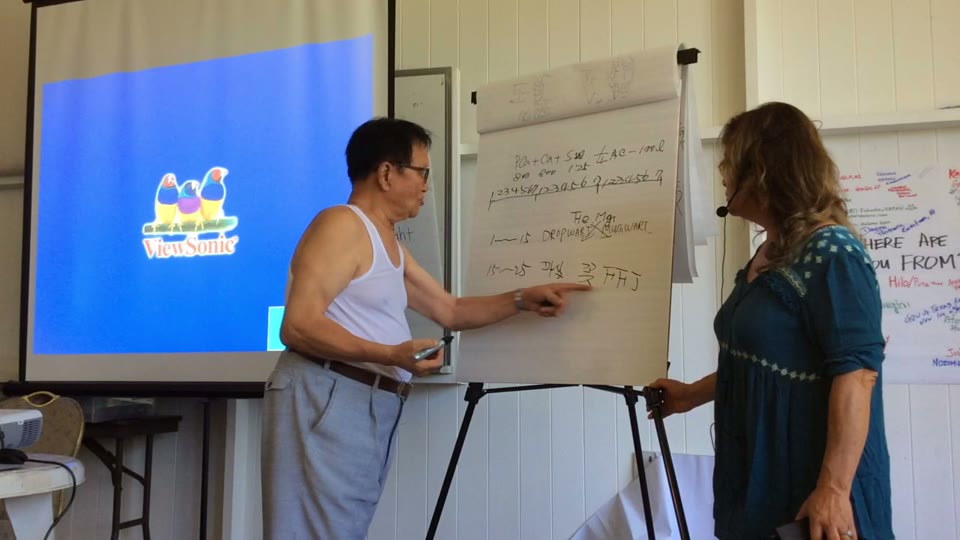
Still at the flip chart, with the projector showing only a blank screen. Under the weekly spray formula from the last page, Cho writes '1~15 DROPWART MUGWART' with 'Fe Mn' over them (first written the wrong way round, then crossed), then '15~25 과실 꽃 FFJ', and marks 1—15 and 15—25 under the three weeks of 1–7. The flip chart comes down at about 42:30 so the projector can be used.
- Food for the body-building stage — Food (FPJ) of mugwort (쑥) and water dropwort (미나리), once a week (Cho). No dilution spoken. The handout (XFLH5606) gives 발효액 (쑥·미나리) 1:500 in the seed and seedling column, and 1:500 (mugwort, dropwort, 동자액 young green fruit) in Type 2.
- Food for the flowering and fruiting stage — Food (FFJ) of ripe fruit or fully opened flowers, once a week (Cho and interpreter). On a mango carrying big and small fruit, use the juice made at that flowering time. No dilution spoken. The handout gives 1:500 (acacia flower, 동자액, fruit ferment) at the changeover and 1:2000–3000 (acacia flower, fruit ferment) in Type 3, so the printed Type 3 rate is much weaker than the earlier stages.
-
Like a child of 1 to 15, a young crop gets Food (FPJ) of mugwort and water dropwort
Board: '1~15 DROPWART MUGWART' with 'Fe Mn' over them. The body is being built, so it needs iron and manganese.
▶ 22:04 Written on the board
-
Mugwort carries more iron; water dropwort carries more manganese
First said the other way round, with 'magnesium' for manganese. Dr. Park corrected it from the room, and Cho's own Korean at 26:15 confirms: mugwort iron, dropwort manganese.
▶ 24:02 As spoken
-
Ages 1 to 15 are the body-building years, so iron and manganese are needed in quantity
Cho's picture: a child's body is being built fast; so is a young crop's.
▶ 29:03 As spoken
-
Past that, there's no need to build the body: switch to fermented flowers and setting fruit (FFJ)
Cho says 'past twenty' here; the board and his later Korean say 15–25. The interpreter said '20 to 45'.
▶ 29:18 As spoken
-
When the crop flowers and sets fruit, give the juice made at that stage
Cho at the board: a mango tree carries big and small mangoes at once; give the fermented juice of the flowering time. Same family of Food, different kind.
▶ 30:48 As spoken
-
Ages 15–25: Food (FFJ) of ripe fruit or fully opened flowers
Board: '15~25 과실 꽃 FFJ'. At this age the body stops getting bigger and the job becomes raising a baby, so not mugwort or dropwort but fruit or flower juice works best.
▶ 31:23 Written on the board
-
The switch comes at about one third of the plant's growth
Interpreter: 'when their height is one third of that crop… a three meter crop… one foot high'. Cho's Korean, partly audible, seems to count the leaves the crop grows over a whole year. Not settled.
▶ 33:48 As spoken
-
Weekly: first half, mugwort and dropwort once every week; second half, fruit or flower once every week
Cho: 'then the nutrition is balanced.' The interpreter turned this into 'two weeks'.
▶ 35:07 As spoken
-
Don't wait to treat a disease; match the nutrition so it doesn't come
Cho's prevention-first rule; the interpreter gave only 'they will grow very healthy'.
▶ 36:12 As spoken
-
Run comparison plots until you can read the crop at a glance
Treat one plot this way and another that way, watch them grow, and the process gets into your body: one look and you see what you did wrong.
▶ 36:40 As spoken
-
One of Cho's teachers was a grandmother of 78; he was about 30
She taught by history and old stories: her parents farmed by watching the seasons and nature. His teacher in Japan stopped lecturing if a student sat crooked.
▶ 38:52 As spoken
-
The old farmers farmed with wisdom, watching nature; modern farmers farm with the head
Modern people calculate and can't work out the answer. Old people cared about each other; now everything is calculated, 'so there's no warmth (정)'.
▶ 40:24 As spoken
- No dilution is spoken on this page; the rates in the treatments come from the printed handout.
- The ages (1–15, 15–25) are a human picture, not a crop calendar. How they map onto a crop is not settled: the interpreter's 'one third of the height… a three meter crop… one foot' doesn't add up, and Cho's Korean there is partly inaudible.
- On the board, 1—15 and 15—25 are marked under three weeks of 1–7; whether they mean days or the ages laid over the weeks is not clear.
- The interpreter called 미나리 'watercress'. It is water dropwort (Oenanthe javanica), a different plant.
- Cho explains the mugwort and dropwort choice with Korean care of mothers after childbirth and the Dongui Bogam (iron for lost blood, manganese for healing). Those are claims about people, not tested here, and we don't repeat them as advice.
- While the crop is building its body, Food (FPJ) of mugwort and water dropwort assists it with iron and manganese.
- Once it flowers and sets fruit, switch to Food (FFJ) of ripe fruit or opened flowers, made at that stage.
- Give Food once a week, in rhythm, rather than waiting for a problem.
- Keep a comparison plot so you learn to read your own crop.
What the room didn't hear
Where the English in the room left out or changed what Master Cho said in Korean.
-
▶ 23:33
The room heard You need to give them dropwort, which is watercress, and the mugwort.
Cho said 미나리: water dropwort.
Watercress is a different plant. Make the Food from water dropwort.
-
▶ 34:19
The room heard So after that, when they became the ability to have a baby, so you need to prepare them.
Cho said At that age the body doesn't get bigger; the job of raising a baby has to develop, so not mugwort or dropwort: fermented juice of fruit or flowers works best.
The reason for changing the Food was dropped.
-
▶ 35:07
The room heard So it's like up to here, it's almost two weeks, so two weeks you need to use this material for the young plant.
Cho said Week by week: in the first half, mugwort and dropwort once every week; in the second half, fruit or flowers once every week. Then the nutrition is balanced.
Cho's once-a-week rhythm became 'two weeks'.
-
▶ 36:12
The room heard So if you give a nutrient according to their nutrient cycle, they will grow very healthy.
Cho said Don't wait to treat a disease once it comes. Match the nutrition so it doesn't come, and it won't.
Cho's prevention-not-cure rule was softened to a general promise.
Next to Master Cho's books
-
Agrees
Mugwort iron, dropwort manganese His 2006 text gives the same split: mugwort rich in iron, dropwort in manganese, found after puzzling over why women used them.
CGNF Advanced (2006.02) (English translation), p. 9
-
Agrees
Mugwort and dropwort FPJ for the young stage The October 2017 prescription table puts FPJ of mugwort and dropwort at 1:500 in the seed and seedling column.
Cho nutrient cycle prescription table (Oct 2017, transcribed) — Seed/Seedling Treatment (종자·종묘처리)
-
Agrees
Body-building first, then the reproductive switch His 2003 book says the change from vegetative to reproductive growth doesn't happen at once; the plant prepares for it. The human ages here are this session's picture for the same idea.
Cho, Janong Natural Farming (2003), p. 81
“So don't wait to treat a disease once it comes. Match the nutrition so it doesn't come, and it won't.”
▶ 36:12
“When your body goes crooked, your thinking goes crooked too, so you can't listen properly.”
▶ 38:09
“Olden days, they farm with the wisdom, and the modern farming is with their head.”
▶ 40:55
In this part
- 21:53Ages 1–15: mugwort and dropwort Food (FPJ)
- 23:24Iron or manganese? Dr. Park sorts it out
- 24:51Why mugwort and dropwort: iron and manganese
- 28:21Fast growth, then flower and fruit Food (FFJ)
- 30:35The board: 15–25, fruit and flower FFJ
- 33:31When to switch, and the weekly rhythm
- 36:12Prevent, don't treat; run comparison plots
- 37:44Sit up straight: the grandmother who taught Cho
- 40:24Farming with wisdom, not the head
Transcript
English translation, checked against the Korean as spoken.
21:53 Kim Chang (interpreter): I'm going to compare with the human being now.
21:56 Master Cho: Take a person. From age one… until about fifteen, you give mugwort and dropwort FPJ. This [dropwort?] is iron…
사람이야. 한 살에서 [열다섯 살] 될 때까지는 쑥, 미나리 천혜녹즙을 주는 거예요. 이 [미나리?]는 철분이고…
22:46 Because this is in it — the iron makes blood, makes blood, and drives growth. [unclear — about children growing well] And what guards that is our manganese — it [unclear]… From age one to about [fifteen], you give this.
이게 들어 있기 때문에, 이 철분이 있는 것은 피를 만들고, 피를 만들고 [성장 작용]을 시키려고. [불명확: 아이들이 잘 자란다는 내용] 그걸 막아 주는 게 우리 망간이 [불명확]를 막아 주는 거예요. 한 살서부터 몇 살까지는 요걸 주는 거고
23:23 Kim Chang (interpreter): So let's say you're a human being between one year old to 15 years old. You need to give them dropwort, which is watercress, and the mugwort. The dropwort has an iron, so it helps the blood. And then the mugwort has a magnesium.
23:43 Master Cho: Manganese.
망간.
23:44 Kim Chang (interpreter): Magnesium.
23:46 Audience: Magnesium? Is it magnesium? No.
23:51 Master Cho: Manganese.
망간.
23:52 Audience: Manganese. (spelling it out) M-A-N-…
23:56 Kim Chang (interpreter): Manganese.
24:02 Dr. Hoon Park: Mugwort is iron — iron.
쑥이 철분이요, 철분.
24:07 Kim Chang (interpreter): Mugwort has more iron. Watercress has more manganese. Minari… sorry, is it the other way around? Thank you, Dr. Park. Mugwort has more iron and the watercress, dropwort, They have more manganese. Manganese.
24:50 Master Cho: So in Korea, when a mother gives birth, the grandmothers come and do the after-birth care, and they always boil dried mugwort and wash her with that water.
그래서 이게 이제 한국에서는 엄마가 아기를 낳으면 할머니들이 와가지고 산후조리를 하잖아. 꼭 마른 쑥을 갖다가 끓여가지고 그 물로 씻겨.
That's the first few minutes. Members read all 170 lines, with the Korean as spoken, and watch along.
Become a member