Seawater 1:30, Two Hours Before Sunset = Fast Uptake
Master Cho Han-kyu, interpreted by Kim Chang, Founder of Korean Natural Farming (Janong)
Master Cho spoke Korean, with an interpreter. We translated every Korean line again and checked it, so you read what he said, not only what the room heard.
Members watch every session
The whole seminar, as it happened, with the checked English beside the video. Membership is $60 a year.
This part runs from 41:38 to 58:06 of the session video. Keep watching and the next part plays on.
Now playing the next part: Microbes Digest, You Absorb: Keep Microbes and Feed Local
Cho says the soil's hometown is the sea, from Genesis, and tells Elisha salting the spring in 2 Kings as the Bible's seawater story. Then the ranch: cows dying on acidic grass, an owner afraid of salt, and the fix, seawater diluted 1 to 30 because seawater is 3% salt and a plant's green blood 0.1%. For drought pasture he gives the timing: spray 1 part seawater to 30 parts fresh water two hours before sunset, cut and feed the next day, and the same timing for every crop.
What he taught
How much seawater does Cho give an acidic or drought-stressed pasture, and when?
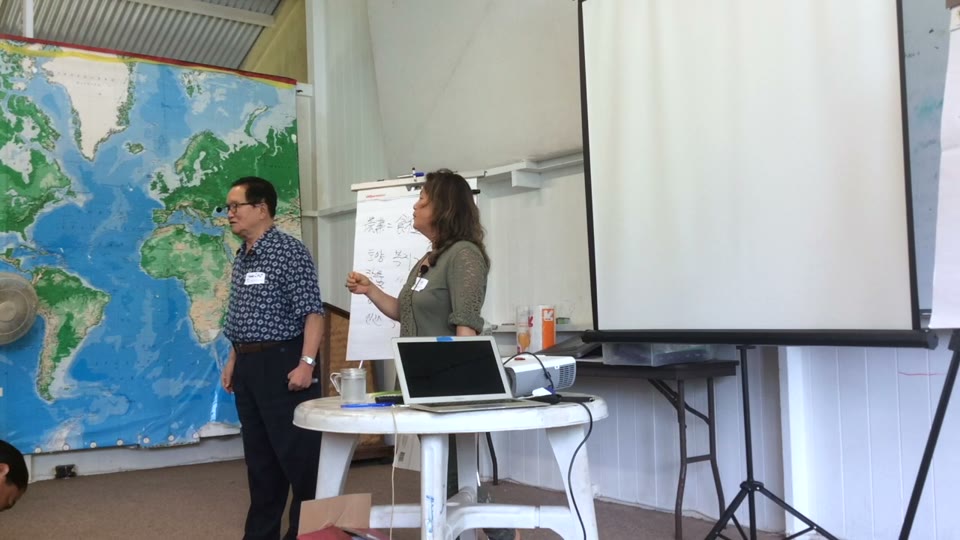
Thursday morning, about 42 minutes in. Cho stands at the flip chart (earlier notes still showing) and tells the story of a big Hawaiʻi ranch he visited. No slides; the numbers are spoken. Near the end he sits down because his legs hurt.
- Seawater for an acidic pasture (the ranch) — 1 part seawater to 30 parts water (1:30), sprayed on the pasture to bring acidic grass to neutral. Reason: seawater is about 3% salt and alkaline; a plant's 'green blood' is 0.1% salt, so 1 into 30 matches it. Cho's Korean and the interpreter agree on 1:30.
- Seawater for drought pasture — 1 part seawater (바닷물) to 30 parts fresh water (민물), sprayed on the pasture about two hours before sunset; cut and feed the grass the next day. Source: Cho's Korean (the word 'sunset' is a reconstruction). The interpreter gave 1:30 and the next-day cutting, said 'two hours before sunrise', then corrected to 'late afternoon, 3 or 4 pm' and 'before sun goes down two hours'.
- Timing for every crop — Give nutrients, the nutrient solution, about two hours before sunset to any crop or fruit tree (Cho names macadamia, papaya, mango); absorption gets very fast. Source: Cho's Korean; the interpreter dropped the crop list.
-
The soil's hometown is the sea, so Natural Farming uses a lot of seawater.
Cho cites Genesis: the waters gathered into the seas and the dry land appeared out of them.
▶ 43:19 As spoken
-
Elisha poured very clean salt into the spring; the salt water reached the sick fields and they gave a good harvest.
Cho places it in Second Kings (열왕기하). His Bible precedent for seawater.
▶ 45:16 As spoken
-
More than 95% of Natural Farming comes from the Bible, and the Bible is action and practice.
The interpreter said 'about 95%'.
▶ 46:56 As spoken
-
At a big dairy ranch on the drive from Hilo, cows died after grazing; Cho tasted the grass and found it strongly acidic.
Acidic grass rots the cows' stomachs; the pasture had to be made neutral. The ranch is not named with certainty (heard as 'Parker Ranch').
▶ 49:18 As spoken
-
Seawater is alkaline, so it brings acidic pasture to neutral.
The owner feared salt poisoning would kill more cows. Cho: 'knowledge became a disease.'
▶ 51:10 As spoken
-
Seawater is 3% salt; a plant's green blood is 0.1% salt; so put 1 part seawater into 30.
3% ÷ 30 = 0.1%. Animal blood is red, plant blood green.
▶ 51:59 As spoken
-
With 1:30 seawater on the pasture, the grass came back to neutral and the cows recovered.
Interpreter: 'cows these days are all cured.' Cho's Korean here is partly unclear.
▶ 53:43 As spoken
-
Pigs or chickens fed strongly acidic grass can die.
Interpreter: 'might die or get sick.'
▶ 54:02 As spoken
-
In Hawaiʻi, when rain is followed by a dry spell, grass is likely to turn acidic.
This is the drought case for the spray below.
▶ 54:29 As spoken
-
In a drought, spray the pasture with 1 part seawater to 30 parts fresh water two hours before sunset, then cut and feed it the next day.
Cho's Korean: '[해 지기] 2시간 전에 바닷물 하나에다가 민물 삼십에 타 준 것을 목초지에다 뿌려 놓은 후에 그 이튿날...'. 'Sunset' is reconstructed; the interpreter first said 'sunrise', then '3 or 4 pm'.
▶ 54:54 As spoken
-
About two hours before sunset is when the crop takes in nutrients most vigorously.
Cho links it to the day's carbon assimilation winding down (that phrase is partly reconstructed).
▶ 55:35 As spoken
-
The same two-hours-before-sunset timing goes for every crop and fruit tree: macadamia, papaya, mango. Absorption gets very fast.
Not only pasture.
▶ 55:57 As spoken
-
It is a 'plant clock', set by where the sun rises and sets, matched to the physiology of every living thing.
The interpreter: 'according to their cycle, nutrient cycle.'
▶ 56:26 As spoken
-
Supply the right kind, at the right time, in the right amount (적기, 적질, 적량), matched to the crop's life.
Cho: 'what we're doing is working out which nutrient the crop needs and how much.'
▶ 57:02 As spoken
- The ranch result is Cho's story; no numbers on the pasture's acidity or the herd were given.
- 'Sunset' in Cho's Korean (해 지기, at 3294 and 3362) is a reconstruction: the machine pass heard only 'two hours before'. Sunset is what the interpreter settled on and what Cho's books say.
- The ranch name is not confirmed.
- The spray is for pasture and crops; Cho says later in the session that this seawater teaching is for crops, not for giving to livestock.
- Minerals (seawater) go on at 1 part to 30 parts fresh water, to match a plant's own 0.1% salt.
- After rain then drought, acidic grass can harm stock; diluted seawater assists the pasture back to neutral before it's fed.
- Spray about two hours before sunset (late afternoon), when the plant takes things up fastest; Cho gives the same timing for fruit trees and other crops.
What the room didn't hear
Where the English in the room left out or changed what Master Cho said in Korean.
-
▶ 49:18
The room heard So he went to that ranch and then ate their grass.
Cho said It was a dairy ranch. After the cows grazed the grass, they died. The owner said they were dying, so I pulled some pasture grass and ate it.
The interpreter skipped the set-up: dairy cows dying after grazing.
-
▶ 46:56
The room heard Our natural farming method about 95% is from the Bible.
Cho said More than 95% of Natural Farming comes from the Bible.
Cho said 'over 95%'.
-
▶ 55:22
The room heard 2 hours before sun rise.
Cho said Two hours before [sunset], one part seawater to thirty parts fresh water.
The room first heard 'sunrise'. She corrected to '3 or 4 pm' and later 'before sun goes down two hours'.
-
▶ 55:57
The room heard So all these nutrients when you give to your other crops, always do it [unclear].
Cho said Not just pasture: every crop and fruit tree, macadamia, papaya, mango. Give the nutrients two hours before [sunset] and absorption gets very fast.
The crop list and the reason (fast uptake) were dropped.
-
▶ 56:26
The room heard According to their cycle, nutrient cycle.
Cho said This is a plant clock, set by comparing where the sun rises and where it sets, matched to the physiology of every living thing.
Cho's 'plant clock' image didn't reach the room.
Next to Master Cho's books
-
Agrees
Seawater 3%, plant blood 0.1%, dilute 1:30 Same numbers and the same green-blood argument at his fruit seminar later in 2017.
2017/Advanced Cho/advanced fruit/IMG_3205 @ 1:31:41 (translated)
-
Agrees
Apply two hours before sunset The CGNF advanced text says to finish spraying two hours before sunset on clear days. The interpreter's 'before sunrise' is the odd one out.
CGNF Advanced (2005.08) (English translation), p. 8
-
Agrees
Seawater 1:30 as a first dilution His nutrient-cycle charts from this same week list seawater at 1:30 as the first dilution.
Cho nutrient cycle charts (scan, Oct 22 2017) (English translation), p. 2
-
Agrees
Elisha's salted spring as the Bible basis for seawater He told the same Elisha story earlier in 2017 at Papaikou.
2017/Cho - Papaikou/IMG_9592 @ 0:07:54 (translated)
“So the hometown of the farmland is the sea.”
▶ 43:19
“So knowledge became a disease.”
▶ 51:47
“It's a plant clock, set by comparing where the sun rises and where it sets.”
▶ 56:26
In this part
Transcript
English translation, checked against the Korean as spoken.
41:43 Master Cho: Where do you think the hometown of paddies, fields, soil is?
논, 밭, 토양의 고향이 어디라고 생각하세요?
41:49 Kim Chang (interpreter): So where is the soil's home? Anybody knows? The soil, hometown. Hometown. Hometown. Where is the hometown of the soil?
42:03 Master Cho: ...How come you say that?
…어떻게 해서 그렇게 말해요?
42:04 Audience: The ocean.
42:05 Kim Chang (interpreter): Oh, the ocean. Why do you think it's the ocean?
42:08 Master Cho: Why do you think it's the ocean?
왜 오션이라고 생각하세요?
42:12 Audience: Because Master Cho told me that.
42:15 Master Cho: Ah, he told you. Has anyone here read the Bible?
아, 그분이 말했죠. 여러분 성경 읽어보신 분 계세요?
42:26 Kim Chang (interpreter): Your answer is correct. Anybody read the Bible here? That's where the earth came out of the ocean.
42:37 Master Cho: What this means in detail: the earth, the land, rose up out of the sea. That's in Genesis, chapter … verse … (chapter and verse unclear). God, the Creator, spoke to the waters: 'Gather in one place.' And so it became the sea. And then He said, 'Let the dry land appear.' Appear what? Dry land, land. 'Let the land appear.' What appeared... ...became the land. So the hometown of the farmland is the sea.
이 자세한 말은, 지구 땅이 바다에서 솟아나왔어요. 그게 창세기 …장 …절 (불명확) 하나님께서, 창조주께서 바다에다 대고 '물은 한 곳으로 모여라.' 그래서 바다가 됐잖아요. 그리고 거기다 대고 '뭍은 드러나라' 그랬거든. 뭐를 드러내요? 뭍, 뭍, 땅. 땅을 드러내라. 드러나는 것이… …뭍이 된 거예요. 그래서 농토의 고향은 바다야.
43:22 Kim Chang (interpreter): So in Genesis there is a story that God said to the water, come all together, that became an ocean. And then God said to the land, come up. So that became a field and a land. The soil coming up from the ocean.
43:46 Master Cho: So the Creator called the dry land that appeared 'earth,' and the gathered waters He called 'seas.'
그래서 창조주께서 드러난 뭍을 갖다가 땅이라고 부르고, 모인 물을 바다라고 불렀다고.
43:52 Kim Chang (interpreter): So God said that the land coming up from the ocean, that is the land, and then the water, he called it ocean.
44:07 Master Cho: In Natural Farming, because the hometown, the soil's hometown, is the sea,
자연농업에서는 고향이, 토양의 고향이 바다에 있기 때문에
44:07 Kim Chang (interpreter): In natural farming, we know the hometown of the soil is the ocean, so when we farm, we use lots of ocean water.
44:26 Master Cho: And using seawater in farming...
그런데 바닷물을 갖다가 농사에 … 쓰는 것은
44:37 Kim Chang (interpreter): So in the Old Testament in the Bible, it has information saying that people give ocean water to the crop. It's in the Bible.
That's the first few minutes. Members read all 137 lines, with the Korean as spoken, and watch along.
Become a member