Raise Microbes, Moles Drain the Soil: Macadamias +20% a Year
Master Cho Han-kyu, interpreted by Kim Chang, Founder of Korean Natural Farming (Janong)
Master Cho spoke Korean, with an interpreter. We translated every Korean line again and checked it, so you read what he said, not only what the room heard.
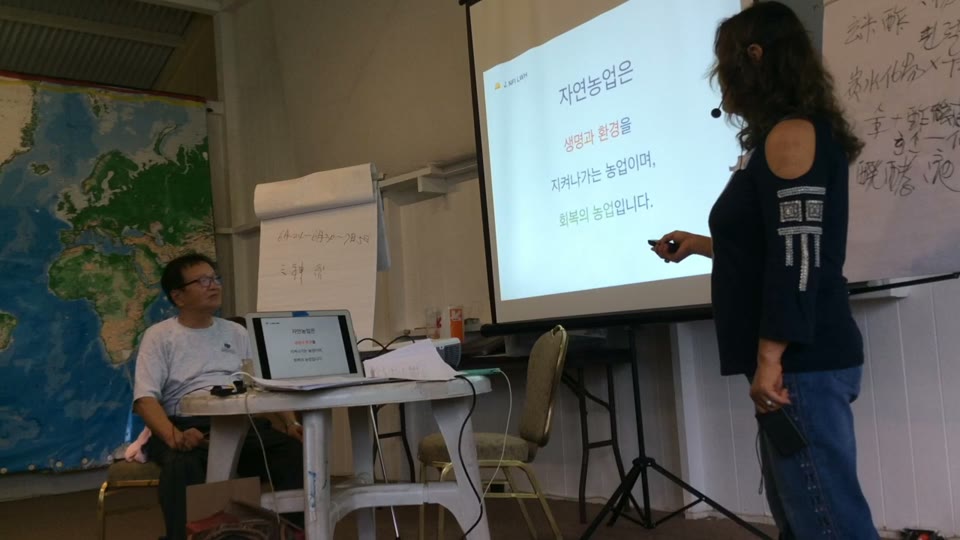
Members watch every session
The whole seminar, as it happened, with the checked English beside the video. Membership is $60 a year.
This part runs from 56:58 to 1:13:44 of the session video. Keep watching and the next part plays on.
Now playing the next part: Microbes 1 → 4: Bamboo Grove to 150 kg per 300 Pyeong
From a drawing of a plant, Cho traces the food chain under it: the leaf feeds the root, root waste feeds microbes, microbes feed earthworms, earthworms draw moles, and mole tunnels air the soil. He tells how Chris Trump's waterlogged macadamia orchard in Kohala came back that way, and how a paste of soil and Microbes (IMO4) healed trunk wounds. Then soil is the crop's mother, and Tanya leads a qigong break.
What he taught
How do microbes, worms and moles fix a waterlogged orchard without cutting the trees?
Cho points at his slide of a plant with sun, leaves, roots and soil life. The Chris Trump story is told without slides. The page ends with a five-minute qigong break (about 4118–4424 s).
- Trunk wound paste (macadamia) — Cho's Korean: soil, with Microbes (IMO4), plus rice bran and glutinous (sweet) rice cooked as porridge, mixed and put on the wounds. The interpreter said 'IMO4 and rice hull, and the rice, make porridge'. No amounts given.
- Draining a waterlogged orchard — Raise the microbes in the orchard so earthworms and moles come and open the soil. No product or rate given here.
-
150,000 to 200,000 microbes live on one square centimeter of leaf
A third of them are lactic acid bacteria and yeast. The interpreter gave only 150,000.
▶ 57:35 As spoken
-
The leaf makes sugar and starch from sunlight and sends it down the stem into storage
Shown on Cho's plant diagram.
▶ 58:07 From the slides
-
Crops pass waste through their roots, and it feeds the life in the soil
Microbes crowd in to eat the root waste; earthworms come to eat the microbes; moles come to eat the earthworms.
▶ 58:48 As spoken
-
Mole tunnels let air into the soil, and roots love oxygen
Cho asked if Hawaiʻi has moles; the room spelled it out.
▶ 1:00:35 As spoken
-
Chris Trump's dying macadamia orchard had standing water on its floor
Leaves dried and yellowish, chlorophyll weak. Waterlogged ground kept air from the roots. Cho told them not to cut the trees.
▶ 1:01:47 As spoken
-
The fix: raise the microbes, and the moles come and drain the water for you
▶ 1:02:14 As spoken
-
After that, the macadamia harvest rose 20% every year
Cho: 'What that was, was making the environment the plant grows in.'
▶ 1:03:18 As spoken
-
Wounds on big trunks healed after a paste of soil, IMO4, rice bran and sweet-rice porridge
Cho: the idea came to him on the spot, from God shaping man out of soil.
▶ 1:04:47 As spoken
-
Soil is the crop's mother, as the womb is the baby's
Restore the soil and the crop grows well.
▶ 1:06:23 As spoken
-
Modern farming puts poison in the soil, then sprays pesticide when the crop dies
▶ 1:07:43 As spoken
- The 20% yearly rise is Cho's figure from memory; no records were shown.
- No amounts were given for the trunk paste; Cho's 'rice bran' and 'sweet rice' are our reading of unclear Korean.
- Cho likens trunk wounds to skin cancer and calls conventional food poison; these are comparisons, not tested, and we don't repeat them as advice.
- Look at drainage before cutting a failing tree: standing water keeps air from the roots.
- Feeding the soil life assists drainage; worms and moles open the ground.
- A leaf feeds the soil through its roots; keep the chain from leaf to microbe to worm intact.
- Soil with Microbes (IMO4) and a little cooked grain can be tried on trunk wounds.
What the room didn't hear
Where the English in the room left out or changed what Master Cho said in Korean.
-
▶ 57:44
The room heard 150,000 microorganisms reside in 1 cm area of the leaf.
Cho said 150,000 to 200,000 of these organisms live on one square centimeter of leaf.
The upper figure was dropped.
-
▶ 1:01:53
Cho said They said they would cut the trees down. I told them not to. Look, water is standing here on the ground.
The decision not to cut the trees never reached the room. 'Cut down' is our best reading of unclear Korean.
-
▶ 1:05:01
The room heard So we mixed soil with IMO4 and rice hull, and the rice, make porridge, and mix together.
Cho said Soil with IMO4, and on top of that rice bran and glutinous (sweet) rice as porridge, mixed in and put on.
Rice bran, not rice hull; the sweet rice was lost. Cho's Korean is not fully clear.
-
▶ 1:05:56
The room heard But after he came home, all of a sudden it hit him: God created us with the soil.
Cho said I went without any idea, and right there it came to me in a flash: how God shaped man from soil. I did it, and the tree lived.
The idea came on the spot, not after he went home.
Next to Master Cho's books
-
Goes further
Macadamia orchard revived, yield up every year In 2018 Cho tells the same rescue as dissolving IMO4 in water and spraying it around the roots. Here his fix is drainage by raising microbes so moles come, plus a soil-IMO4 paste for trunk wounds, and a 20% yearly rise.
2018/Cho - advanced hawaii/cho advanced 2018 3-2 @ 1:28:37 (translated)
-
Agrees
Microbes per square centimeter of leaf, a third of them LAB and yeast In 2018 he gives 100,000–150,000 per cm² with a third of them the same group; the range shifts a little between talks.
2018/Cho - advanced hawaii/cho advanced 2018 3-2 @ 2:06:50 (translated)
-
Agrees
Soil is the crop's mother In the 2017 fruit seminar: a healthy baby comes from a healthy mother, and mother and soil are the capital.
2017/Advanced Cho/advanced fruit/IMG_3443 @ 0:44:45 (translated)
“Everything in the universe grows by God's harmony and providence, not by the technology and machinery people have developed.”
▶ 1:01:12
“What we did is we made the right environment for the crop to grow. That's all we did.”
▶ 1:03:33
“Where do you think the crop's mother is?”
▶ 1:06:23
In this part
Transcript
English translation, checked against the Korean as spoken.
56:58 Kim Chang (interpreter): So this is like a crop that you can say is a papaya or mango or whatever crop you are
56:59 Master Cho: So, look carefully at this picture here.
그래서 여기 영상 좀 잘 보세요.
57:20 Kim Chang (interpreter): growing.
57:21 Master Cho: Now, this leaf has chlorophyll in it.
그런데 이 이파리에는 엽록소가 있어.
57:21 Kim Chang (interpreter): So in a leaf there is green chlorophyll in there.
57:29 Master Cho: And take one square centimeter of this leaf:
그리고 이 잎이 사방 1cm.
57:32 Kim Chang (interpreter): There is only one centimeter of that leaf space.
57:35 Master Cho: 150,000 to 200,000 of these organisms live on it. On one square centimeter.
이 생물이 15만에서 20만 마리가 살아요. 사방 1cm.
57:44 Kim Chang (interpreter): 150,000 microorganisms reside in 1 cm area of the leaf.
57:55 Master Cho: A third of them are lactic acid bacteria and yeast.
그 중에 3분의 1이 유산균하고 효모균입니다.
58:01 Kim Chang (interpreter): There is a one-third of it is lactic acid bacteria in the yeast.
58:07 Master Cho: So when it meets sunlight, it makes sugar, starch.
그래서 그것이 햇빛을 만나가지고서 당분을, 전분을 만들어.
58:14 Kim Chang (interpreter): So when they receive the sunshine, they make a sweet carbohydrate.
58:25 Master Cho: Once it has made the starch, it can't just keep it as it is. It digests it and stores it all away, down the stem, into storage.
그걸 만들어가지고서 전분을 그대로 가지고 있으면 안 되니까요. 그걸 소화시켜가지고서 줄기로, 창고로 다 저장시켜요.
58:31 Kim Chang (interpreter): So they want to store the carbohydrates, so they send it down to the root area and they store the carbohydrates.
58:48 Master Cho: But it isn't only people who eat food and pass waste. Every crop passes waste too.
그런데 사람만 음식을 먹고 대소변을 보는 게 아니라 모든 작물도 다 대소변을 봐요.
58:57 Kim Chang (interpreter): Not only the human being has a waste, even the crops have their own waste.
59:03 Master Cho: [Unclear: about the crop passing its waste.] Then what eats this excrement?
대소변을... (불분명) 그러면 이 배설물은 뭐가 먹어?
59:07 Kim Chang (interpreter): So those wastes go out through their roots.
59:14 Master Cho: Microbes that feed on it come crowding in.
이걸 먹이로 삼는 미생물이 몰려들어.
59:17 Kim Chang (interpreter): So those wastes coming out through the roots, All kinds of microorganisms are starting to gather by the roots because it is their food.
59:26 Master Cho: With so many microbes living there, the earthworms that live on microbes come to eat them.
미생물이 많이 사니까 미생물을 먹고 사는 지렁이가 또 미생물을 먹으러 오는 거예요.
59:36 Kim Chang (interpreter): So around the root there are lots of microbes residing so other little creatures are starting to come and eat microorganisms also.
59:43 Master Cho: And then moles turn up, to live on the earthworms.
또 지렁이를 먹고 살기 위해 두더지가 또 생기는 거예요.
59:51 Kim Chang (interpreter): So when there's an earthworm, there's a little creature digging the soil.
That's the first few minutes. Members read all 156 lines, with the Korean as spoken, and watch along.
Become a member