Microbes 1 → 4: Bamboo Grove to 150 kg per 300 Pyeong
Master Cho Han-kyu, interpreted by Kim Chang, Founder of Korean Natural Farming (Janong)
Master Cho spoke Korean, with an interpreter. We translated every Korean line again and checked it, so you read what he said, not only what the room heard.
Members watch every session
The whole seminar, as it happened, with the checked English beside the video. Membership is $60 a year.
This part runs from 1:13:44 to 1:46:24 of the session video. Keep watching and the next part plays on.
Now playing the next part: Till Shallow, Roots Go Deep: Corn Mulch, Cabbage, Rice
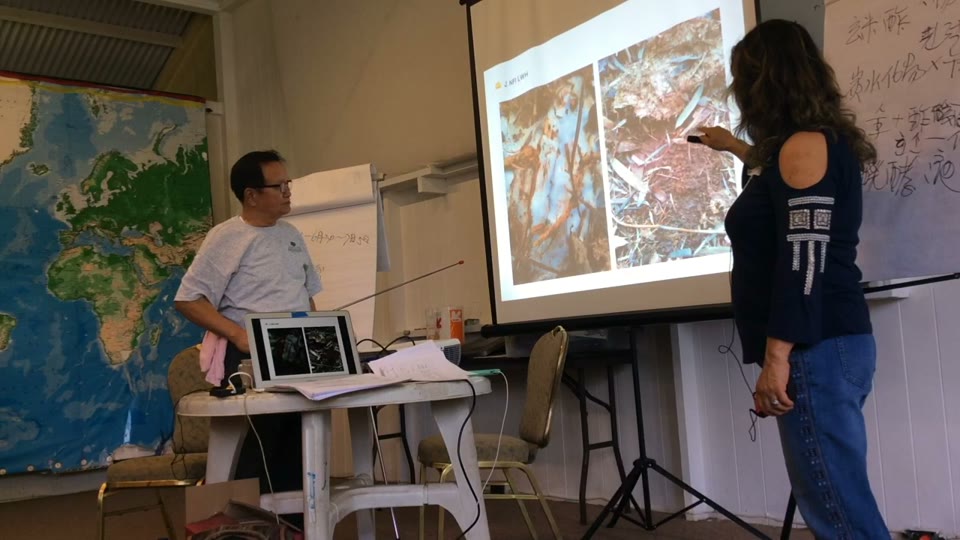
Cho walks through his Microbes (IMO) slides: the starter caught under bamboo, IMO2 with equal sugar, IMO3 on rice bran, and IMO4 made with half field soil so the local microbes meet their relatives. He says natural farming restores soil in two months where organic takes one to two years, then shows IMO4 spread at 150 kg per 300 pyeong in a Korean greenhouse: white film, earthworms, risen soil, and a 180 cm stick that goes all the way in.
What he taught
How do you grow the forest's microbes into something you can spread on a field, and what does it do there?
After the qigong break the camera clip changes (about 30 s of real time missing near 4426 s). Cho lectures from his own slides: photos of bamboo-grove mycelium and castings, the rice box, a Hawaiʻi basket version, IMO2, IMO3, IMO4 heaps, and a Korean greenhouse before and after. The slides carry no readable numbers. An audience member asks which stage he meant, and the interpreter checks the water step with Cho in Korean.
- IMO1 (bamboo grove starter) — Hard-cooked, firm rice (not sticky) in a lunchbox-type box, buried under bamboo. Hawaiʻi version on the slide: rice in a woven basket among dried leaves. Cho, from slides.
- IMO2 — IMO1 mixed with an equal amount of sugar, 1:1 (the interpreter said brown sugar).
- IMO3 — Cho: dilute IMO2 1,000 times and use it to bring rice bran to the right moisture. No rice bran: flour or corn flour mixed half and half with dried banana leaf, or steamed, dried, powdered sweet potato or banana. Interpreter only: moisture 65–70%, about 5 gallons of water per 60 lb of material; put Food (FPJ), Cleanser (brown rice vinegar), IMO2 and seawater (Minerals) or Mineral A in the water; turn when the pile reaches 110–120 (°F, units not said), generally once a day. Make it on a soil floor, seven parts shade to three sun, under cover from the weather, covered with a mat of dried, woven sugarcane leaves; nothing synthetic.
- IMO4 — Cho: IMO3 mixed half and half with soil from your own field or paddy, wetted and fermented again; he adds that half has to come from the mountain. Spread 150 kg per 300 pyeong (about ¼ acre). Feed up to 50% of animal feed. Bed prep shown: no weed scraping, a light rotary till, IMO4, then spray soil treatment solution (SOS); mulch over it outdoors.
- Soil treatment solution (SOS), promised as 'the recipe' — Not dictated on this page. The handout's soil-foundation column (토양기반조성) lists IMO4, Cleanser (brown rice vinegar) 1:500, Food (FPJ of mugwort and water dropwort) 1:500, Medicine (OHN) 1:1,000, malt (beer or sweet-rice-drink lees) 1:500, seawater 1:20–25, Mineral A 1:1,000; about 1 ton of liquid per 300 pyeong as the standard, soaking the top 20 cm; in drought add only more water.
-
A small starter, propagated, can bring five acres back to normal
Cho compared it to the five barley loaves.
▶ 1:14:28 As spoken
-
In a bamboo grove, earthworms gather under mycelium clumps, and their castings are the best organic fertilizer
The castings take a crumb structure.
▶ 1:15:20 From the slides
-
Chewed bamboo root gives sweet juice for 15 minutes; microbes love sweet, so they crowd into bamboo groves
That is why the starter is collected there.
▶ 1:16:18 As spoken
-
IMO1: firm cooked rice in a box, buried under bamboo
Slides show the box and a Hawaiʻi basket version.
▶ 1:17:13 From the slides
-
IMO2: IMO1 with an equal amount of sugar
▶ 1:18:51 From the slides
-
IMO3: IMO2 diluted 1,000 times moistens rice bran
Cho said rice bran; the room heard rice hull or mill run. Substitutes: flour or corn flour half and half with dried banana leaf; powdered sweet potato.
▶ 1:19:18 As spoken
-
IMO3 moisture 65–70%; about 5 gallons of water to 60 lb of material
Interpreter's figures, after checking the water step with Cho in Korean.
▶ 1:22:42 As spoken
-
Turn the IMO3 pile at 110–120 (°F), generally once a day
Interpreter only; units not said.
▶ 1:24:04 As spoken
-
Microbes grow best at seven parts shade to three parts sun, on a soil floor, out of the weather
In Hawaiʻi, cover with dried sugarcane leaves woven into a mat; nothing woven from synthetic fiber.
▶ 1:24:29 As spoken
-
IMO3 put straight on the field has no strength yet
▶ 1:27:44 As spoken
-
IMO4: IMO3 mixed half and half with soil from your own field or paddy
Cho adds that half has to come from the mountain; without it you can't make it.
▶ 1:28:08 As spoken
-
Field soil goes in because microbes are jealous: strangers fight, relatives are welcomed
The field microbes come out to fight and find cousins and uncles already there.
▶ 1:29:00 As spoken
-
Organic farming takes one to two years to bring soil back; natural farming materials take two months
▶ 1:32:04 As spoken
-
True organic farming is sunlight, air, water, soil, crops and people in organic harmony
Using organic materials is 'organic-materials farming'; using a little less chemical and calling it organic is 'a lie'.
▶ 1:33:35 As spoken
-
IMO4 can make up to 50% of animal feed with no problem
▶ 1:37:34 As spoken
-
Spread IMO4 at 150 kg per 300 pyeong (about ¼ acre)
Slide: a greenhouse bed covered in white IMO4. The interpreter first said 300 kg.
▶ 1:37:58 As spoken
-
IMO4 forms a white film over the ground and weeds can't come up through it
Outdoors, mulch over it: direct sun kills the microbes. The greenhouse bed shown had no mulch.
▶ 1:38:25 Shown in the room
-
That bed was poor soil; on rich soil the growth comes out black, not white
▶ 1:39:40 As spoken
-
Bed prep: no weed scraping, a light rotary till, IMO4, then soil treatment solution
Interpreter: 'like a chicken scratching the surface'.
▶ 1:40:24 As spoken
-
After two years of this, you won't need anything else
Cho: microbes are high-grade protein and high-grade calcium, so the crop does fine on that alone.
▶ 1:42:18 As spoken
-
Inside the greenhouse the same soil swelled up after soil-foundation building
Cho: dough without yeast stays hard; with yeast it becomes castella sponge cake.
▶ 1:43:03 Shown in the room
-
After 4 years of natural farming, a 180 cm stick goes all the way in anywhere in the cucumber greenhouse
Microbes and small animals did the deep tilling a tractor can't.
▶ 1:45:03 Shown in the room
- The slides are photos with no readable numbers; the greenhouse results are one farm's pictures, not measured trials.
- Several figures are the interpreter's alone: 65–70% moisture, 5 gal per 60 lb, turning at 110–120, and a '15 to 25 Celsius' whose meaning is unclear.
- About 30 s of real time is missing at the camera-clip join near 4426 s, and Cho's first words on the IMO slides are unclear.
- Cho said rice bran; the interpreter and audience said rice hull and mill run.
- 'Half from the mountain' is clear in Korean, but whether he means the IMO3 or extra forest soil is not.
- Cho's 50% of feed is higher than the 30% he gave in Hawaiʻi in 2018.
- Catch the starter where it's sweet: bamboo groves are full of microbes.
- Mix IMO1 1:1 with sugar for IMO2; dilute IMO2 1:1,000 to moisten rice bran for IMO3.
- Make IMO3 and IMO4 on bare soil, in shade, under a natural cover.
- Mix in your own field soil for IMO4 so the field's microbes meet relatives, not strangers.
- Spread about 150 kg per 300 pyeong (¼ acre), mulch it outdoors, and follow with soil treatment solution.
- Let microbes and small animals do the deep tilling.
What the room didn't hear
Where the English in the room left out or changed what Master Cho said in Korean.
-
▶ 1:20:12
The room heard So if you don't have rice hull you can use flour or corn flour...
Cho said In Korea it's rice bran (쌀겨); if you don't have rice bran, use wheat or corn flour half and half with dried banana leaf.
Bran became hull, and the room then talked about rice hulls and mill run.
-
▶ 1:28:33
The room heard So 50% of the soil from the field, you mix it with a nutrient water.
Cho said Mix in half soil from your field or paddy. Half has to come from the mountain; if you haven't brought it, you can't do it.
The mountain half was dropped.
-
▶ 1:38:09
The room heard This is a quarter acre, and they use 300 kg... 150 kg of IMO4.
Cho said Put 150 kg on 300 pyeong and it turns out like this.
The 300 is the area in pyeong, not kilograms.
-
▶ 1:39:48
The room heard If it has too much nutrient in the soil, it doesn't come out white, it comes out a dark color.
Cho said No, it's poor soil. If there were a lot of nutrients, it wouldn't come out white; it comes out black.
The answer to 'was that soil rich?' (no, poor) never reached the room.
-
▶ 1:42:26
The room heard Microorganism number four, you keep using for two years; after that you hardly use microorganism.
Cho said After just two years you won't need to use anything else, because microbes are high-grade protein and high-grade calcium.
Cho means you stop needing other materials; 'protein' also became 'nitrogen'.
-
▶ 1:16:24
The room heard When you chew bamboo roots, it's very sweet.
Cho said Has anyone chewed a bamboo root? Sweet juice comes out for 15 minutes.
The 15 minutes was dropped.
Next to Master Cho's books
-
Agrees
IMO1: cooked rice in a lunchbox in a bamboo grove Janong says to bury the lunchbox in the local bamboo field or leaf mold. Here he adds why: bamboo roots are sweet, and microbes love sweet.
Cho, Janong Natural Farming (2010 draft), p. 29
-
Agrees
IMO3: IMO2 diluted 1,000 times on rice bran, 65–70% moisture, nutrient liquids in the water His recipe book says dilute IMO2 500–1,000 times, mix with rice bran, 65–70% moisture, OHN, FPJ, BRV and Mineral A in the water. Only the interpreter says rice hull.
Cho, Natural Farming Agricultural Materials (Recipe), p. 15
-
Agrees
IMO4 at 150 kg per 300 pyeong The recipe book gives a minimum of 150 kg per 0.1 ha (about 300 pyeong), scattered thin before planting.
Cho, Natural Farming Agricultural Materials (Recipe), p. 18
-
Differs
IMO4 up to 50% of animal feed In Hawaiʻi in 2018 Cho put IMO4 at up to 30% of feed, and in the 2017 fruit seminar he cited a trial where 50% was too much and 30–40% worked.
2018/Cho - advanced hawaii/cho advanced 2018 2-3 @ 1:00:58 (translated)
“It can do as much as the five barley loaves.”
▶ 1:14:18
“The field microbes come out to pick a fight, and who's there? Their own relatives! Cousins and uncles have come out!”
▶ 1:30:15
“Sunlight, air, water, soil, crops and people have to farm in organic harmony. Only that is organic farming.”
▶ 1:35:50
“This wasn't made with scholarship or with technology.”
▶ 1:44:03
In this part
- 1:13:44IMO1: the starter from the bamboo grove
- 1:18:51IMO2 and IMO3: one to a thousand on rice bran
- 1:21:17Question: IMO2 or IMO3? Water and moisture
- 1:24:18Seven shade, three sun: where microbes grow
- 1:27:44IMO4: field soil, jealous microbes, welcome relatives
- 1:31:51Two months, not two years: what organic really means
- 1:37:28IMO4 in feed and on the field: 150 kg per 300 pyeong
- 1:41:23Greenhouse results: risen soil, a 180 cm stick
Transcript
English translation, checked against the Korean as spoken.
1:13:44 Tanya: All right. That's enough. Thank you very much.
1:13:44 Kim Chang (interpreter): That's a microorganism starter. That's the one group.
1:14:08 Master Cho: ...it can set [the soil] right.
...바로잡을 수가 있어요.
1:14:11 Kim Chang (interpreter): You can use those microbes to spread, inoculate five acres.
1:14:17 Master Cho: It can do as much as the five barley loaves did.
그리고는 보리떡 5개만큼 능력을 발휘할 수 있는 것입니다.
1:14:24 Kim Chang (interpreter): So that is just like the five barley loaves.
1:14:28 Master Cho: Propagate this, and you can bring five acres of land back to normal.
이걸 확대 배양시키면 5에이커 땅을 정상으로 회복시킬 수가 있습니다.
1:14:41 Kim Chang (interpreter): How do you propagate this microorganism to use 5 acres? Propagated microorganisms.
1:14:51 Master Cho: So when you go into a bamboo grove like this,
그래서 이렇게 대나무 밭에 가서 보면
1:14:53 Kim Chang (interpreter): So when you go into bamboo forest, you will see lots of mycelium growing like that.
1:14:57 Master Cho: there's a lot of mycelium in a bamboo grove. where there's a clump like this, there are lots of microbes under it, so earthworms gather there.
대나무 밭에는 마이셀리움이 많습니다. 그래서 이런 덩어리가 있으면 이 덩어리 밑에는 미생물이 많기 때문에 지렁이가 모여 있는 겁니다.
1:15:11 Kim Chang (interpreter): So underneath the mycelium, when you lift it, there's a lot of earthworms living in there.
1:15:20 Master Cho: And the droppings the earthworms leave after eating the microbes take on a crumb structure, like this.
그럼 지렁이가 미생물을 먹고 싼 똥이 이렇게 떼알 구조가 되어 있는 거예요.
1:15:27 Kim Chang (interpreter): So you see this one is earthworm's waste. Because there's so much earthworm living in there, all these wastes look like this.
1:15:37 Master Cho: Like this. Of all organic fertilizers, the best-quality one is earthworm castings.
이렇게요. 거름 중에서, 유기질 거름 중에서 가장 질이 좋은 유기질 거름이 지렁이 똥이에요.
1:15:41 Kim Chang (interpreter): So in the organic fertilizer that Earthworm always is the best one.
1:16:00 Master Cho: Now, why does something like bamboo have so many microbes? Has anyone here ever chewed a bamboo root?
이제 그러면 대나무 같은 건 왜 미생물이 많으냐 그러면 여러분 대나무 뿌리를 씹어보신 사람이 있으세요?
1:16:12 Kim Chang (interpreter): Anybody chew the bamboo roots?
1:16:17 Master Cho: No one? Sweet juice comes out for 15 minutes.
없대요? 15분간 단물이 나와요.
1:16:24 Kim Chang (interpreter): When you chew bamboo roots, it's very sweet.
1:16:28 Master Cho: So what the bamboo roots excrete...
그래서 대나무 뿌리에서 나오는 대소변은
1:16:29 Kim Chang (interpreter): So bamboo crops are very sweet.
1:16:40 Master Cho: Microbes love sweet things, so all kinds of microbes crowd into a bamboo grove in great numbers.
그래서 미생물은 단 걸 좋아하기 때문에 대나무 밭에 미생물이 다양하게 아주 많이 몰려들어요.
That's the first few minutes. Members read all 304 lines, with the Korean as spoken, and watch along.
Become a member