Teach It as You Got It: Lineage and Certification Levels 0–5
Drake Weinert, Pure KNF; organizer of the seminar
Members watch every session
The whole seminar, as it happened, with the checked English beside the video. Membership is $60 a year.
This part runs from 1:38:17 to 2:05:30 of the session video. Keep watching and the next part plays on.
Now playing the next part: Liquor + Air = Vinegar: Make It From What Grows Here
Asked whether apple wine can stand in for makgeolli in Medicine (OHN), Drake gives the general rule and argues for teaching the recipe as received and keeping local changes labelled. Then he writes the certification ladder on the flip chart, levels 0 to 5, and explains who may certify whom; the room asks for shared teaching materials.
What he taught
How do you pass Cho's methods on without losing the reasons behind them, and who checks that a teacher can make the solutions?
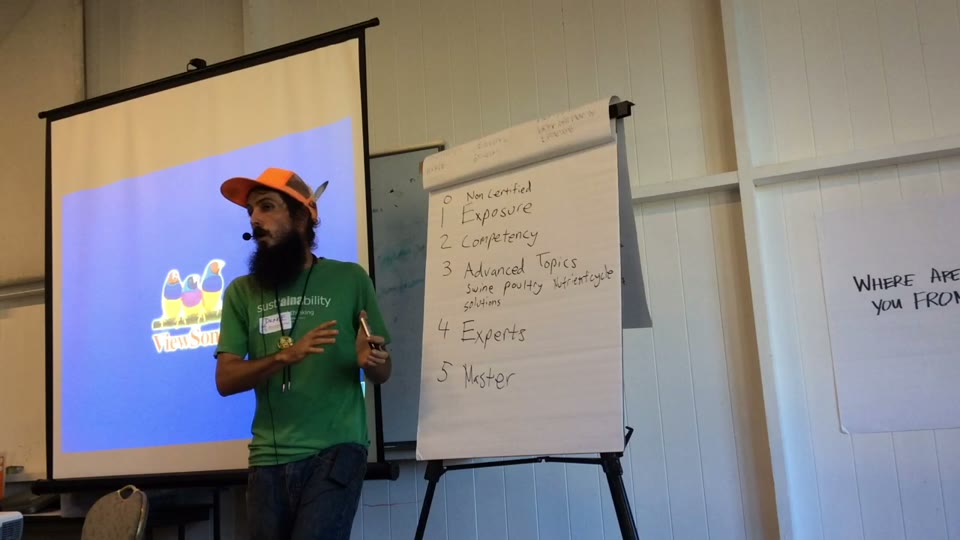
Drake Weinert continues in English. From about 1:43:00 he writes the levels on the flip chart, read off the frames: '0 Non Certified / 1 Exposure / 2 Competency / 3 Advanced Topics (swine, poultry, nutrient cycle, solutions) / 4 Experts / 5 Master'. The projector shows only a ViewSonic screen. Cho doesn't speak. This is about teaching and certification, not field technique.
- Rehydrating dried Medicine (OHN) herbs — General rule: any fermented, slightly alcoholic liquid. As received: makgeolli. Homemade apple wine fits the rule, but teach makgeolli. (Drake, spoken.)
-
Teach the method as you received it, and keep your local changes labelled
The rump-roast story: a cut made because grandma's pan was small became 'the recipe' and lost its reason.
▶ 1:39:11 As spoken
-
Teach Microbes (IMO) collection on rice; local starches like ʻulu also work
Rice has its hull off so the starch is available and the IMO grows well on it. Drake has seen growers collect on a crop and return it to that crop.
▶ 1:40:17 As spoken
-
To rehydrate dried OHN herbs you need a fermented, slightly alcoholic liquid; the recipe as received uses makgeolli
Asked whether homemade apple wine works: it fits the general rule. Use what you have, but teach the specific recipe.
▶ 1:41:07 As spoken
-
Certification levels: 0 non-certified, 1 exposure, 2 competency, 3 advanced topics, 4 experts, 5 master
Written on the flip chart. Level 3 topics listed: swine, poultry, nutrient cycle, solutions.
▶ 1:43:11 Written on the board
-
Level 2 (competency) checks that you can make the nine core solutions Joe outlined, plus seawater
Making them right doesn't mean applying them right; that's the next step.
▶ 1:45:37 As spoken
-
An ISO certification path was outlined by 'Mr. O', who came with Cho on an earlier visit
ISO means records: which FPJ lot went on which field, and when. Drake is trying to automate it.
▶ 1:47:28 As spoken
-
Four people held level 4 (expert); level 5 (master) is only Master Cho
No set requirements for level 4: peers judged each other on curricula, slides and attending Cho's advanced trainings.
▶ 1:53:21 As spoken
-
Level 2 is an open certification: your teacher checks you off, and anyone can see the photo of each person's LAB
Part of what Drake calls bringing transparency through CGNF US, CGNF Hawaiʻi and CGNF International.
▶ 1:56:19 As spoken
-
Drake: Cho walks into a field and sees it, so his prescription may differ from the book
He diagnoses in real time.
▶ 1:58:18 As spoken
-
CGNF's goal is official instruction and teaching manuals; for now it's a work in progress
Asked twice from the floor, once with the PADI dive-training system as the model.
▶ 1:59:00 As spoken
-
Level 5 awards level 4; level 4 teaches and checks level 2; level 2 can teach level 1
Drake's summary of CGNF Hawaiʻi at the time.
▶ 1:59:20 As spoken
-
To issue an official CGNF Hawaiʻi level 1 certificate you must hold level 2
Anyone with level 3 may go ahead and teach, but certifying needs someone to have checked your LAB and other solutions first.
▶ 2:00:07 As spoken
- Drake says he isn't speaking officially; the levels describe CGNF Hawaiʻi as he saw it in October 2017.
- This page is about teaching and certification, not farming technique.
- When you teach, give the recipe as you received it, then your local change, and say which is which.
- Keep notes and a whole-jar photo of each solution you make; that's what a competency check looks at.
Next to Master Cho's books
-
Goes further
Rehydrate dried OHN herbs with makgeolli; apple wine by the same rule Cho's Korean posters soak the dried herbs in makgeolli for 1-2 days and allow beer if there's no makgeolli. Homemade fruit wine isn't in the books; Drake's general rule stretches the beer substitution.
CGNF posters (Korean) (English translation), p. 19
-
Goes further
Collect IMO on cooked rice; local starches also work Cho's method uses cooked rice in a cedar box. Drake keeps rice as the taught method and calls local starches a field adaptation; the books don't discuss ʻulu or kalo.
Cho, Janong Natural Farming (2003), p. 97
“You gotta pass down the lineage, but then you gotta use what works and make it applicable to your area.”
▶ 1:41:56
“Master Cho has a gift where he just walks in the field and he sees it.”
▶ 1:58:18
“We're taking something that's formless, nature. It takes form, and we try to put even more form on that.”
▶ 1:58:34
In this part
- 1:38:17Q&A: apple wine for Medicine (OHN)
- 1:39:11The rump roast: why teach it as you received it
- 1:40:16Microbes on rice, and local starches
- 1:42:40Certification levels 0 to 3
- 1:47:20ISO and record-keeping
- 1:52:12Experts, master, and an open process
- 1:56:58Q&A: shared materials; who can certify whom
- 2:02:22Q&A: apprentice, journeyman, master; local vinegar
Transcript
Transcribed and checked by hand against the recording.
1:38:17 Drake Weinert: The other thing that I wanted to talk about here, are there any more questions on this before we transition to something else?
1:38:28 Audience: I had a question about the alcohol that you can use to hydrate OHN. Yes, you got it. Like if you have a bunch of extra apples and you make apple wine out of it, can you use that to hydrate your ingredients in OHN?
1:38:42 Drake Weinert: Yeah, alcohol content is [unclear] a permanent product. So usually when I teach, I try to teach as by the book as I can, as what I was received. Because as Joe was saying, there's a lineage to this. And what I find is if I teach you my modification, then you go and you think that's the way. And then forever, whoever you teach thinks that modification is the way. So I got this example: a computer science professor took his rump roast at Thanksgiving. And on the recipe it said, cut off the back part and put it in a pan and bake it. And he asked one day, he's like, he asked his wife,
1:39:27 why are you cutting off the rump? Isn't that the best part of the rump roast? And she's like, well, the recipe says to do this, right? And so forever she had done it that way. So he goes to his grandma, who she got the recipe from, and he asks her, [unclear], why are you cutting off the rump roast? Well, it turns out the pan was too small, so she had to cut off the thing so it fit inside the oven. But now they had a bigger pan, they had a bigger oven, there was no reason to cut that off, right? But if I pass that down and my recipe says, cut off the head and throw that away,
1:40:04 Now forever people are going to be cutting off the best part of the rump roast and not realizing why those things are there. So in my learning, I always try to pass on how I learn. So I often say collect IMO on rice, because that's how I learned. There are many reasons to use rice. It is a white rice. The hole is taken off so it's an available starch. The IMO grows so nice on it, it does what you want it to do. There are many reasons to keep it the way we learned. However, I just the other day, I was on Facebook and I realized people think, like, people take me a little too literally.
1:40:49 And they're like, oh, we can use ʻulu, we can use [unclear: kalo?]. And I'm like, yeah. Yeah, you can, you can use what's at your feet. You can use these things, these starches. And so that's what I want to teach. I want to say, OK, so this question came up to me just now about the wine. Can I use wine for this specific part? What you need is a fermented, slightly alcoholic thing for rehydration. That's the general rule. Why do they use soju or makgeolli, actually?
That's the first few minutes. Members read all 325 lines, with the Korean as spoken, and watch along.
Become a member