Send a Dowry at Transplant, Then Read the 180-Day Chart
Master Cho Han-kyu, interpreted by Kim Chang, Founder of Korean Natural Farming (Janong)
Master Cho spoke Korean, with an interpreter. We translated every Korean line again and checked it, so you read what he said, not only what the room heard.
Members watch every session
The whole seminar, as it happened, with the checked English beside the video. Membership is $60 a year.
This part runs from 1:24:33 to 1:54:45 of the session video. Keep watching and the next part plays on.
Now playing the next part: Feed 5–7 Days Early: Ripening, Flower Buds, Leaf Shape
Rice goes to the field on May 5. Cho's dowry story: like a father sending a daughter off with money, give extra at the end of Type 2 so the transplant roots in and fruits. He says Natural Farming is a work in progress that Hawaiʻi must build for its own weather, then walks the rice chart by date and leaf count, calls rice a 180-day crop, warns against overfeeding, and reads the nitrogen, phosphorus, potassium and calcium needs of each stage.
What he taught
When does the crop need its extra feeding, and how do you read a stage chart to know what to give?
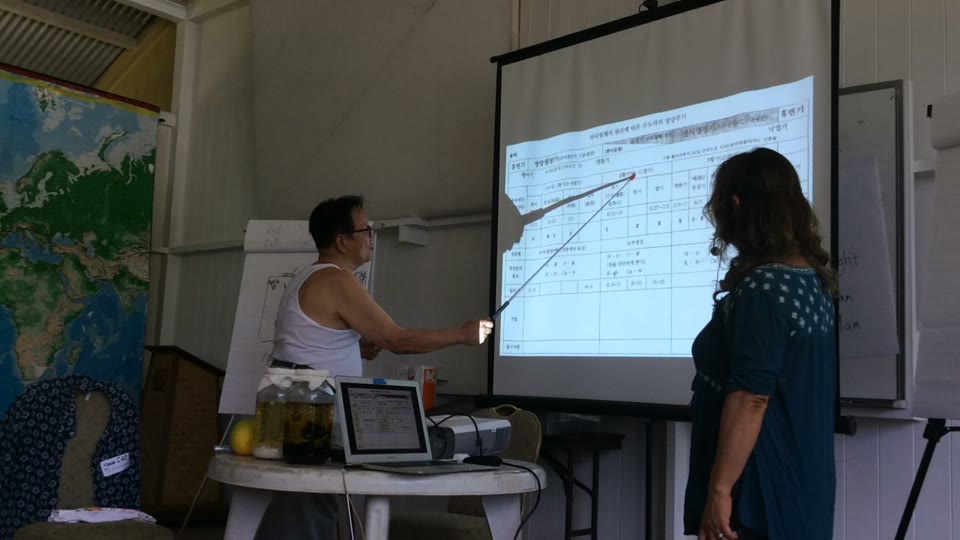
The rice chart (DJSS5255) is projected for the whole page; Cho points with a long pointer, partly seated after about 1:40. Dates and leaf counts here were read off the chart and checked against the photo. Drake made an English version of the chart overnight that marks levels H, M and L.
- The dowry: extra feeding at the end of Type 2 (transplanting) — No recipe or rate given on this page. Cho: give it at the end of Type 2, when the seedling 'marries' into the field (rice, May 5); she keeps the money and spends it when she's pregnant. The interpreter: 'That's why we're using Type 2 right before getting married.' The handout has no separate dowry column; its Type 2 column is on page 4.
- Nutrient needs by stage (rice chart, DJSS5255) — Vegetative, consumptive growth (Type 2): N high, P high, K low, Ca low. Changeover, conservation growth: N low, P high, K medium, Ca medium ('makes the body firm'). Reproductive, accumulating growth: N low, P medium, K medium, Ca high ('maintains the body'). Cho's Korean matches the chart throughout; the interpreter said 'lots of calcium phosphate' for the reproductive stage, where the chart and Cho have phosphorus medium.
-
Rice is transplanted at the strong-seedling stage, May 5, and gets Type 2 again in the main field
Chart: 장묘 5/5, type II. The second half is the interpreter's.
▶ 1:24:37 From the slides
-
Give the extra feeding at the end of Type 2, at transplanting, like a dowry
Type 2 builds the trunk, like a daughter at home until about 22. Given at the end of Type 2, the crop roots in (착근) well in the field and fruits well.
▶ 1:29:23 As spoken
-
Make your solutions ahead of time so the right one is ready at the right stage
Without it, the crop gets 'inner sickness': disease and bug attack, and fruit that doesn't form and falls (interpreter).
▶ 1:31:09 As spoken
-
Natural Farming is a work in progress; Hawaiʻi has to build its own cycle for its own weather
Taiwan, Hong Kong, China and Korea all differ. CGNF should gather each region's results into a global Natural Farming standard. Cho's new book, combining his roughly ten Korean books with about 300 photos, was due by the end of November 2017.
▶ 1:34:00 As spoken
-
Rice chart dates: sprouting 2/12, young seedling 3/12, strong seedling 5/5, second stage 6/12–15 to 6/27–7/2
Then flowering 7/3–7, embryo growth 8/7, embryo ripening 8/17, 9/3. The interpreter misread 6/27–7/2 as 'June 12th to July 22nd'.
▶ 1:39:25 From the slides
-
Rice by leaf count: transplant (first stage) at 5–6 leaves, second stage 10–11 leaves, third stage 15 leaves
Look at the date, the type the plant should be in and the leaf count, and at a glance you know which stage it is and what to give.
▶ 1:39:35 From the slides
-
Rice is a 180-day crop: seed in February 12, harvest September 2
Chart's last date is 9/3. Cho: papaya or banana in Hawaiʻi, from flower to harvest, works out to 180 days 'just the same'.
▶ 1:42:53 As spoken
-
Divide a 180-day chart for your crop and it tells you what to give on which days, and what the plant should look like
Hold the chart up against the crop and you can tell whether you are late or early, then adjust with the nutrients, instead of wandering the field.
▶ 1:44:10 As spoken
-
The same kind of chart works for chickens, pigs and cattle
Feed and nutrients matched to each period; they don't get sick and they develop well.
▶ 1:45:27 As spoken
-
Plants and animals get sick more from eating too much than from hunger: fertilize a little short of enough
Given a little less than enough, it's taken up well and the plant grows sturdy. 'Less is more' (interpreter).
▶ 1:47:49 As spoken
-
Coffee given too much fertilizer drops more fruit
Cho's example for overfeeding.
▶ 1:48:26 As spoken
-
Vegetative growth (Type 2): nitrogen high, phosphorus high, potassium low, calcium low
Chart 소비생장 (raised on the endosperm, 'the mother's milk'): N多 P多 K少 Ca少. 'This is the fertilizer that builds up the body.'
▶ 1:48:50 From the slides
-
The VI printed under sprouting is a mistake for IV; IV is the seed stage, at harvest and at planting
Raised by the interpreter and Drake; Cho: 'Number 4.'
▶ 1:50:36 From the slides
-
Changeover (conservation growth): nitrogen low, phosphorus high, potassium medium, calcium medium
Chart 보전생장: N少 P多 K中 Ca中, 'makes the body firm'. Leaf counts 6.5–11, 9–10, 11–15 (Cho read them like dates).
▶ 1:51:26 From the slides
-
Reproductive (accumulating) growth: nitrogen low, phosphorus medium, potassium medium, calcium high
Chart 축적생장: N少 P中 K中 Ca多, 'maintains the body'. For fruit trees this is also when next spring's flowers are prepared. Then it goes to seed.
▶ 1:53:36 From the slides
- The dowry is a picture, not a recipe: no rate or formula is given on this page, and the handout has no dowry column.
- All dates are for rice in Korea. Cho asks Hawaiʻi to build its own chart.
- The chart prints VI under sprouting; Cho says it should be IV.
- '180 days' for papaya and banana is Cho's rough figure, not worked out on tape.
- Several dates and leaf counts were misheard by the interpreter and the machine passes; the chart photo was used to settle them.
- Cho's dowry story includes a bride whose stress ends in miscarriage, and he says going hungry heals people's sickness. Those are claims about people, not tested, and we don't repeat them as advice.
- Make your solutions ahead, so each is ready when its stage arrives.
- Give the extra feeding at the end of the vegetative stage, at transplanting, to assist the crop in rooting in.
- Feed a little short of enough; overfeeding brings sickness and fruit drop.
- Early growth wants nitrogen and phosphorus; the changeover wants phosphorus; fruiting wants calcium.
- Keep a dated, leaf-counted chart for your own crop, and use it to tell whether you're early or late.
What the room didn't hear
Where the English in the room left out or changed what Master Cho said in Korean.
-
▶ 1:29:30
The room heard That's why we're using Type 2 right before getting married.
Cho said Give it at the end of Type 2; she holds on to it and spends it when the time comes. Then the crop roots in well in the field it was transplanted to, and fruits well.
The point of the dowry, rooting in after transplant, was dropped.
-
▶ 1:35:30
The room heard So CGNF Hawaii will develop those with the information as a CGNF International research center.
Cho said We gather it all in one place, CGNF puts it together, and we have to make a global Natural Farming standard.
Cho's aim, one world standard built from regional results, didn't come through.
-
▶ 1:40:57
The room heard In the field, in this stage, you see that this date, June 12th to July 22nd.
Cho said Chart: second stage early 6/12–15, late 6/27–7/2.
The interpreter misread 7/2 as July 22; Cho's own words for the dates are unclear.
-
▶ 1:44:52
The room heard If you have this chart, you know, look at the plant, oh, this time we need to give this nutrient.
Cho said Hold the table up and compare, and when you look at the crop you can tell: we're late now, or we're early. Then you adjust with the nutrients.
'Late or early' is how the chart is used; it was dropped.
-
▶ 1:53:36
The room heard So at that time, in this stage, you give less nitrogen, lots of calcium phosphate.
Cho said At that time nitrogen is low, phosphorus medium, potassium medium, calcium high. Then you have to maintain the mother's body.
The room heard 'lots' of phosphorus at fruiting; Cho and the chart say medium.
Next to Master Cho's books
-
Agrees
Rice chart: dates, leaf counts and N/P/K/Ca by stage The projected chart is the same table printed in the Plant Textbook: same dates, leaf counts and N/P/K/Ca levels, including the VI under germination that Cho corrects to IV here.
CGNF Plant Textbook, p. 78–79
-
Agrees
Overfeeding causes disease; feed a little short of enough The textbook compares fertilizing rice to meals and says eating to about 80% full keeps the stomach healthy; overfed early, the crop can't take food when it matters.
CGNF Plant Textbook, p. 39–40
“Natural Farming is a work in progress.”
▶ 1:34:00
“So with crops too, when you fertilize, give a little short of enough; then it's taken up well and the plant grows sturdy.”
▶ 1:47:49
“Less is more.”
▶ 1:48:13
In this part
- 1:24:33Transplant May 5, and the dowry
- 1:28:52Give the dowry at the end of Type 2
- 1:31:05Get ready ahead, or the crop gets sick
- 1:33:51Natural Farming is a work in progress
- 1:36:04Cho's new book
- 1:38:39Reading the rice chart by date and leaf count
- 1:42:53180-day crops: make your own chart
- 1:45:59Overfeeding makes them sick; less is more
- 1:48:44N, P, K and calcium by stage (and VI should be IV)
Transcript
English translation, checked against the Korean as spoken.
1:24:36 Master Cho: So here is [weaning]. And this is the strong-seedling stage, May 5, when you transplant the seedlings.
그래서 여기가 [이유기]야. 그리고 이것이 장묘기, 5월 5일날에 모를 낼 때.
1:24:46 Kim Chang (interpreter): So there is a, after baby became a seedling, we moved to the field. So we moved to the field. So that's the main field. We use a type 2 again.
1:25:04 Master Cho: So you have to transplant the seedlings then. Everyone, in Hawaii, when you marry off a daughter, do you send her with a dowry, or just send her?
그래서 [이때] 모를 내야 되는데, 여러분들, 하와이에서 딸 시집 보낼 때 지참금 줘서 보내나, 그냥 보내나?
1:25:17 Kim Chang (interpreter): When your daughter is getting married, do you have a dowry?
1:25:21 Audience: No. Dowry.
1:25:25 Kim Chang (interpreter): Do we have those?
1:25:27 Master Cho: What do you think?
어때요?
1:25:35 Kim Chang (interpreter): Huh? Cash? Cash? ... They say there's no such thing. There's none of that. In that case, his father is doing rice farming. I don't think that's the translation in [English], but they, I don't know, in English, I don't know, they don't have that word.
어? 그게 캐시? 캐시? ... 그런 게 없대요. 그런 거 없어요.
1:26:12 Master Cho: Then think of it this way. The daughter has married into her husband's family and isn't used to it yet, and she needs pocket money. Can she ask her husband for it? Can she ask her mother-in-law?
그러면 이렇게 생각해 봐. 딸이 시집가가지고 시집에 아직 익숙해지지 않았는데 용돈이 필요해. 그러면 남편 보고 달랠 수 있고, 시어머니 보고 달랠 수 있고?
1:26:34 Kim Chang (interpreter): She needs some money. Can she ask money to her husband or her mother-in-law?
1:26:38 Master Cho: [She can't ask, can she?] They say she can't. Right, she can't. She'd have to suffer it inwardly, wouldn't she?
[못 달래죠?] 그럴 수가 없대요. 예, 그럴 수가 없지. 속으로 [앓아야] 될 거 아니야.
1:26:42 Kim Chang (interpreter): But still she needs some money.
1:26:50 Master Cho: So the father should think ahead and send her off with some money; then her married life goes well.
그러면 아빠가 [미리] 생각을 해서 그 돈을 좀 줘서 보내야 시집살이가 잘 되거든요.
1:27:02 Kim Chang (interpreter): So if her father is more wise, he should think of those things. spending money and then send her away. Then there would be no problem.
1:27:15 Master Cho: Is it easier to send her with money, or easier to send her with nothing?
주고서 보내는 게 편해? 그냥 보내는 게 편해?
1:27:21 Kim Chang (interpreter): So for your parents' situation, do you feel more better with some money, or send her away without anything?
That's the first few minutes. Members read all 294 lines, with the Korean as spoken, and watch along.
Become a member