Crops Get Morning Sickness Too
Master Cho Han-kyu, interpreted by Kim Chang, Founder of Korean Natural Farming (Janong)
Master Cho spoke Korean, with an interpreter. We translated every Korean line again and checked it, so you read what he said, not only what the room heard.
Members watch every session
The whole seminar, as it happened, with the checked English beside the video. Membership is $60 a year.
This part runs from 25:44 to 41:38 of the session video. Keep watching and the next part plays on.
Now playing the next part: Seawater 1:30, Two Hours Before Sunset = Fast Uptake
From the Korean saying 'a good field bears healthy children', Cho moves to pregnancy and morning sickness as his picture of a body asking for what it needs. Then he turns it on the farm: pigs, cows, chickens, papaya, mango and tomato have their own morning sickness and cycles, and corn bears its ears for its own young, not for us.
What he taught
What does Cho mean when he says crops get morning sickness?
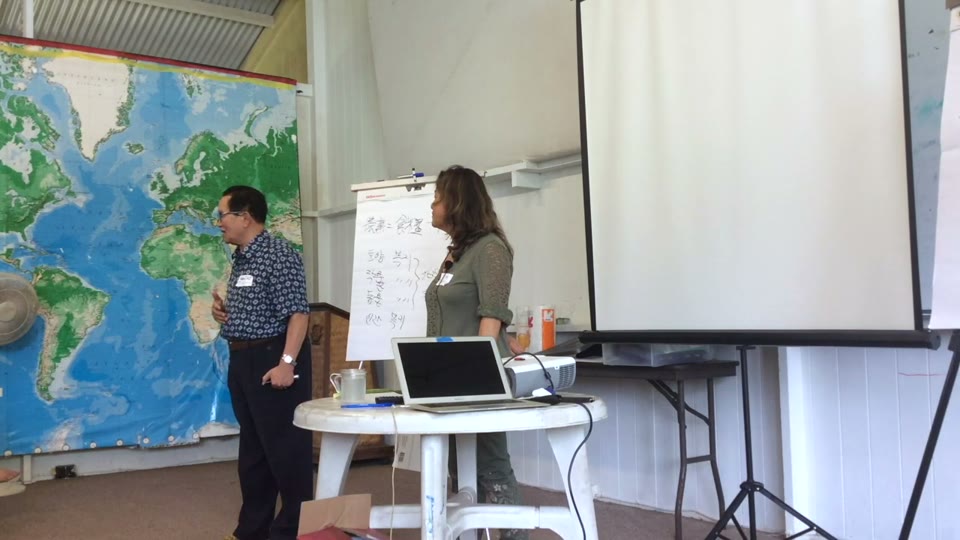
Still Thursday morning, same flip chart as the page before. Cho uses pregnancy as his picture of a body's changing needs and questions the room, then applies it to livestock and crops. Nothing is held up and no slides are shown.
-
Korean saying: the field has to be good to bear healthy children.
A 'healthy field' is a healthy mother's body; her health counts if it bears a baby well. Cho uses it as the bridge from soil to the life cycle.
▶ 25:44 As spoken
-
Cho's picture: a craving is the body asking; a nutrient picked by analysis is the head asking.
'What you crave is what the body wants; what you like by analysis is what the head wants.' He turns the picture on crops and livestock below.
▶ 29:56 As spoken
-
Follow what the body wants: that is the real thing.
The interpreter: 'follow what body wants, not what we think.'
▶ 30:40 As spoken
-
Pigs, cows, papaya, mango and tomato all go through 'morning sickness'.
Cho: 'Is it only people?' and names them. Mango is a likely reading of an unclear word.
▶ 37:16 As spoken
-
Pigs, chickens, papaya and mango have their own cycles too, 'from microbes to every living thing'.
Cho uses 생리 (menstruation) for the reproductive cycle of livestock and crops; only natural farmers think this way, he says.
▶ 37:37 As spoken
-
A famous professor called Cho crazy for saying crops have cycles like this.
Cho then asked him whether corn bears its ears for people to eat.
▶ 38:40 As spoken
-
Corn bears its ears to raise its own children, not for people to eat.
People cut in and take them. The interpreter: 'stealing from the crop.'
▶ 39:38 As spoken
-
Putting humans first is self-righteousness and arrogance.
Cho asks whether man is the lord of creation who shows it love.
▶ 41:19 As spoken
- Most of this page is about human pregnancy: Cho says morning sickness is the growing baby's bones asking for calcium phosphate and that a daughter should get it before marriage. These are not tested and we don't repeat them as advice.
- The crop side is only named here (who has a 'morning sickness'); what to give the crop at that stage comes later in the seminar and in Cho's books.
- Some Korean around 2155-2166, 2315 and 2406 could not be recovered.
- Crops and livestock change what they need as they move toward bearing young; watch for that turn.
- Corn and fruit are the plant's offspring: the plant is feeding its young, and you take a share.
What the room didn't hear
Where the English in the room left out or changed what Master Cho said in Korean.
-
▶ 37:16
The room heard All the livestock, all the plants, fruits, they have a morning sickness.
Cho said Pigs do it too, cows, papaya, mango, tomato, all of them.
The interpreter dropped the crops and animals Cho named.
-
▶ 41:19
The room heard So people always think about their health first.
Cho said It is the self-righteousness and arrogance of people who put humans first.
Cho blamed human-centredness, not concern for health.
Next to Master Cho's books
-
Agrees
Crops have a 'morning sickness' at the changeover His 2003 book says plants get 'morning sickness' at flower-bud differentiation, that the changeover treatment answers it, and that sour things and calcium phosphate are good for it. Here he gives only the human picture and names the crops.
Cho, Janong Natural Farming (2003), p. 79
-
Agrees
Same picture in his teaching posters The CGNF posters say plants also experience morning sickness just before flower-bud formation, when nutrients are drawn off by the growing offspring.
CGNF posters (Korean) (English translation), p. 3
“What the body wants is the real thing.”
▶ 30:40
“Corn bears its ears to raise its own children, not for people to eat.”
▶ 39:38
In this part
Transcript
English translation, checked against the Korean as spoken.
25:58 Kim Chang (interpreter): In Korean old saying, the soil is healthy and then you will have healthy children.
26:11 Master Cho: And 'a healthy field' means this: healthy children are born from a healthy mother's body.
그리고 건강한 밭이라고 하는 건 바로 뭐냐면, 건강한 엄마 몸에서 건강한 자녀가 태어난다 그런 말이지.
26:20 Kim Chang (interpreter): So healthy field makes mama body healthy, so healthy baby is coming out.
26:31 Master Cho: Don't misunderstand me. Who gives birth to the baby — a man or a woman? [second half partly unclear]
오해하지 마세요. 애기 낳는 분은 [남자여, 여자여]?
26:40 Kim Chang (interpreter): Don't misunderstand me. Who bears the baby? Is it the dad or mom?
26:51 Master Cho: So a mother's health only counts as health if it's health that bears a baby well.
그럼 엄마의 건강은 애기를 잘 낳는 건강이래야 건강한 거지.
26:52 Audience: It's mom.
26:54 Kim Chang (interpreter): So mom has to be healthy to have a healthy baby, right? That's the healthy mom.
27:09 Master Cho: Yes or no?
27:13 Audience: Yes.
27:16 Master Cho: Now then, here: when you were pregnant with that baby — morning sickness...
자, 그러면 여기서, 그 애기를 임신했을 때 입덧…
27:23 Kim Chang (interpreter): So whoever had a baby before, when you bear a child, who didn't have morning sickness? No morning sickness? No morning sickness... two people.
27:37 Master Cho: Ah, two... [unclear]
아, 두 [명]… […]
27:54 Kim Chang (interpreter): So who had morning sickness?
27:56 Audience: Yeah.
27:57 Master Cho: [You had morning sickness] and you felt good? [partly unclear]
[입덧]하고… 기분이 좋았다고?
28:02 Kim Chang (interpreter): Do you feel good or bad when you have morning sickness?
28:06 Audience: Not good at all.
28:08 Master Cho: Then why do you get that bad thing?
그 나쁜 것을 왜 [겪어야] 하느냐고.
28:12 Kim Chang (interpreter): So why should you feel bad? Why do you have morning sickness?
28:24 Master Cho: That's scientific thinking.
그게 과학적인 생각이요.
28:24 Kim Chang (interpreter): That's... chemistry, you know, analyzing the chemistry.
28:34 Audience: [Hormone?] imbalance. [unclear] Not in balance. Balance is...
28:39 Kim Chang (interpreter): Ah, you mean [nutrients]...? Balance... right? You mean it's out of balance. (checking the room's answer with Cho; partly unclear)
아, […] 말인 거죠? 균형이… 맞아요? 균형이 안 잡혀서 말이에요.
28:40 Audience: Deficient in nutrients.
28:42 Kim Chang (interpreter): Oh, he can understand! [A hears 'can't']
That's the first few minutes. Members read all 160 lines, with the Korean as spoken, and watch along.
Become a member