Build the Coop Before the Chicks: Gus's Hard Lesson
Gus, with Master Cho Han-kyu (interpreted by Kim Chang), Hawaiʻi farmer; trained with Cho in Korea, April 2017
Members watch every session
The whole seminar, as it happened, with the checked English beside the video. Membership is $60 a year.
This part runs from 2:11:53 to 2:30:05 of the session video. Keep watching and the next part plays on.
Now playing the next part: A Yolk You Can Lift: Hen Houses and Egg Tests
Gus tells the room about two weeks of poultry training in Korea and his first batch at home: 100 chicks shared with Stephen, and most of his died. Not from sickness: fear of mongoose kept them crowded in too small a space. Kim Chang, the interpreter, adds her own lessons on mongoose and rats, Cho says with proper housing not one of 100 chicks dies, and Steve tells how fish killed his.
What he taught
What went wrong when two Hawaiʻi farmers first raised chicks Cho's way, and what does Cho say would have prevented it?
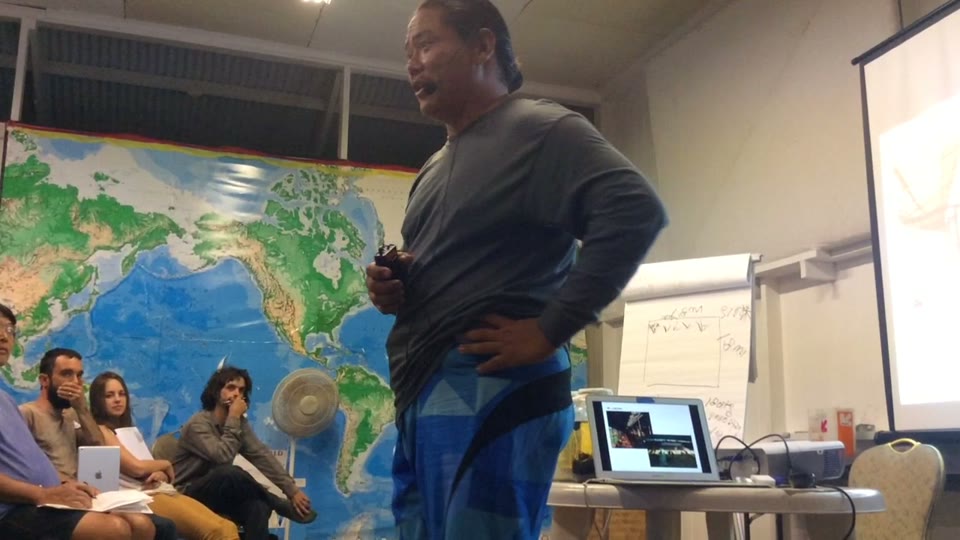
Gus stands in the audience and speaks in English (2:12:00); the interpreter relays to Cho in Korean and puts Cho's questions to him. From 2:23 the interpreter tells her own coop story. Gus points at a slide of a Korean coop built inside a second structure.
- Predator-proofing a coop (Kim Chang's own experience) — Use hardware cloth, not chicken wire: rats get through chicken wire and it rusts away. Rats tunnel underneath, so lay wire on the ground as a skirt. Gus: Korean coops are a house inside another structure, a second barrier.
-
Two weeks of hands-on poultry training in Korea, April 2017
After Cho visited Stephen's farm on Oʻahu he invited him to Korea; Gus went too.
▶ 2:12:06 As spoken
-
Cho's chicken teaching is set to the day: feed, water, space
'A very set prescription for both meat birds and layers.'
▶ 2:13:37 As spoken
-
Don't start until everything is in place
Gus: 'Right there we failed': no feeders made, no housing set, no feed set up.
▶ 2:14:19 As spoken
-
Broilers are a short game, layers a long game
Feed, housing, care and even how you think about them differ.
▶ 2:15:22 As spoken
-
Against a conventional Oʻahu producer: 'no comparison'
Smell, cleanliness, the birds' well-being, intestine and gizzard size, and fat at slaughter. No cost data: Cho asked, Gus couldn't get it.
▶ 2:18:59 As spoken
-
100 chicks, 50 each; Gus had close to 70% mortality
'Only 18 chickens made it.' Stephen did much better.
▶ 2:19:47 As spoken
-
The cause was fear of mongoose: the birds were kept in too small a space and crushed each other
He waited three weeks for electric tape that never came. None were sick.
▶ 2:20:55 As spoken
-
Use hardware cloth and a wire skirt on the ground
The interpreter's own coop: chicken wire rusted and disappeared and the rats came back.
▶ 2:22:43 As spoken
-
Gus trapped two to three mongoose a day for 3–4 weeks before the chicks came
And at least one a day after.
▶ 2:25:15 As spoken
-
With proper facilities, of 100 chicks not one dies
Cho: prepare the chick facilities completely, then put the chicks in.
▶ 2:27:47 As spoken
-
Steve fed cooked fish after the swine seminar and his chicks died with bluish-purple faces
The interpreter calls it protein intoxication.
▶ 2:29:11 As spoken
- One farm's first try, told from memory; no cost data.
- The mortality numbers don't add up as said: 100 chicks, 'close to 70%' mortality, 18 survivors, and Steve's batch reported to Cho as 36 of 50 alive. The 18 is most likely Gus's own 50 (64% lost). Steve's own figure ('not even 10%... more than 10%') is hard to hear.
- 'Protein intoxication' is the interpreter's label for Steve's losses.
- Have housing, feeders and feed ready before the chicks arrive.
- Give chicks the space Cho's prescription calls for; crowding killed more than predators did.
- Use hardware cloth and lay wire on the ground against rats and mongoose; a double barrier is better still.
- Don't feed young chicks cooked fish.
What the room didn't hear
Where the English in the room left out or changed what Master Cho said in Korean.
-
▶ 2:24:36
The room heard So the poor chicks that were born, because we didn't know how to take care of them properly with the housing, that's where those things happen.
Cho said People like this killed the chicks that had finally been given a life.
The interpreter softened Cho's blunt blame into an excuse.
-
▶ 2:25:40
Cho said (Told none were sick) Then they died from poor management.
Cho's verdict went unsaid; the interpreter argued with him in Korean instead.
-
▶ 2:27:47
The room heard Once you have a right system, right housing, not even one chick dies.
Cho said If the facilities are set up properly, when 100 chicks arrive not a single one dies. They all grow well.
The benchmark, 100 chicks, was dropped.
Next to Master Cho's books
-
Agrees
Prepare everything before the chicks come His Advanced bulletin says brooder, heat and all materials must be fully ready at least a day, or no later than four hours, before the chicks are placed.
CGNF Advanced (2006.03) (English translation), p. 36
-
Agrees
Fish-fed chicks dying: protein poisoning In the 2017 swine seminar Cho calls the same deaths protein-induced food poisoning; Steve says he fed fish after that seminar.
2017/Advanced Cho/swine/IMG_1691 @ 0:06:32 (translated)
“You need to do it exactly the way Master Cho says to do it. But until you do it, you don't realize what he really tells you.”
▶ 2:14:10
“The biggest reason, I found out, was my fear.”
▶ 2:20:55
“Then not knowing is what makes you the thief.”
▶ 2:26:00
“They die because there isn't enough love.”
▶ 2:27:15
In this part
Transcript
Transcribed and checked by hand against the recording.
2:11:54 Kim Chang (interpreter): Oh, you raised meat birds. Yes. So please stand up and tell your story.
2:12:05 Gus: So it was in April of this year we were in Korea. The story actually goes, Master Cho visited us on Oʻahu, did a workshop, I believe it was in January? February, early part of the year. And we had these torrential downpours, just pounding rain. We were supposed to do farm tours, and we actually ended up canceling two farms, or two places to visit. But we did visit with Stephen and his farm in Waialua. And when Master Cho arrived, it was like, I guess similar to how Moses parted the Red Sea.
2:12:52 The clouds opened up, we had blue skies, and we were actually able to visit and see all of Stephen's farm. And I think it was either the next day or a few days later that I called from Stephen and he said, Hey, Master Cho called me up, he wants to see me in Korea next week. He wants me to come to Korea and he wants to teach me about raising chickens. I was like, oh, but I don't want to go by myself. He said, don't worry Gus, we go. But Steven and both myself needed some time to get together so it was April. We were there and for two weeks we had an intensive program in Korea.
2:13:30 Probably the most hands on and the most detailed information. I've been studying Master Cho's work for a long time but his information that he provides you for chicken raising is down to the day. They'll tell you how much feed they need, how much water they need, how much space they need. It's a very set prescription for both meat birds as well as layers. So we came back and the first thing we did was order our chickens. It forced us to not just talk about it, to do it. And one of the first things we learned was, or one of the first things I learned was,
2:14:09 you need to do it exactly the way Master Cho says to do it. But until you do it, you don't realize what he really tells you. So one of the big things that he emphasized in the class was don't start until you have everything in place. So right there we failed because we started, we didn't have our feeders made, we didn't have our housing set, we didn't have our feed set up. So that was the biggest lesson, have everything in place before you start. But having gone through the training with Master Cho, having had the experience of actually
2:14:41 taking chicks out of the box that were day old, putting them onto the ground with brown rice gave me the confidence and courage to try again. I swore off chickens: mongoose, dogs, even my own children.
That's the first few minutes. Members read all 211 lines, with the Korean as spoken, and watch along.
Become a member