Brown Sugar + Rice = the Whole Toolbox
Joe McGinn, Hawaii Natural Farming, Oʻahu
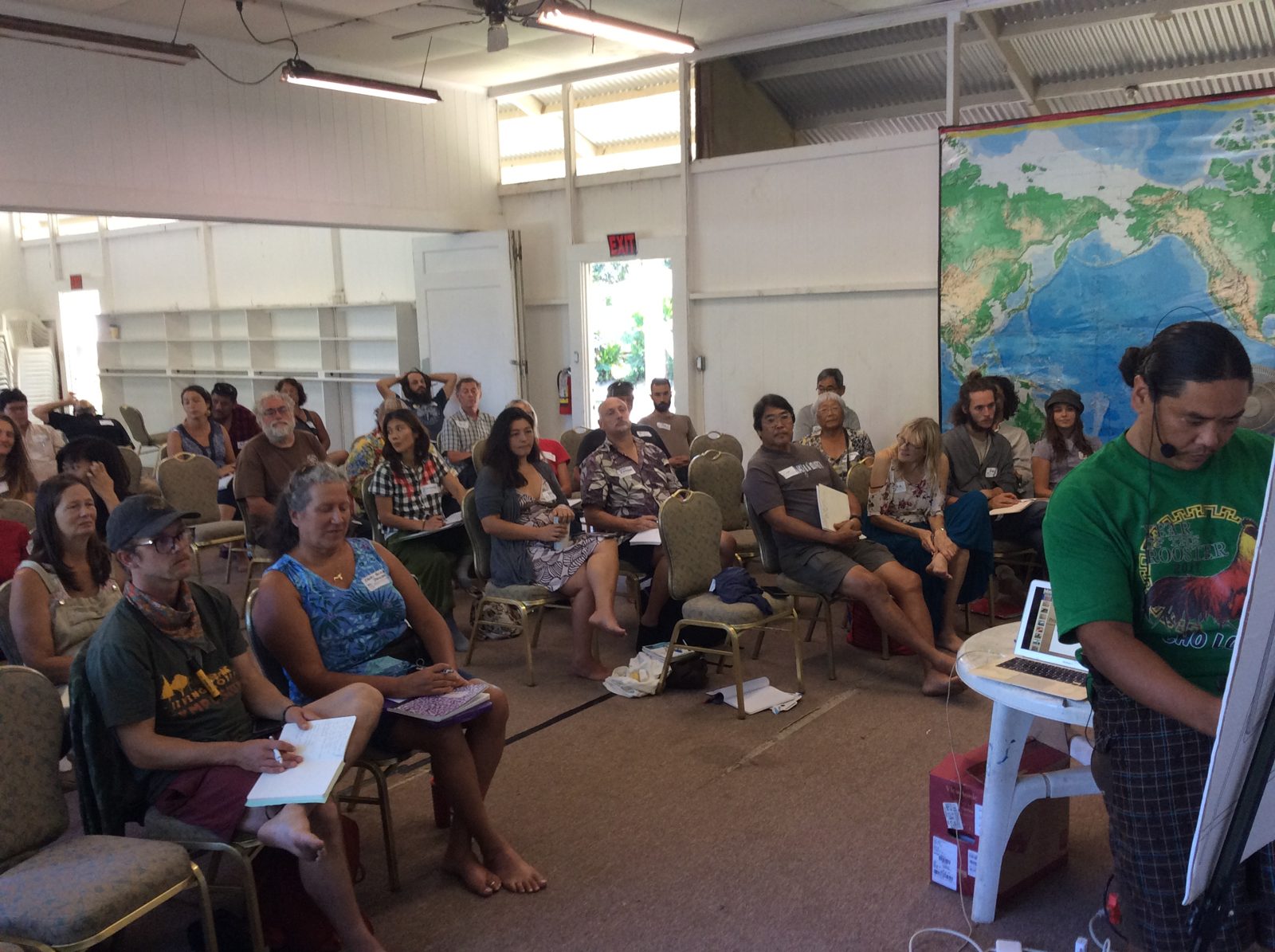
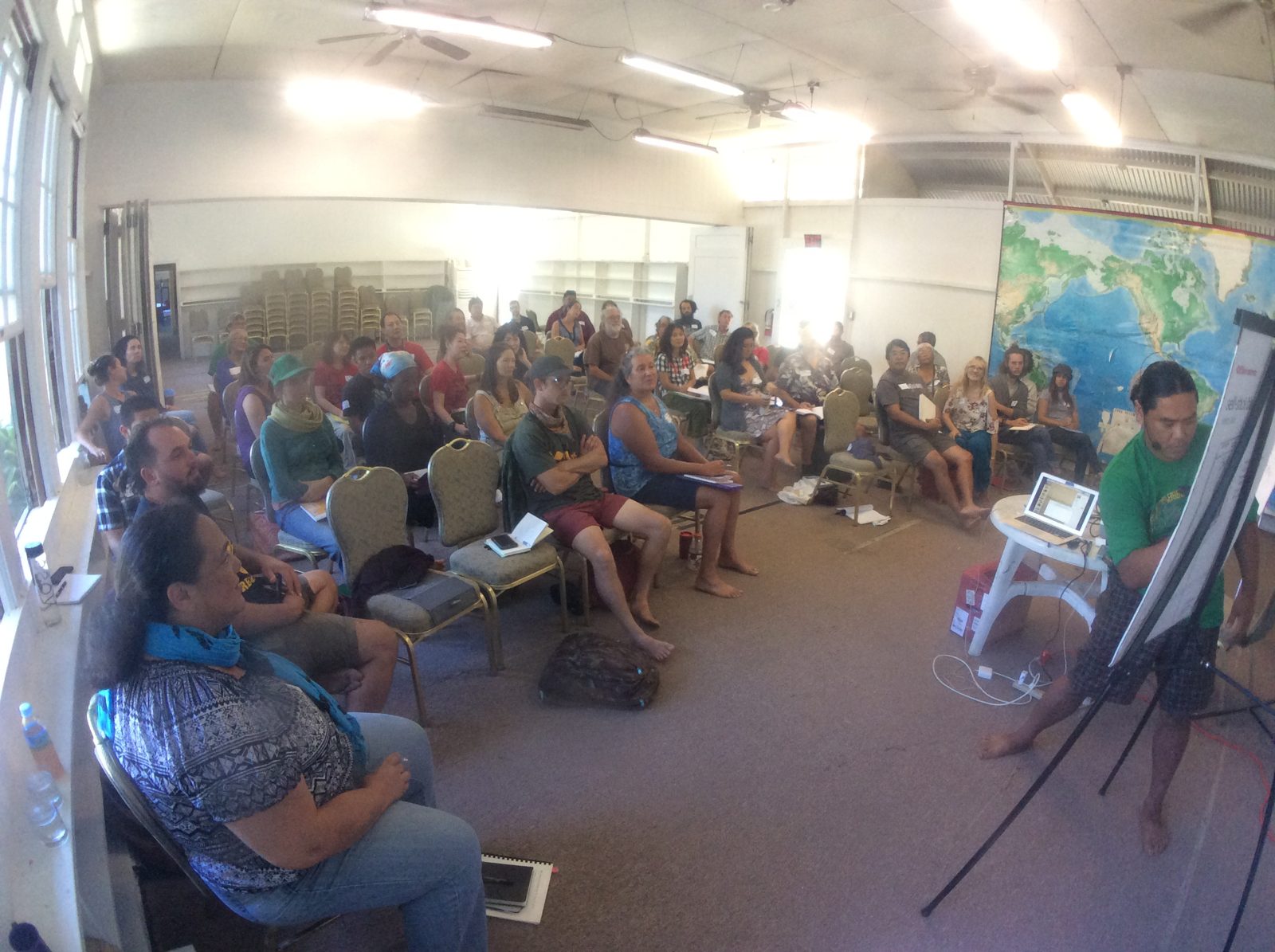
Video of this visit will be added to the members' archive. The transcript times below match that recording.
Joe McGinn opens the afternoon by asking everyone where their grandparents are from, then walks through Cho's principles of natural farming in slides, read through a Hawaiian lens. He ends on a simple point: every solution rests on brown sugar or on rice vinegar, so anyone can start, beginning with Food (FPJ).
What they found
What do Cho's principles look like when an Oʻahu farmer teaches them, and what is the least you need to start?
Thursday afternoon, the first talk after lunch. Joe McGinn, a guest speaker from Oʻahu, gives a slide talk in English ('Basic Principles of Natural Farming'). Master Cho is in the room but doesn't speak in this part, so there is no Korean and no interpreting. Slides read from the frames: a genealogy (Hawaiʻi > Ahupuaʻa > ʻIli > ʻOhana > Kānaka), the principles from Cho's 'blue book', the nutritive cycle as keiki/mākua/kūpuna, a guiding-principle triangle, photos of Microbes (IMO#1) boxes, and a 'Language of Natural Farming' slide.
- Microbes (IMO#1) box, as Joe teaches it — A natural wooden box filled about two-thirds with rice; the air space is 'very, very important'. Bamboo is a good place to set it. (Joe, spoken and slide; no quantities.)
- Where a beginner starts — Food (FPJ): plant material and a little brown sugar in a jar. Joe starts beginners here because it needs nothing else. (Joe, spoken.)
-
Supermarkets and tractors came in around the 1930s, so grandparents born before then farmed without machines or chemical fertilizer
Joe's reason for asking where everyone's grandparents are from: they very likely practised some kind of natural farming.
▶ 4:34 As spoken
-
Everyone trained by Cho now belongs to an unbroken chain of knowledge from Cho's teachers through Cho
So they owe it the most honest, pure keeping. Joe says Cho learned from 'five masters' in Japan and names Shibada Genshi; Cho's own books name three teachers.
▶ 8:46 As spoken
-
Cho's principles on the slides: environmentally friendly, respect for life, high quality, no pesticide, no herbicide, no mechanical tillage, no chemical fertilizer, no pollution, no artificial heating, farmer-made feed and farmer-made solutions, the nutritive cycle
Joe calls them the principles in Cho's 'blue book' and frames 'environmentally friendly' as mauka to makai.
▶ 11:26 From the slides
-
Insects are messengers: don't shoot the messenger
Read what the bug is telling you, then give the right nutrient, the right amount, at the right time.
▶ 12:17 As spoken
-
A tractor tills 6 to 8 inches at most; earthworms go as deep as 6 meters in a drought
Joe's case for letting soil animals do the tillage.
▶ 12:46 As spoken
-
Two lettuce heads planted the same day: one on bagged organic fertilizer, one on natural farming
Shown on the 'High Quality' slide to answer the myth that untreated produce is full of bug holes. No measurements given.
▶ 13:15 From the slides
-
The nutritive cycle in Cho's terms is Type 2, changeover, Type 3
Type 2 builds the plant body, mainly nitrogen, like a child building its skeleton. The changeover is like entering the reproductive years ('morning sickness'), fed calcium phosphate (Structure, WCP). Later, as fruit forms, calcium (Reproduction, WCA), like calcium for kūpuna.
▶ 15:00 As spoken
-
Reproduction (WCA) at fruit forming improves shelf life and sweetness, and helps move nutrients if there's a blockage
Joe's summary; no trial shown.
▶ 16:19 As spoken
-
Joe's group grows Microbes (IMO) around the Hawaiian moon night called Akua
Akua can mean God and, Joe says, fungus. 'The results speak for themselves, go try it out.' No results were shown.
▶ 18:10 As spoken
-
Guiding triangle for decisions: first the ʻāina, then people, our own desire last
Ask: is it best for this place (microbes, plants, animals, land, water)? Is it good for people? Only then: is it what I want?
▶ 21:54 From the slides
-
Microbes (IMO#1): box two-thirds full of rice, keep the air space; bamboo is a great place to collect
Shown with photos of the group's boxes.
▶ 22:37 From the slides
-
Microbes (IMO), Protectors (LAB) and Medicine (OHN) are the three most powerful, and take the most time, commitment and resources
Joe's ranking. His 'Language of Natural Farming' slide listed BRV twice on purpose; the second should be OHN, and the room also called out seawater.
▶ 23:24 As spoken
-
Food (FPJ, FFJ) and Fuel (FAA) all need brown sugar; Cleanser (BRV), Reproduction (WCA) and Structure (WCP) all rest on vinegar from rice
So 'the entire system can be broken down into two things, brown sugar and rice.' Start beginners on FPJ: a jar and brown sugar.
▶ 23:47 As spoken
-
Brown rice beats white because the nutrients are in the bran and hull, which milling takes away
Joe credits a 'Susan Kiefer' (name as heard). A question about whether the calcium solutions need brown rice vinegar is held for later; Kim Chang, the interpreter, and Cho answer it near the end of Drake's talk.
▶ 25:09 As spoken
-
Dr. Park: almost all the solutions get better with age
Joe: 'In natural farming, all of us get better with age.'
▶ 26:17 As spoken
- This is Joe McGinn's teaching, not Cho's. Cho doesn't speak in this part.
- The lettuce comparison and the Akua-moon IMO were shown or described without measurements.
- Several answers in the opening grandparents round are in Hawaiian and only partly audible.
- Joe's '0.02% understood' figure is second-hand (via Chris Trump); he gives the rest as 98.98%, which should be 99.98%.
- If you're new, start with Food (FPJ): plant material and brown sugar in a jar.
- Leave air space in a Microbes (IMO#1) box; don't pack it full.
- Before a decision, ask what's best for the land first, then for people, and only then what you want.
- Treat insects as a message about the crop's condition, and answer with the right feed at the right time.
Next to Master Cho's teaching
-
Agrees
Type 2, changeover, Type 3 These are Cho's own terms: Type II for active vegetative growth, Type III for flowering, with the changeover between them likened to morning sickness.
Cho, Janong Natural Farming (2003), p. 83
-
Differs
Cho learned from 'five masters' in Japan Cho's book names three Japanese teachers: Yamagishi Miyozo, Shibada Genshi and Ōinoue Yasushi. Cho names the same three later this afternoon. Five is Joe's number, not Cho's.
Cho, Janong Natural Farming (2003), p. 7
-
Agrees
IMO#1 box not overfilled; air space matters Cho fills the cedar box with steamed rice to about 7 cm and warns that overfilling cuts off the air the aerobic microbes need. Joe's 'two-thirds full' makes the same point.
CGNF Advanced (2005.05) (English translation), p. 29
-
Agrees
WCA late, as fruit forms, for sweetness and keeping Cho sprays WCA after the fruit has sized up, to stop overgrowth and give sweet, firm fruit.
Cho, Janong Natural Farming (2003), p. 132
“Don't shoot the messenger. They're communicating something to you.”
▶ 12:17
“While a lot of people out there are just trying to fight to get a piece of a pie, guess what? We got the recipe. We can make as many pies as we want.”
▶ 20:50
“In natural farming, guess what, all of us get better with age.”
▶ 26:42
In this talk
- 0:00Where are your grandparents from?
- 4:15Grandparents farmed before supermarkets and tractors
- 5:53Cho's teachers and the chain of knowledge
- 10:13The person, the family, the land
- 11:23Cho's principles, slide by slide
- 14:59The nutritive cycle as keiki, mākua, kūpuna
- 16:43The Akua moon, spirit and practice
- 21:05Guiding principle: ʻāina, people, desire
- 22:32Brown sugar and rice: the language of natural farming
- 25:40A full toolbox, better with age
Transcript
English translation, checked against the English as spoken.
0:00 that we do in our class to sort of get people to know each other better, also to make natural farming a little bit more personal and relevant to who we are and where we come from. So with every class we start with three basic questions. So if you don't mind, entertain me if you will. This is probably the biggest room we've done it for, but I think we can do it. My wahine warned me, she said, don't do it, there's too many people. I said, no, I think we can, I think you can. So the way we can be successful at this is have your answers ready. Let's move really quickly.
0:33 Let's respect each other as well. So everyone's going to have a chance to talk. So if you can, allow them to speak. Allow us to hear what they have to say. And we'll bring it all together once it's all said and done. So if you don't mind, we'll start on this side of the room.
0:55 Okay, three questions we're going to ask. Question number one, where are your grandparents from? Question number two, you know what, we'll save question number two and we'll save question number three for later. So this is how it's going to work later. So later on, after the session, you guys have a chance, come up here and answer these questions. Question number two, where are you from? So that's either where you were born, where you're living now, where you're farming or gardening now. Could be any one or any of those three things.
1:26 But go ahead and put the name of that place of where you're from. And also, what do you want to learn? With all the classes that we offer, we try to structure the education specifically to your needs. So if there's specific things you folks want to learn, go ahead and write that up. I want to learn this, I want to know more about this, I need clarification on this. So we'll take questions two and three and we'll save that for you guys can do later. But the one question I really want to have and everyone answer out loud is where are your grandparents from?
1:56 So Dana, where are your grandparents from? (In Hawaiian) ... my grandparents ... my father is from Kauaʻi. Kauaʻi? Where in Kauaʻi? Poʻipū. Poʻipū? Okay. (Answers in Hawaiian, not clearly heard) ... Kona. Kona? Okay. Of Hōnaunau. Hōnaunau. (In Hawaiian, only partly clear) My mother ... the grandparents ... [place unclear]. [Place unclear], awesome. (Hawaiian, unclear.) Awesome, okay.
... koʻu mau ʻelemakule ... koʻu makuakāne no Kauaʻi. (ʻōlelo Hawaiʻi, unclear) ... Kona. ʻO koʻu makuahine, ʻelemakule ma ... [unclear] E hapa ... [unclear]
2:41 (In Hawaiian) I'm from Puna ... from Kaimū, Kalapana. Kaimū, Kalapana. But again, we gotta be quick, okay? We got 50 people in here, so where are your grandparents from? If you're lucky to know where all four of your grandparents come, shout out the name real fast. But let's know, where are your grandparents from? My name is Larry. Larry, what's up Larry? Italy. Italy, awesome. Ireland, Norway, and Russia. Cool. Japan. Japan. Just so we can help get each other to move to the world. So that was Dana, that was Larry. Brother, your name is? Camden. Camden. His grandparents are from Japan?
No Puna wau ... Kaimū, Kalapana mai au.
3:25 Both grandma, grandpa, both sides, mom and dad. Other ones from Washington. Washington? Cool, cool. Mahalo. Vancouver. Your name is? Susanna. Susanna. Where are your grandparents from Susanna? Vancouver, BC. Uh huh. Oregon, California. Born North Shore of Oahu, outside of Honolulu. Her family raised rice at one time, the largest rice from Oahu. That's on my dad's side. My mom's side, my grandfather, he grew up on a plantation in Maui called Hāmākua Poko Plantation. And my grandmother was born in Waipiʻo Valley, a couple of valleys over here on the way.
4:13 So that's where I come from. One reason we ask where your grandparents come from is because if you're lucky enough to spend time with your grandparents when you were younger as a child, or people around your grandparents' age, guess what? Where did they get their food from? 1930s, they say, is about when supermarkets came into existence. So if your grandparents were alive before that, guess what? They didn't get their food from the supermarket. It didn't exist. 1930s is about the same time that heavy machinery or tractors also came into existence. So guess what?
4:51 Your grandparents lived in a time when they would farm and grow food without having machinery or chemical fertilizers. So if you were lucky enough to spend time with your grandparents, guess what? I can almost guarantee you they would do some form of natural farming with their own food without imported feeds, without imported chemicals or pesticides. So that's just one reason we like to ask this of you folks. which also shows that we have a connection. I don't know if you guys realize that, but we are actually a lot more closely related than you may have initially thought.
5:27 So our grandparents, where we come from, is also our connection in terms of the microflora, the microbiota, the microbial life that is a part of our bodies. so would you not think that we could somehow connect to where our DNA comes from to be healthier and happier as a people I think so so we ask this also to highlight certain places and look at connections so again a lot of people come from Japan and one thing that I know even Drake and I have been talking about is wow I wish we could get a hold of the writings of Master Cho's masters Those writings do exist. They're out there.
6:11 I don't speak Japanese, but I'm hoping that someone here who has a connection to Japan, at least they have relatives in Japan who may have access to this information, or may be willing to read and share this information with us. So Master Cho speaks of five masters that he learned from all over Japan. So if you guys from Japan want to share that, that's something that we could all go to. So in the... who has Master Cho's books? Right here. Yeah, check that one out. So the blue one, yeah. The blue one he talks about his masters. Shibata Genshi is one of them. A couple more, yeah.
6:52 So you can find Master Cho's masters in those books. Another thing we like to do is just familiarize people with the basic principles of natural of natural farming. Is everyone familiar with Master Cho's principles of natural farming? You know it's funny that I think most of the people in this room could probably make an FPJ or an OHN or a LAB, but coming back to the principles and the foundation that all this is built upon, a lot of times in the instruction of the classes that we go to, it just gets right over. So just to get you guys familiar with the basic principles,
7:35 just to sort of set the framework, right? So in a sense, I'm pretty sure if you read Master Cho's book, you guys read all of these, but just to keep it fresh and in front of the mind. So some of the basic principles of natural farming, of course the three questions that we talked about are there, and about genealogy. Another reason why this is important is because the genealogy of who we are and where we come from. We're fortunate for our grandparents. Here, moving forward, now that we know where we come from, we are responsible for every generation that comes after us.
8:14 Our children, our grandchildren, our great-grandchildren. And how we treat this planet and what we do will have a direct impact upon the quality of their lives. That's us in terms of people. How we're so lucky, so lucky to be a part of this train today is because of Master Cho. the knowledge that we receive guess what, there's a genealogy that comes with that knowledge as well he gives us the genealogy when he talks about his five masters so when we look at this I tell everyone that everyone in here is now part of the unbroken chain of knowledge that comes directly from Master Cho
8:52 that came directly from his masters, so you have a responsibility in here to uphold that knowledge in the highest, most honest, most purest way possible. You owe that to everyone that has come before you, Master Cho and his masters, and everyone that comes after you. You also have a responsibility to the other people in this room. Because guess what? The people, at least in the English-speaking countries, who have been trained by Master Cho, aren't that many of us. These are the guys who did it six years ago out here in Kohala.
9:27 the people in the room that's it that's us so how far we go how we treat each other how we communicate with each other how we share with each other will have a direct impact on how fast or slow, how fun or not fun it is when we do it together. So genealogy both in terms of our DNA genealogy both in terms of our knowledge we have really, I guess you could say it's almost like a burden, a heavy burden that we carry with us. So I want you guys to keep that in mind that the knowledge that Master Cho is going to bestow upon us because it really is some powerful stuff.
10:13 One thing we try to take a look at, at least from a Hawaiian lens, is how the kanaka or the Hawaiian takes a look at land. So really the kanaka or the person begins with taking care of his or herself. So for all you guys that are in here, taking care of yourself is probably the best way to show that natural farming works. Are you happy? Are you healthy? Do you have a good relationship with your spouse, with your children, with your grandparents, with your neighbors? So taking a look at how the person, number one, is healthy both in terms of physical,
10:52 mental, and spiritual, and how that extends to their greater community, whether it be their family, their extended family, and their larger community. And eventually they're all part of the larger Hawaiʻi and inevitably the larger part of the world. So we like to take this approach with looking at both our knowledge and and how we work. So it's working ourselves first, working on making our family solid, making our community solid, and growing up from there. Eventually the whole world can change. These are the basic principles of natural farming that Master Cho talks about in the Blue Book.
11:28 We'll go through them really quickly right now. Environmentally friendly, so in Hawaii, we have the term mauka to makai. The Hawaiians knew that everything was connected. The water was connected from the mountains to the ocean and back again. Everything you do in natural farming is environmentally friendly. If anything, the environment and you as a person will get better and stronger just by being exposed to it. Respect for life, all forms of life. Everything that was created on this planet has a reason and purpose. Just because we don't think it should be there or we don't want it around,
12:04 It doesn't mean that it's not there for a reason. And most likely it means that it's communicating something to us. So if you see bugs in your garden, certain kind of bugs, you see them doing certain things that you don't want, don't shoot the messenger. They're communicating something to you. And with the tools that Master Cho is going to give us, we can positively affect the environment to either encourage more of a message to that creator. So keep that in mind as we're going through this. Master Cho is giving us tools.
12:33 But based upon our ability to perceive what's happening and knowing right nutrient, right amount, right time, we can encourage these guys to flourish. Master Cho talks about tillage. The maximum tillage that you can probably get on the most expensive tractor you can buy is six or maybe eight inches. In times of drought, earthworms can come down as deep as six meters. Who would you rather have doing the tillage, the work for you on the farm? Expensive piece of machinery or these guys?
13:06 High quality. One of the biggest myths of going organic is that your product is going to be full of holes from bugs, it's not going to be as good as the chemical version. These two heads of lettuce were planted at the same exact time. This was actually done with a bagged organic fertilizer, and this with natural farming. So again, pesticides, if you see the word side, it means to kill pests, meaning anything that's living that you don't want around, but there are no such things as pests, there are no such things as bad insects or animals.
13:39 Same thing with herbicides, if you don't plant some of these herbicides, you kill the herb. But what ends up happening is you end up killing way more of your environment as it sticks around way longer than it should. Master Cho talks about no mechanical tillage, heavy tillage. This is a problem we have on Oʻahu. Where we're from, big heavy commercial ag still dominates much of the landscape and this is what we see in central Oahu.
14:07 No chemical fertilizers. Most chemical fertilizers are salt based so you end up killing your plants and they could be a big impact on your soil when you use chemical fertilizers. Plus they're expensive. No pollution, so even when it comes to livestock, a natural farming pig pen is actually a really healthy environment if it's built and maintained properly. Master Cho talks about no artificial heating, making your own feeds, making your own inputs, and of course the nutritive cycle theory. So Master Cho is going to go a lot more into this, but this is one way we like to take a look at it.
14:45 um really taking it back to who we are as people plants animals and people we all come from the same structure right sunlight soil water we all are made from the same thing so if you think about the nutritive cycle, the terms Master Cho uses is Type 2, changeover, and Type 3. Type 2, changeover, Type 3. So in the Type 2 situation, what's happening is you're forming the plant body. The same way a young child is going to form the basic structure of its body, its skeletal system, its nervous system, its digestive system, A plant in this phase is also forming the same basic processes.
15:29 And as that plant moves into its reproductive years, getting ready for menstruation, getting ready for a changeover or that time when the morning's in the first, getting ready to reproduce similarly as a plant begins to flower, that's a visual indication that you're heading into a changeover. And finally, the golden years. Later on in life, you know they talk about the calcium in the body for your kūpuna. You don't want to get osteoporosis and break your hips or you can't reach your calcium. So similarly with people, in certain growth periods we need nitrogen as a plant to form its basic body.
16:06 As we go into the reproductive years, the changeover, calcium phosphate, remember, to prevent the morning sickness, and WCA later on in life when your fruits are ready to form. The WCA will actually improve the shelf life of your product. The WCA will also improve the sweetness and if there's any blockage it will help to move nutrients around. So this is how we take a look at the illustrative growth cycle. And one thing we've really tried to do along the way is really take a look at what is place-based and culturally appropriate for natural farming.
16:43 natural farming. We've actually been able to find a lot of similarities between what Master Cho shares in natural farming and the culture and farming practices that are in this place. Some simple things, like looking at the lunar calendar. There's a brother on this island, Keahi. Keahi's not here today but he shared with me a word. Does anyone have a phone that has a good internet access? My phone has this horrible internet access. Do me a favor. Go to wehewehe.org. Are you guys familiar with wehewehe.org? W-E-H-E-W-E-H-E.org. So wehewehe.org is an online Hawaiian dictionary.
17:28 Okay, so look up the word fungus. What is the word for fungus? Fungus. Does anyone know? Off the top of their heads? I know it's a B. Does anyone know what the word for fungus is? B. Akua. Akua. Okay, so you guys ever heard people say mahalo ke Akua? You ever heard that term? Akua means different things. So Akua can mean fungus, can mean God. But when we look at the lunar calendar, there's actually a moon called Akua. And what we found is that if you can grow your IMO, or try to cultivate your fungus around this moon,
18:17 the results speak for themselves. So go try it out. But also if you look at other things, like the spiritual aspect of this. So for each of us as individuals, we may do the same thing in terms of practice by following it step by step, step we all bring a different spiritual element to this and really it is our connection to the place the plants and the animals of that area that will yield different results so we've been doing natural farming for about six years, and I got scolded because we're raising pigs at home,
18:54 and my wife told me what are you doing you've been doing this for six years you should be able able to talk to them, with the amount of time that I spend with these pigs on a daily basis feeding them. Pigs are intelligent animals but I should be able to communicate them with a verbal command, they should listen. I should have by now been able to build this relationship with my animals to have that type of loving relationship but for me that wasn't even in my realm of possibility but now that it's in your realm of possibility as you guys start to raise livestock think about developing
19:24 that type of relationship with your animals the same type of relationship that hopefully you could have with other people in your family or even your own children where they talk to you and they listen. My children are far from that, but I'm working on getting to a point where I can talk to my animals and my children and they listen to what I have to say. But what it comes down to, though, is this is practical. It needs to be practical. We need to be able to do this and survive, both in terms of surviving as an operating farm or garden and also as a business.
19:56 So looking at how natural farming can be applied in these different scenarios. Science in here is unreal. So there's people who do science work or research. I got this from Chris Trump who said that in terms of microbiology world, they understand that's in 0.02% of what's happening. So 98.98% of what's happening in terms of microbiology, the scientists themselves they say, they have no clue what's going on. So imagine the potential for learning, the potential for growth in that industry.
20:29 You have someone young looking to get into the sciences, exploring microbiology, exploring microbiology, this is huge for us. And of course business. So I think we're going to change the world with the way we not only grow our crops and raise our animals, but how we apply this natural farming technology. So it will be this huge opportunity for business for all of us in this. And you know, while a lot of people out there are just trying to fight to get a piece of a pie, guess what? We got the recipe. We can make as many pies as we want.
20:59 So let's not fight each other over this and see how we can grow this together. But inevitably we're going to come into certain situations where Master Cho's not there, or maybe we can't connect to someone else and we stop and think, okay, what am I going to do? I have this situation here, I've got to figure it out, and I don't know what to do. This triangle oftentimes is flipped upside down, where it is the desire of man that gets put at the top. Other people and the land often are second to what is being decided, whether it be greed, pursuit of,
21:45 I don't know, whatever. But, one thing we try to do is take this and fit this. So, whenever we make a decision and we try to share this with other people, the first question we ask is, is it best for the island? Is it best for this place? Is it best for the microbes, the plants, the animals, the land, the water? And is it also good for the people? Whatever we do, is it going to be good for me, you, my neighbor, my children? And then finally, last is our desire. So if it's good for the ʻāina, it's good for other people, we'd be pretty certain that whatever decision you make is going to be good
22:17 for everyone so this is a little guiding principle, a little triangle that we use to help us make decisions and always remember that whatever we do is the best for the ʻāina, is the best for us, okay, pretty sure it can be good for whatever we decide. Here's just some pictures of some IMO that we've made so you can be familiar with it. IMO, natural reusable box, two-thirds full, air space very, very important, Bamboo is a great place to make it. Okay, how are you guys with all of these inputs?
23:02 I guess everyone pretty much made everything there. I'm waiting for someone to notice the mistake. Did anyone notice it yet? Yeah, so what am I missing? Seawater. OHN. So that should be OHN here. So the test, to see if you guys are paying attention. But one thing I'd like to share with people is IMO, LAB and OHN. These are probably the three most powerful inputs that we have in natural farming. But they also take the longest in terms of time and commitment. They also take the most in terms of resources, having to gather, having to make, and having to be committed to doing.
23:46 FPJ, FFJ, FAA. What is something similar about all three of these things? They all require one thing to make. Fermentation. Brown sugar. So I like to start people with making FPJ because you can start immediately with FPJ, with a little bit of brown sugar in the jar, and you're rocking and rolling already. So BRV, WCA, WCP. What's similar about these things? The salt. The vinegar. BRV, the vinegar. So essentially, if you think about it this way, all of this can be reduced to brown sugar. It's brown sugar based, right? All of these things, if we're making our BRV, what are we using? Rice.
24:31 rice. So the entire system can be broken down into two things which is brown sugar and rice. So if you have brown sugar and you have rice, essentially, theoretically, you can produce everything that you see there. So when you make the calcium things with vinegar, is it wrong to use other kinds of vinegar? Does it have to be rice-based? Does it have to be brown? Can you write your question so we can think about it at the end? Yep. Thank you. That's a really good question. It's a really good question. But you just said rice, so you gave a clue. Yeah.
25:08 The difference between brown rice and white rice is what? Bran. Yeah. And I think it was Susan Kiefer that shared this with me. She shared with me the reason why brown rice is so much better for us, or even brown rice vinegar is better for us. It's all those nutrients in the hull, so when they take the hull off, you take the good stuff away and make the white rice. But essentially, the point of this being that, you know, understand that it is simple. People are going to say, oh, it's 10 things I got to make. Oh, it's too hard. No, it's not.
25:44 And the reality is that you can have all of these tools in your toolbox based upon the upon the situation that you have you can deploy these things based upon what your plan or your animal or your soil need but you need these things to be ready based upon what's happening in nature so if you haven't made all of these things if you don't have all of these things in your farming arsenal right now, just get up to speed and when the time is right when the time is right you know one of the things I really really love about natural farming is I remember Dr. Park saying all of
26:20 these things almost all of these things get better with age. There was a time where I worked in the computer industry doing website coding and video production and even though I was right there on the cutting edge these younger kids coming up younger than me and they just moved quicker today they got it faster and I felt slow and old so I had to change the game because I didn't like those rules. In natural farming, guess what, all of us get better with age no matter what we do. Do these things, keep doing it, we'll all get better with age.
26:51 You can find us online, not so much on the website, but go ahead and take a look at our Facebook as well as our Instagram page, Hawaii Natural Farming. You can see some of the things we've done and have been doing. I want to acknowledge some people who have made the trip all the way from Oahu. These are people who have participated in our class. I'm just going to, if you don't mind, just write down the names. Uncle Daniel over here. Just make sure I get everybody. Kamaile back there, Kamaile and Mālama. Brother Stephen Bolasan in the back has been doing some unreal stuff with taro.
27:41 Yeah. Okay, cool. You guys want to see some pictures real quick?